Safeguarding Oil and Gas Leasing and Permitting Act of 2021 This bill requires the President and the Department of the Interior to obtain the approval of Congress before implementing a moratorium on oil and gas leasing in the Gulf of Mexico region of the outer Continental Shelf.
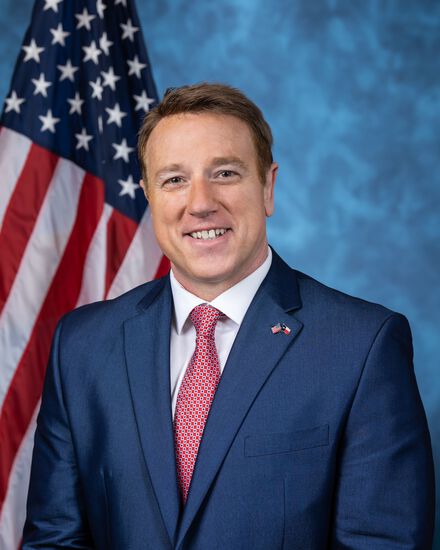
Rep. Pat Fallon
Sponsored bills
This resolution requests that the President transmit to the House of Representatives documents related to the amount of funding that was provided in specified laws regarding COVID-19 (i.e., coronavirus disease 2019) and is currently unspent. The specified laws include the Coronavirus Preparedness and Response Supplemental Appropriations Act, 2020; the Families First Coronavirus Response Act; the Coronavirus Aid, Relief, and Economic Security Act (CARES Act); the Paycheck Protection Program and Health Care Enhancement Act; and Division N of the Consolidated Appropriations Act, 2021.
Religious Insignia on Dog Tags Act This bill directs the Department of Defense (DOD) to allow trademarks owned or controlled by DOD to be combined with religious insignia on commercial identification tags (i.e., dog tags) and to be sold by lawful trademark licensees. The bill applies retroactively to September 13, 2013.
Stop Corrupt Iranian Oligarchs and Entities Act This bill directs the Department of the Treasury to report to Congress on Iranian individuals and parastatal groups that have close relationships with the Iranian government, including information regarding (1) their known sources of income, (2) their indices of corruption, (3) their involvement in key U.S. economic sectors, (4) the structures and ownership of the parastatal groups, and (5) the potential effects of imposing sanctions on these entities and individuals.
This bill restricts eligibility for certain federal assistance benefits to U.S. citizens or nationals. This restriction applies to all means-tested benefits, other than tax benefits, and to benefits authorized under the Social Security Act. An individual must provide evidence of citizenship or nationality status and attest to that status when applying for these benefits.
Reopen Schools Act This bill requires a local educational agency (LEA) to reopen its elementary and secondary schools as a condition for receiving certain supplemental education emergency relief funding. Specifically, an LEA must provide in-person instruction to at least 50% of its students in order to receive the full funding. An LEA that provides in-person instruction to at least some of its students shall have its funding reduced on a pro rata basis.
Personalized Care Act of 2021 This bill revises provisions relating to health savings accounts (HSAs), including to redefine eligible individual for HSA purposes to allow increased participation in HSAs, increase the limit on contributions to HSAs, permit the payment of health insurance premiums from HSAs, include within the definition of qualified medical expenses periodic fees paid for medical services and amounts paid by a member of a health care sharing ministry, treat periodic provider fees as deductible medical expenses, and lower the 20% penalty for nonqualified distributions from HSAs to 10%.
Defund Planned Parenthood Act of 2021 This bill restricts federal funding for Planned Parenthood Federation of America Inc. or any of its affiliates or clinics for one year. Specifically, it prohibits funding those entities unless they certify that the affiliates and clinics will not perform, and will not provide funds to entities that perform, abortions during that year. If the certification requirement is not met, the Department of Health and Human Services and the Department of Agriculture must recoup any federal assistance received by those entities. However, the bill's funding restriction does not apply to abortions performed in cases of rape or incest or when necessary to resolve a physical condition that endangers a woman's life. The bill also provides additional funding for community health centers for the one-year period. These funds are subject to the same abortion-related restrictions and exceptions.
Support And Value Expectant Moms and Babies Act of 2021 or the SAVE Moms and Babies Act of 2021 This bill prohibits the Food and Drug Administration (FDA) from approving any new drug (either as a brand-name drug or a generic) intended to terminate a pregnancy and imposes additional restrictions on such drugs that are already approved. Under the bill, an already-approved drug intended to terminate a pregnancy may be dispensed to a patient only with a prescription. Furthermore, the FDA may not approve any labeling change that would authorize (1) using the drug after 70 days of gestation, or (2) dispensing the drug by any means other than in-person administration by the prescribing health care practitioner. The FDA must also impose additional restrictions on such already-approved drugs, including by (1) requiring the prescribing health care practitioner to receive a special certification, (2) prohibiting the practitioner to also act as the dispensing pharmacist, and (3) requiring the practitioner to have the ability to provide surgical intervention to the patient. The bill also rescinds any investigational use exemption already granted to such a drug if the bill would have prohibited the FDA from granting the exemption. (Currently, the FDA may grant an exemption to certain market approval requirements if a drug is intended solely for use in safety and effectiveness investigations.)

Protecting Americans from Unnecessary Spread upon Entry from COVID-19 Act of 2021 or the PAUSE Act of 2021 This bill maintains immigration restrictions put in place under public health emergency authorities to prevent the introduction of COVID-19 (i.e., coronavirus disease 2019) from foreign countries. Specifically, the bill prohibits the Department of Health and Human Services from rescinding or reducing the stringency of the restrictions. It also prohibits the Department of Homeland Security from stopping or reducing enforcement of the restrictions. These prohibitions remain in effect until (1) federal and state COVID-19 emergency orders are lifted, and (2) the risk of introducing COVID-19 in or from Canada and Mexico is minimal.