

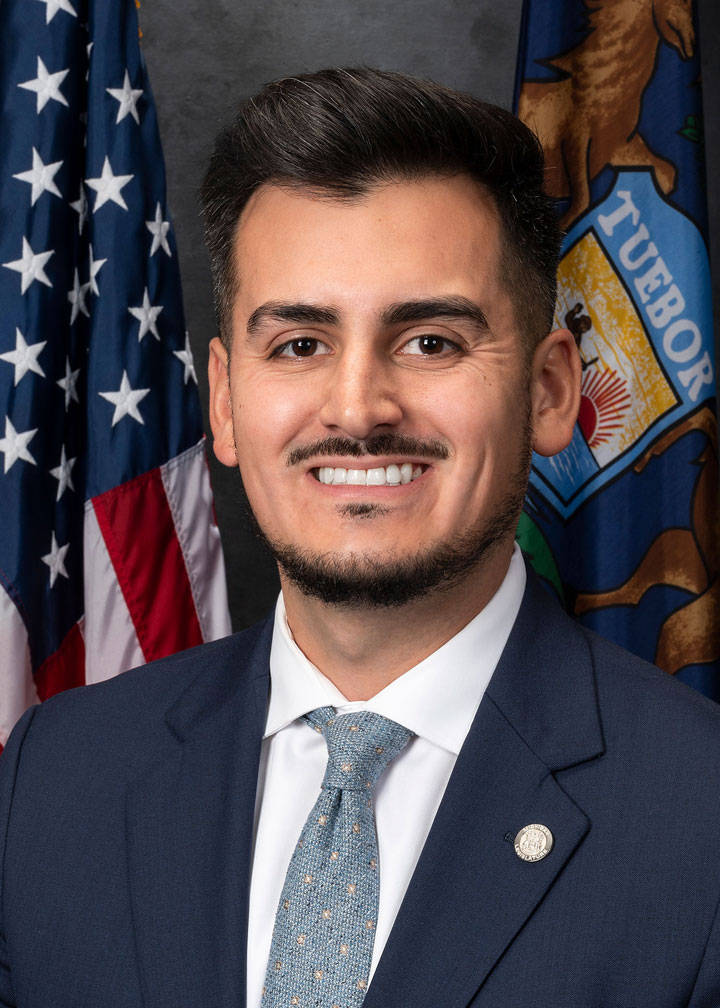
Photo of Darrin Camilleri
D Michigan Senate · District 4 On the 2026 ballot

Sen. Darrin Camilleri

Compare
Total votes
4,537
all sessions
Attendance
100%
12 missed
Near the chamber average
With party
96%
of cast votes
Near the chamber average
Bipartisan score
2%
crosses aisle rarely
Lower than 77% of chamber peers
Sponsored
1,282
bills & resolutions
Near the chamber average
Committees
5
assignments
1,282 bills and resolutions

Sponsored bills

Total
1,282
Primary
127
Co-sponsor
1,155
This page
1,282
matching current filters
Primary SB 1052
Passed · Michigan Senate · Lead sponsor
Environmental protection: hazardous waste; disposal facilities; impose moratorium on, limit capacity and geographic concentration of, and prohibit acceptance of TENORM by. Amends secs. 11102, 11110, 11125, 11132, 11514b, 62501 & 62502 of 1994 PA 451 (MCL 324.11102 et seq.); adds secs. 11122, 62508b & 62509d & repeals secs. 11111 & 11112 of 1994 PA 451 (MCL 324.11111 & 324.11112).

Maddy summaryThis bill amends Michigan's environmental laws to impose stricter limits on the location and capacity of hazardous waste disposal facilities. It requires the state to update its waste management plan every five years, ensuring that new facilities are not concentrated in already polluted communities and that the total licensed capacity matches the state's actual waste generation needs. Additionally, the legislation specifically prohibits the acceptance of a type of radioactive waste known as TENORM at designated disposal sites. These changes aim to improve geographic distribution and prevent overloading specific areas with waste treatment infrastructure.

Passed Dec 12, 2024 0 co-sponsors
Co-sponsor SB 542
Passed · Michigan Senate · Co-sponsor
Health: pharmaceuticals; choice of formulation, dosage, and route of administration for opioid antagonists by certain persons and governmental entities if department of health and human services distributes opioid antagonists free of charge; allow. Creates new act.

Maddy summaryThis bill allows individuals and government agencies in Michigan to select the specific type, dosage, and delivery method of free naloxone provided by the state's Department of Health and Human Services. The law applies only when the department distributes these overdose reversal drugs at no cost to help reduce opioid-related overdoses. While it grants recipients the choice of formulation and administration route, it includes a provision to maintain federal funding eligibility if those choices would jeopardize state grants.

Passed Dec 12, 2024 1 co-sponsor
Co-sponsor SB 1101
In committee · Michigan Senate · Co-sponsor
Law enforcement: other; individuals filing complaints against law enforcement; allow to remain private. Creates new act.

Maddy summaryThis bill establishes the Reporting of Law Enforcement Officer Misconduct Privacy Act to protect the identities of individuals who file complaints against police officers for unauthorized, unlawful, or negligent actions. It mandates that agencies and other entities receiving these complaints must not reveal the complainant's name unless the individual explicitly consents, a court orders it, or specific legal exceptions apply, such as when criminal charges are filed. The law also sets a civil fine of up to $500 for anyone who knowingly violates these privacy protections.

In committee Dec 11, 2024 1 co-sponsor
Co-sponsor SB 1097
In committee · Michigan Senate · Co-sponsor
Law enforcement: records; law enforcement officer separation of service record act; revise. Amends secs. 1, 2, 3 & 5 of 2017 PA 128 (MCL 28.561 et seq.) & adds arts. 3 & 4.

Maddy summaryThis bill modifies Michigan's existing law regarding the separation of service records for law enforcement officers. It requires agencies to create detailed records explaining the reasons and circumstances surrounding an officer's departure, including any active disciplinary investigations from the previous year. The law mandates that these records be finalized within five days of separation and allows officers to review, dispute, or request corrections to the information provided. Additionally, the bill establishes a process for officers to submit written statements if they disagree with the agency's assessment, ensuring their perspective is included in the official record.

In committee Dec 11, 2024 1 co-sponsor
Co-sponsor SB 1098
In committee · Michigan Senate · Co-sponsor
Law enforcement: records; reference to the law enforcement officer separation of service record act; update. Amends secs. 7 & 9 of 1978 PA 397 (MCL 423.507 & 423.509). TIE BAR WITH: SB 1097'24

Maddy summaryThis bill updates Michigan's employee right to know law to clarify how law enforcement agencies handle personnel records and internal investigations. It requires employers to delete disciplinary reports older than four years from public records, except when the information is needed for legal cases, arbitration, job separation reviews, or licensing compliance. Additionally, the bill mandates that employers maintain separate confidential files for internal criminal investigations, notifying employees once these files are created or completed. If an investigation concludes without disciplinary action, the file must be destroyed unless it is shared with another law enforcement agency or the state commission for specific licensing purposes.

In committee Dec 11, 2024 1 co-sponsor
Co-sponsor SB 1100
In committee · Michigan Senate · Co-sponsor
Law enforcement: other; disclosures by law enforcement officers act; modify definition of involuntary statement. Amends sec. 1 of 2006 PA 563 (MCL 15.391).

Maddy summaryThis bill modifies the definition of an "involuntary statement" for law enforcement officers in Michigan, specifically regarding when such statements must be disclosed. It clarifies that a statement is considered involuntary only if an officer is forced to provide information under threat of losing their job or facing other employment sanctions. The legislation also updates the list of who counts as a law enforcement officer to include emergency dispatch workers and local corrections officers. These changes affect state agencies and local law enforcement entities by altering the rules on when officers must reveal certain information. The bill takes effect 90 days after it is signed into law.

In committee Dec 11, 2024 1 co-sponsor
Co-sponsor SB 1099
In committee · Michigan Senate · Co-sponsor
Law enforcement: employment; licensing requirements under the Michigan commission on law enforcement standards act; update. Amends secs. 9, 9a, 9b, 9c, 9d & 11 of 1965 PA 203 (MCL 28.609 et seq.).

Maddy summaryThis bill updates Michigan's licensing requirements for law enforcement officers by clarifying the standards and procedures agencies must follow to hire and license personnel. It mandates that agencies verify an officer's compliance with specific criteria, such as training, physical ability, psychological fitness, and background checks, before the officer takes their oath of office. Additionally, the legislation requires agencies to submit written documentation to the Michigan Commission on Law Enforcement Standards within ten days of administering the oath to confirm these standards have been met. These changes apply to all law enforcement officers not covered under the specialized sections for college-trained or experienced officers, ensuring a consistent verification process across the state.

In committee Dec 11, 2024 1 co-sponsor
Co-sponsor SB 1096
In committee · Michigan Senate · Co-sponsor
Criminal procedure: sentencing guidelines; sentencing guidelines for certain tampering with evidence offenses by law enforcement officers; provide for. Amends sec. 16x, ch. XVII of 1927 PA 175 (MCL 777.16x). TIE BAR WITH: SB 1095'24

Maddy summaryThis bill proposes changes to Michigan's sentencing guidelines specifically for law enforcement officers who commit tampering with evidence offenses. It directly affects police and other criminal justice personnel by updating the rules used to determine their potential prison sentences for these crimes. The legislation amends an existing section of the state's code of criminal procedure to reflect these new sentencing standards. By modifying the legal framework for punishment, the bill aims to ensure consistent and appropriate sentencing for officers involved in evidence tampering cases.

In committee Dec 11, 2024 1 co-sponsor
Co-sponsor SB 1095
In committee · Michigan Senate · Co-sponsor
Crimes: other; tampering with evidence by law enforcement officer with specific intent; prohibit, and provide penalties. Amends sec. 483a of 1931 PA 328 (MCL 750.483a).

Maddy summaryThis bill amends Michigan's penal code to create specific criminal penalties for law enforcement officers who tamper with evidence, particularly digital recordings from body-worn cameras. It prohibits officers from intentionally removing, altering, or destroying evidence, as well as from failing or deactivating their body cameras during the use of excessive force. The legislation also strengthens protections against retaliation for individuals reporting crimes and clarifies that offering or threatening to offer value to influence witness statements is illegal. Violations by officers are classified as felonies or misdemeanors depending on the severity of the act, with potential prison sentences and fines. The bill includes exceptions for lawful attorney conduct and ensures that officers can still be charged with other crimes related to the same incident.

In committee Dec 11, 2024 1 co-sponsor
Co-sponsor SB 100
Passed · Michigan Senate · Co-sponsor
Transportation: railroads; minimum freight train operating crew size; require. Amends 1933 PA 354 (MCL 462.101 - 462.451) by adding sec. 352.

Maddy summaryThis bill requires railroad companies in Michigan to operate freight trains with a crew of at least two people. The rule applies to all freight trains but includes specific exceptions for locomotives used in helper service, which assists trains with mechanical issues or steep grades, and hostler service, which moves trains short distances within a yard. Additionally, the requirement does not apply if a federal law or regulation already mandates a crew of two or more for freight trains in the state. By adding this section to the existing railroad code, the legislation establishes a clear minimum staffing standard for freight operations while acknowledging current federal standards and specialized operational scenarios.

Passed Dec 11, 2024 1 co-sponsor
Showing 161 to 170 of 1,282 bills
Previous 1 … 16 17 18 … 129 Next