

Maddy summarySB 477 sets a 10% annual cap on the portion of an electric utility's weather-adjusted retail sales that can be served by alternative energy suppliers, directly affecting Michigan utilities and their customers seeking to switch providers. The bill includes key exceptions: facilities already using alternative suppliers since 2008 (including expansions), iron ore mines/processing facilities in the Upper Peninsula under specific settlement agreements, and customers on a pre-2016 enrollment queue. It requires utilities to maintain a confidential queue for new customers and adjust the cap downward if usage remains below 10% for five years. The law aims to balance customer choice with grid stability for Michigan's electric utilities.
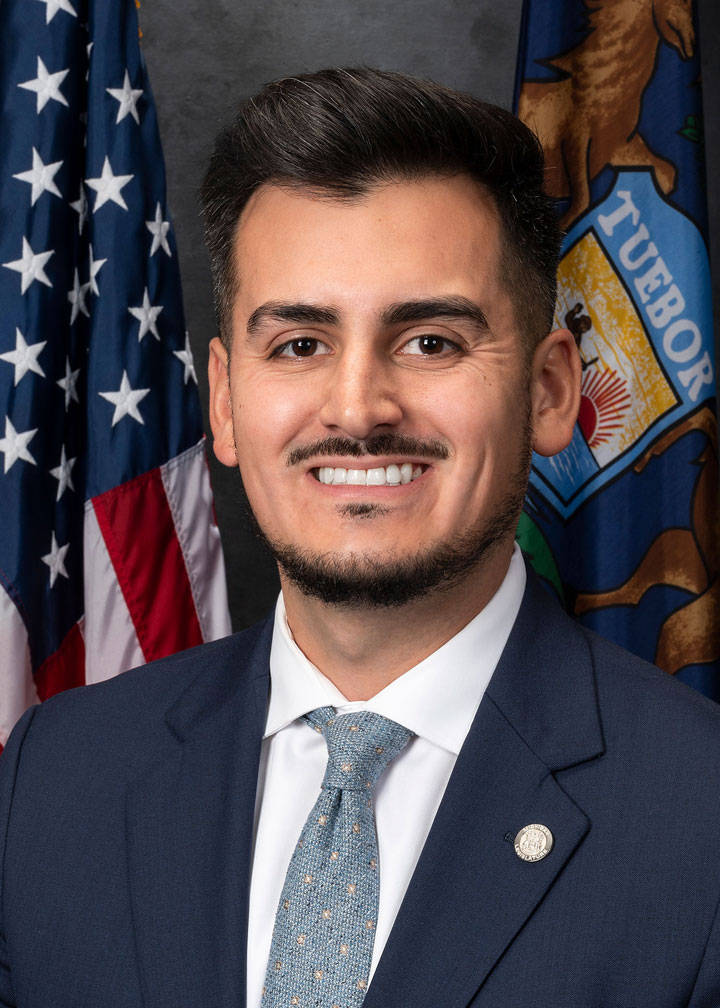
Sen. Darrin Camilleri
Sponsored bills
Maddy summarySB 404 requires public schools in Michigan to ensure at least one staff member at each school is trained to administer naloxone (an opioid overdose reversal medication) if the state health department provides it at no cost. Schools must develop policies requiring staff to notify parents when naloxone is used and call 9-1-1 for suspected opioid overdoses. The bill directly affects public school districts, intermediate districts, and public school academies by mandating training and response protocols for opioid-related emergencies. It specifies naloxone must be FDA-approved and defines "opioid-related overdose" to include symptoms like respiratory depression or unconsciousness needing medical help.
Maddy summarySB 405 amends Michigan's "Administration of Opioid Antagonists Act" by revising the definition of "governmental agency" to explicitly exclude school district boards, public school academies, and licensed healthcare providers (under Public Health Code Part 209). This change means these entities will no longer be subject to the act's requirements regarding opioid antagonist access and training. The bill directly affects school districts, public school academies, and licensed healthcare facilities by removing them from the scope of the law. The amendment clarifies which organizations must comply with the act's provisions, focusing on state and local government entities rather than schools or healthcare providers. This is a technical definitional update with no new requirements or funding changes.
Maddy summarySB 453 requires Michigan public school districts, intermediate districts, and public school academies to include one unit of age- and grade-appropriate Black history instruction in their history curriculum starting in the 2027-2028 school year. This instruction must cover Black contributions to U.S. society, the history of Black communities in Michigan and the Midwest (including discriminatory policies), and civil rights advancements. The bill also mandates a similar unit of Indigenous People history instruction with identical content requirements. The superintendent of public instruction must develop guidelines with input from cultural centers and scholars, and all instruction must be inclusive and non-discriminatory for all students.
Maddy summarySB 454 creates a Cultural History Advisory Board within Michigan's Department of Education. The board, appointed by the superintendent of public instruction, must include 16 members representing specific cultural communities (Asian-American/Pacific Islander, Latino/Hispanic, Black, Middle Eastern/North African/Chaldean, Indigenous, Caribbean-American, Jewish-American, European-American) plus educators, school administrators, labor representatives, and higher education experts. The board must develop curriculum recommendations and professional development resources for K-12 schools on teaching the history of these cultural groups, with a deadline of two years after all members are appointed. This bill directly affects Michigan public schools by establishing a new body to guide inclusive history education resources.
Maddy summarySB 455 requires Michigan schools to provide cultural competency training for educators and school personnel who interact with students. Starting in the 2027-2028 school year, all educators must complete this training using resources developed by the state department by June 2027, covering topics like diversity, cultural identity, historical contributions of various groups (including Black, Indigenous, Latine, Hispanic, and others), and implicit bias. School personnel with student contact, but not educators, must also receive similar training - excluding the historical topics. The bill mandates that training materials align with state social studies standards and be developed with expert input.
Maddy summarySB 319 amends Michigan's public employee collective bargaining law to require that minimum staffing levels within a bargaining unit become a mandatory topic for negotiation between public employers and employee representatives. This applies specifically to public employees covered under 1969 PA 312 (which includes most state and local government workers like teachers, nurses, and first responders), making staffing levels a required subject of bargaining alongside wages and hours. The bill includes a limited exception: if a public employer faces reduced state funding or property tax revenue, it may choose whether to negotiate staffing levels, but must otherwise include them in bargaining. The change directly affects public sector workplaces where employee bargaining units exist, ensuring staffing levels cannot be unilaterally set by employers without negotiation.
Maddy summarySB 459 creates a tax credit for Michigan residents who pay user fees to operate vehicles on public service facilities (like toll roads or bridges) when those facilities are the only transportation option to or from specific townships. It applies to taxpayers living in or working in townships with populations of 10,000-15,000 located in counties with over 1.5 million people, starting tax years beginning January 1, 2026. The credit covers all qualifying user fees paid during the tax year, with refunds issued if the credit exceeds the taxpayer’s total tax liability. This bill directly affects residents and workers in defined high-population-county townships who rely on these public service facilities for commuting.
Maddy summaryThis Senate Resolution (SR 60) designates June 23-29, 2025, as "Grassroots Week" in Michigan. It honors precinct delegates and grassroots leaders who organize community political engagement, register voters, and connect neighborhoods to elected officials. The resolution encourages all Michigan residents to express gratitude for these volunteers' time and efforts in strengthening local democracy. As a ceremonial resolution, it does not create new laws or alter existing policies.
Maddy summaryThis resolution (SR 55) formally recognizes June 2025 as Lesbian, Gay, Bisexual, Transgender, Queer+ (LGBTQ+) Pride Month in the state of Michigan. It does not create new laws or change existing policies; instead, it serves as a symbolic statement of recognition by the Michigan Senate. The resolution highlights historical milestones for LGBTQ+ rights, including Michigan's 2023 law adding sexual orientation and gender identity to anti-discrimination protections, and acknowledges ongoing efforts to support LGBTQ+ communities. As a procedural resolution, it directly affects the state's official calendar and public acknowledgment of Pride Month, without imposing any legal obligations.