

Maddy summarySB 631 abolishes the Michigan Strategic Fund and the Michigan Economic Development Corporation, transferring all their powers, assets, and responsibilities to a new "Bureau of Fair Competition and Free Enterprise" within the Department of Labor and Economic Opportunity. The bureau will coordinate state economic development programs, including job creation initiatives and economic incentives like grants or tax breaks, replacing the previous entities. The bill states these changes are needed to promote "fair competition and free enterprise" and ensure state incentives produce measurable economic benefits. The new bureau’s director will be appointed by the governor, and all existing programs under the repealed entities (such as brownfield redevelopment and tourism marketing) will be administered by the bureau moving forward.
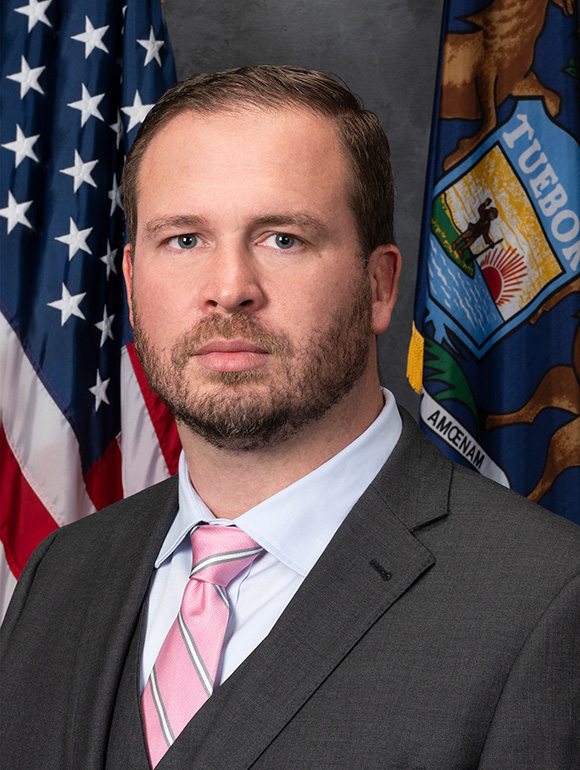
Sen. Jonathan Lindsey
Sponsored bills
Maddy summarySCR 6 is a memorial resolution passed by the Michigan Legislature to honor Virgil Clark Smith, a former member of the Michigan Senate (1988-2000) and House of Representatives (1977-1988). The resolution commemorates his 40+ years of public service, including his historic role as the first African American Senate Democratic Floor Leader. It expresses the Legislature's tribute to his dedication, leadership, and legacy as a trailblazing legislator and later Wayne County Circuit Court judge. The resolution was adopted unanimously by both chambers in October 2025 and will be transmitted to Smith's family.
Maddy summarySB 605 amends Michigan's Child Protection Law (MCL 722.627) to add "a state legislator" as an authorized recipient of confidential child abuse and neglect records. This change directly affects state legislators seeking such records, child protective services agencies handling the records, and families whose records may be disclosed. The key mechanism updates the existing list of permitted recipients to include legislators, who can now access records for legislative oversight purposes under the same confidentiality safeguards applied to other authorized entities. The bill does not alter how records are handled by existing authorized parties like courts, healthcare providers, or child welfare agencies.
Maddy summarySB 587 requires Michigan's Public Service Commission to submit a detailed report to the House and Senate energy committees before approving any rate increase for gas, electric, or steam utilities. The report must explain the proposed increase, its justification, and expected impact on customers. Committees then have 30 days to hold a public hearing and issue a nonbinding recommendation to the commission. This change applies to all utilities seeking rate hikes and adds a legislative review step before final approval. The bill modifies existing rate approval procedures without altering the core process for utilities to file applications.
Maddy summaryThis bill establishes a 10% cap on the portion of an electric utility's retail sales that can be served by alternative electric suppliers, meaning no more than 10% of a utility's customers may switch to alternative providers at any time. The cap can be adjusted downward if less than 10% of sales are already with alternatives, but must return to 10% after five years without adjustment. Exceptions allow specific customers - like those with facilities continuously served by alternatives since 2008 or Upper Peninsula iron ore facilities under settlement agreements - to exceed the cap for their operations. The bill also maintains a queue for customers waiting to switch to alternatives as of December 2015, requiring utilities to manage these requests annually. These changes directly affect Michigan electric utilities, their retail customers, and alternative energy providers seeking to serve them.
Maddy summaryThis bill proposes a constitutional amendment requiring Michigan's state budget bills to be passed into law by a specific annual deadline. If the budget isn't enacted by that date, both state legislators and the governor would lose their pay until the budget is approved. The amendment modifies three sections of the state constitution to establish this deadline and link compensation to budget passage. It specifically targets the general appropriation bills that fund state operations, not other legislation. The deadline is defined by existing law (MCL 18.1365) as the date set for budget enactment each year.
Maddy summarySB 516 would allow Michigan pharmacists to provide ivermectin without a prescription, directly affecting pharmacists and patients seeking this medication. The bill requires that ivermectin sold over-the-counter must meet manufacturing standards and have clear labeling with dosage, contraindications, and safety information. It amends Michigan’s Public Health Code to add new sections (17771 and 17771a) enabling this access under pharmacist discretion. The bill is currently in committee after being introduced on September 3, 2025.
Maddy summarySB 70 designates a specific segment of M-34 in Hillsdale County (between Pioneer Road and South Pittsford Road) as the "Deputy Sheriff William Butler, Jr. Memorial Highway." This bill amends Michigan's Memorial Highway Act (2001 PA 142) by adding Section 115 to formally name the highway portion. The change affects signage and official references to that section of M-34, directly honoring Deputy Sheriff William Butler, Jr. through the highway designation. The bill was enacted into law on August 26, 2025.
Maddy summarySB 511 amends Michigan's gambling law to clarify and expand exceptions for small-scale social wagers. It allows informal betting among friends or groups (up to 100 people) where each person wagers no more than $25, the game is incidental to a social relationship, and organizers cannot profit beyond winning prizes like other participants. The bill explicitly prohibits such games from being promoted by businesses to attract customers or held in venues like bars. This change directly affects social groups hosting casual bets, ensuring these activities remain legal under specific, limited conditions.
Maddy summarySB 438 repeals 2023 PA 10, which required prevailing wages and fringe benefits for workers on state construction projects. This bill directly affects state contractors and construction workers by removing the requirement to pay prevailing wages on state-funded projects. The repeal eliminates the specific legal provisions (MCL 408.1101-408.1126) that governed wage standards and penalties for noncompliance. As a procedural repeal, it makes no new policy changes but removes the existing law.