

Maddy summaryThis bill modifies Michigan's Highway Advertising Act to clarify rules about billboard owners crossing limited-access highways to install or maintain signs. It requires permits for anyone crossing these roadways to erect or maintain signs, but allows exceptions when the property is only accessible by crossing the highway. The legislation also establishes penalties, including fines and sign removal, for violating these permit requirements. Directly affected parties include sign owners, their agents, and property owners who maintain signs on their land. The bill aims to streamline enforcement while ensuring exceptions exist for properties with no alternative access routes.
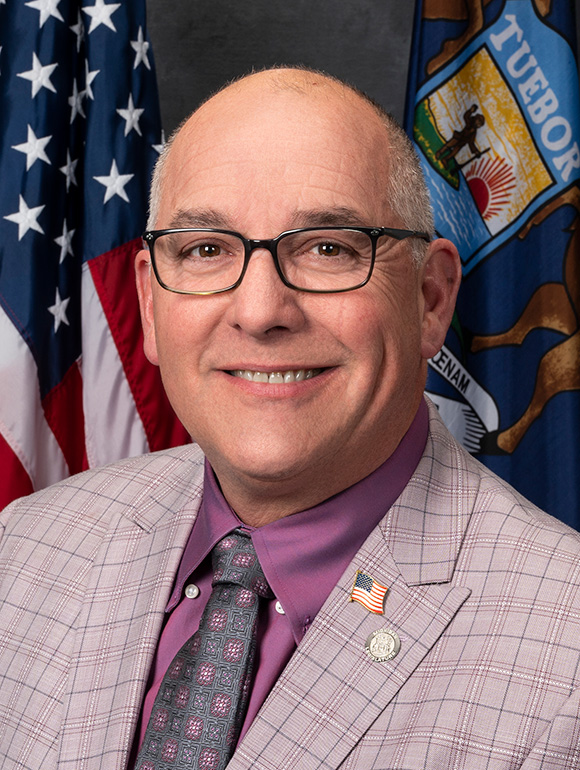
Sen. Joe Bellino
Sponsored bills
Maddy summaryThis bill is a concurrent resolution that formally honors Bruce Patterson, a former Michigan state legislator who served in both the House of Representatives and Senate. It recognizes his public service career, which included leadership roles in committees on energy policy, environmental protection, and consumer rights, as well as his advocacy for nursing home care and water pollution control. The resolution expresses the Legislature's tribute to his memory and directs that copies be sent to his family.
Maddy summaryThis bill allows Michigan townships to hire accredited election contractors when their clerk or deputy clerk is unavailable to handle election duties. Under the new provision, the township board can contract with a qualified, accredited individual who lives nearby to perform registration, nomination, and election functions until the clerk returns or a replacement is appointed. The contracted individual would have the same authority as a deputy clerk and must submit regular reports to the township board about their work. This change aims to ensure election operations continue smoothly during clerk absences without requiring the township to wait for a new clerk to be appointed or elected.
Maddy summarySB 398 modifies requirements for substance use disorder treatment programs in Michigan and prohibits state agencies from creating new rules about these services. It directly affects treatment providers and the state health department (DHHS) by changing existing standards for program operations and blocking future rulemaking on specific service requirements. Key provisions include updating program eligibility rules under MCL 333.6230 and banning the development of new rules under MCL 333.6234. The bill aims to streamline program standards while preventing additional regulatory burdens on treatment providers.
Maddy summaryThis bill creates new lifetime hunting and fishing licenses specifically for disabled veterans in Michigan, starting on July 1, 2027. The licenses are priced based on the veteran's disability rating, ranging from free for those rated 100% disabled to $100 for those rated 30% or more but less than 50% disabled. These lifetime licenses include standard hunting and fishing privileges such as deer, waterfowl, turkey, and all-species fishing, but holders must still follow all current hunting and fishing regulations. The bill also establishes how applications are processed, what information is required, and how much license sellers can retain as fees.
Maddy summaryThis bill allows nurse practitioners to determine disability status for individuals seeking parking placards in Michigan, expanding the list of medical professionals authorized to certify disabilities. The legislation amends existing vehicle code sections to include nurse practitioners alongside physicians, physician assistants, physical therapists, occupational therapists, and optometrists as qualified providers for disability determinations. It does not change the specific medical criteria for qualifying disabilities or the rules governing parking placards, but rather broadens who can officially verify that a person meets those criteria. The bill affects disabled individuals who need parking accommodations and healthcare providers who may issue these certifications.
Maddy summarySB 810 is a procedural bill that repeals 2025 PA 23, the "Comprehensive road funding tax act" (MCL 205.901-205.913). It directly affects the tax provisions previously established under that law, which would have imposed specific taxes to fund road maintenance. The bill does not create new taxes or policies but formally removes the existing tax framework. This repeal would eliminate the legal basis for those taxes if enacted. (2 sentences, as it is a procedural repeal bill.)
Maddy summaryThis resolution designates February 19, 2026, as "Conductive Education Day" to recognize a teaching method developed in Hungary that helps people with neuromotor disabilities - including cerebral palsy, stroke survivors, and multiple sclerosis patients - improve mobility and independence through neuroplasticity-based learning. It does not create new laws or allocate funding but formally acknowledges Conductive Education's potential to benefit nearly 9 million people in the U.S. and Canada. The resolution encourages broader support for this program without specifying any concrete policy changes. As a symbolic gesture, it directly affects awareness and advocacy for Conductive Education rather than individual beneficiaries.
Maddy summarySB 775 requires all state public meetings to be audio-recorded, expanding a prior rule that only applied to specific boards like licensing commissions. It affects state agencies such as rule-making bodies and commissions by mandating recordings in formats like audio-only, video, or digital broadcasts. The bill requires these recordings to be kept for one year, ensuring they can be accessed by the public under Michigan’s Freedom of Information Act. This policy change enhances transparency by making meeting content more readily available for review.
Maddy summarySB 774 amends Michigan's Money Transmission Services Act to prohibit certain foreign remittance transfers under specific circumstances. The bill directly affects money transmitters (like Western Union or digital remittance services) operating in Michigan that handle payments to recipients outside the United States. Key provisions include adding new sections (21a and 35) that establish restrictions on foreign remittance transfers and updating licensing requirements for these businesses. The changes aim to regulate how money transmitters handle cross-border payments, focusing on specific transaction types rather than broadly banning all international transfers.