

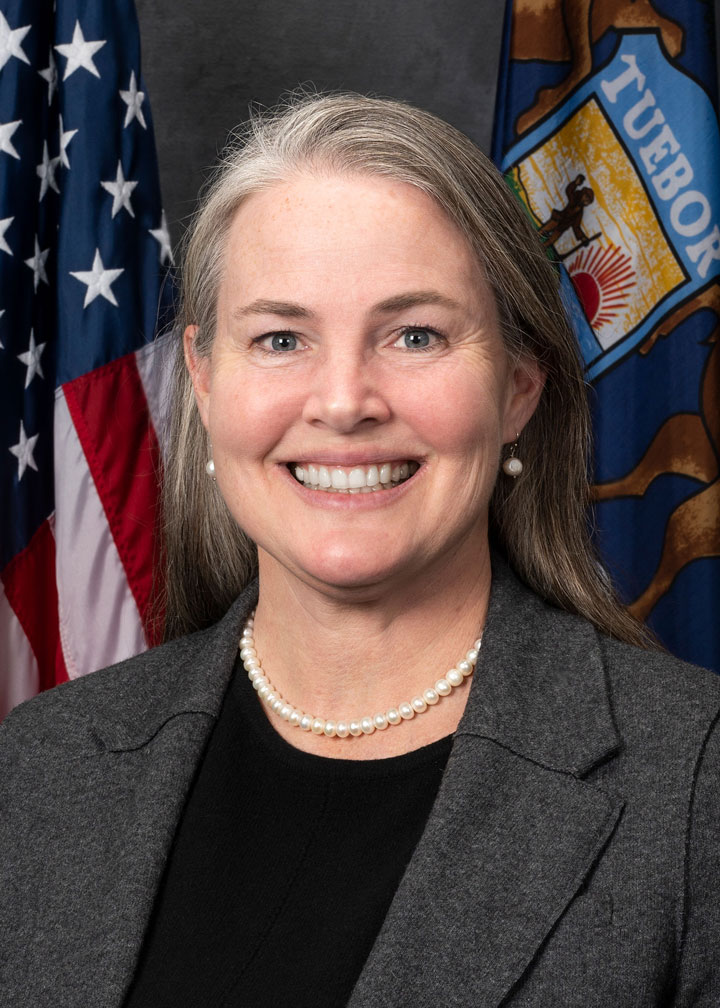
Photo of Sue Shink
D Michigan Senate · District 14 On the 2026 ballot

Sen. Sue Shink

Compare
Total votes
1,308
all sessions
Attendance
100%
1 missed
Higher than 77% of chamber peers
With party
99%
of cast votes
Near the chamber average
Bipartisan score
1%
crosses aisle rarely
Near the chamber average
Sponsored
752
bills & resolutions
Higher than 92% of chamber peers
Committees
7
assignments
752 bills and resolutions

Sponsored bills

Total
752
Primary
91
Co-sponsor
661
This page
752
matching current filters
Co-sponsor SB 1097
In committee · Michigan Senate · Co-sponsor
Law enforcement: records; law enforcement officer separation of service record act; revise. Amends secs. 1, 2, 3 & 5 of 2017 PA 128 (MCL 28.561 et seq.) & adds arts. 3 & 4.

Maddy summaryThis bill modifies Michigan's existing law regarding the separation of service records for law enforcement officers. It requires agencies to create detailed records explaining the reasons and circumstances surrounding an officer's departure, including any active disciplinary investigations from the previous year. The law mandates that these records be finalized within five days of separation and allows officers to review, dispute, or request corrections to the information provided. Additionally, the bill establishes a process for officers to submit written statements if they disagree with the agency's assessment, ensuring their perspective is included in the official record.

In committee Dec 11, 2024 1 co-sponsor
Co-sponsor SB 1098
In committee · Michigan Senate · Co-sponsor
Law enforcement: records; reference to the law enforcement officer separation of service record act; update. Amends secs. 7 & 9 of 1978 PA 397 (MCL 423.507 & 423.509). TIE BAR WITH: SB 1097'24

Maddy summaryThis bill updates Michigan's employee right to know law to clarify how law enforcement agencies handle personnel records and internal investigations. It requires employers to delete disciplinary reports older than four years from public records, except when the information is needed for legal cases, arbitration, job separation reviews, or licensing compliance. Additionally, the bill mandates that employers maintain separate confidential files for internal criminal investigations, notifying employees once these files are created or completed. If an investigation concludes without disciplinary action, the file must be destroyed unless it is shared with another law enforcement agency or the state commission for specific licensing purposes.

In committee Dec 11, 2024 1 co-sponsor
Co-sponsor SB 1099
In committee · Michigan Senate · Co-sponsor
Law enforcement: employment; licensing requirements under the Michigan commission on law enforcement standards act; update. Amends secs. 9, 9a, 9b, 9c, 9d & 11 of 1965 PA 203 (MCL 28.609 et seq.).

Maddy summaryThis bill updates Michigan's licensing requirements for law enforcement officers by clarifying the standards and procedures agencies must follow to hire and license personnel. It mandates that agencies verify an officer's compliance with specific criteria, such as training, physical ability, psychological fitness, and background checks, before the officer takes their oath of office. Additionally, the legislation requires agencies to submit written documentation to the Michigan Commission on Law Enforcement Standards within ten days of administering the oath to confirm these standards have been met. These changes apply to all law enforcement officers not covered under the specialized sections for college-trained or experienced officers, ensuring a consistent verification process across the state.

In committee Dec 11, 2024 1 co-sponsor
Co-sponsor SB 840
Passed · Michigan Senate · Co-sponsor
State agencies (proposed): boards and commissions; Black leadership advisory council; establish. Creates new act.

Maddy summaryThis bill establishes the Black Leadership Advisory Council by codifying its structure and duties into state law. The council will consist of 16 voting members, including the director of the Department of Labor and Economic Opportunity and 15 individuals appointed by the governor to represent diverse Black leadership fields, with specific requirements for immigrant representation and youth inclusion. Its primary function is to advise the governor on policies aimed at eliminating racial inequity in areas such as healthcare, housing, and employment, while also identifying laws that perpetuate such disparities. The council will operate independently in its advisory role but relies on the department for budget and management, and it is required to submit an annual report on its activities and recommendations.

Passed Dec 11, 2024 1 co-sponsor
Co-sponsor SB 100
Passed · Michigan Senate · Co-sponsor
Transportation: railroads; minimum freight train operating crew size; require. Amends 1933 PA 354 (MCL 462.101 - 462.451) by adding sec. 352.

Maddy summaryThis bill requires railroad companies in Michigan to operate freight trains with a crew of at least two people. The rule applies to all freight trains but includes specific exceptions for locomotives used in helper service, which assists trains with mechanical issues or steep grades, and hostler service, which moves trains short distances within a yard. Additionally, the requirement does not apply if a federal law or regulation already mandates a crew of two or more for freight trains in the state. By adding this section to the existing railroad code, the legislation establishes a clear minimum staffing standard for freight operations while acknowledging current federal standards and specialized operational scenarios.

Passed Dec 11, 2024 1 co-sponsor
Co-sponsor SB 333
In committee · Michigan Senate · Co-sponsor
Individual income tax: deductions; deduction for family leave optimal coverage benefits; provide for. Amends sec. 30 of 1967 PA 281 (MCL 206.30). TIE BAR WITH: SB 0332'23

Maddy summaryThis bill amends Michigan's income tax law to allow taxpayers to deduct family leave optimal coverage benefits from their taxable income. The change applies to individuals who pay for these specific family leave insurance plans and directly affects their state tax liability. By adding this new deduction, the legislation reduces the amount of income subject to state taxation for those who utilize the coverage. The bill does not alter how the benefits are calculated or the eligibility requirements for the insurance plans themselves.

In committee Dec 11, 2024 1 co-sponsor
Co-sponsor SB 332
In committee · Michigan Senate · Co-sponsor
Labor: leave; family leave optimal coverage benefits; provide for. Creates new act.

Maddy summaryThis bill establishes the Family Leave Optimal Coverage Act to provide paid time off and financial benefits to Michigan workers for caring for family members during events like childbirth, adoption, domestic violence, or serious health issues. To qualify, employees must have earned at least $3,000 in wages during a specific base period or be self-employed, and the program requires both employer and employee contributions to a state fund. The legislation defines eligible family members broadly to include children, parents, spouses, and domestic partners, while also setting rules for calculating benefit amounts and preventing discrimination against those who take leave. Additionally, the act outlines procedures for filing claims, resolving disputes, and reporting data to the Department of Labor and Economic Opportunity.

In committee Dec 11, 2024 1 co-sponsor
Co-sponsor SB 820
Passed · Michigan Senate · Co-sponsor
Health facilities: hospitals; certain policies on patients who are giving birth; require a hospital to adopt. Amends secs. 20201 & 21513 of 1978 PA 368 (MCL 333.20201 & 333.21513) & adds sec. 21537.

Maddy summaryThis bill requires hospitals in Michigan to adopt and publicly post a written policy outlining the rights and responsibilities of patients. The new policy must include specific protections such as non-discrimination, access to medical records, privacy during treatment, and the right to refuse care while being informed of the consequences. A critical provision ensures that hospitals must stabilize a pregnant patient in labor before terminating the patient-provider relationship due to a refusal of treatment. Additionally, the bill mandates that facilities provide clear information about billing, financial assistance, and the staff responsible for a patient's direct care.

Passed Dec 11, 2024 1 co-sponsor
Co-sponsor SB 825
Passed · Michigan Senate · Co-sponsor
Health: occupations; Michigan essential health provider recruitment strategy; expand to include midwives. Amends secs. 2701, 2705, 2709 & 2723 of 1978 PA 368 (MCL 333.2701 et seq.).

Maddy summaryThis bill expands Michigan's Essential Health Provider Repayment Program to include midwives alongside other healthcare professionals such as physicians, nurses, and dentists. By adding midwives to the list of eligible "designated professionals," the legislation allows them to receive loan repayments or expense reimbursements if they agree to work full-time in designated health resource shortage areas. The key mechanism involves a contractual agreement where the state repays a portion of the professional's education debt or training costs in exchange for a service commitment that matches the repayment amount or lasts for at least two years. This change aims to incentivize midwives to practice in underserved communities to help address local healthcare needs.

Passed Dec 11, 2024 1 co-sponsor
Co-sponsor SB 823
Passed · Michigan Senate · Co-sponsor
Civil rights: sex discrimination and harassment; prohibition of sex discrimination in places of public accommodation and public services; extend to prohibit discrimination based on pregnancy or lactating status. Amends sec. 301 of 1976 PA 453 (MCL 37.2301).

Maddy summaryThis bill expands Michigan's civil rights protections by explicitly adding pregnancy and lactating status to the definition of "sex" under the Elliott-Larsen Civil Rights Act. It directly affects businesses, educational institutions, and public services by prohibiting discrimination against individuals based on these specific conditions. The law clarifies that places of public accommodation include various private clubs, such as country clubs and sports organizations, ensuring broader coverage against unfair treatment. By amending existing statutes, the measure aims to ensure that pregnant people and those who are lactating are treated with the same protections as other individuals in public spaces.

Passed Dec 11, 2024 1 co-sponsor
Showing 371 to 380 of 752 bills
Previous 1 … 37 38 39 … 76 Next