

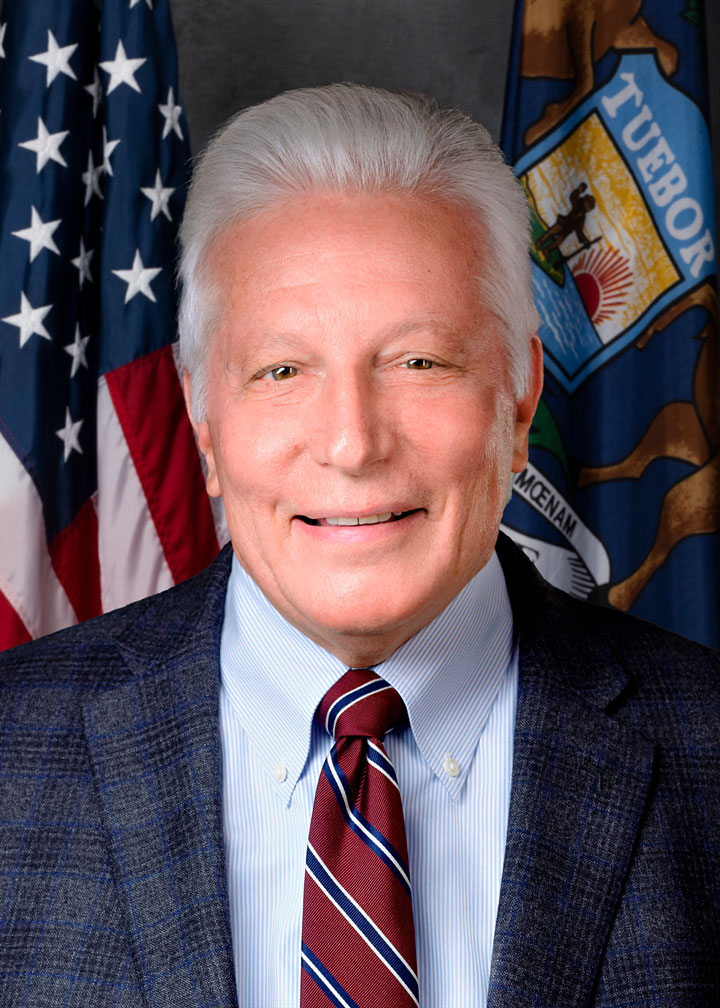
Photo of Paul Wojno
D Michigan Senate · District 10

Sen. Paul Wojno

Compare
Total votes
3,032
all sessions
Attendance
99%
26 missed
Near the chamber average
With party
98%
of cast votes
Higher than 78% of chamber peers
Bipartisan score
1%
crosses aisle rarely
Lower than 82% of chamber peers
Sponsored
1,516
bills & resolutions
Near the chamber average
Committees
7
assignments
1,516 bills and resolutions

Sponsored bills

Total
1,516
Primary
108
Co-sponsor
1,408
This page
1,516
matching current filters
Primary SB 918
Passed · Michigan Senate · Lead sponsor
Mental health: other; petition for access to assisted outpatient treatment; expand to additional health providers. Amends sec. 473 of 1974 PA 258 (MCL 330.1473).

Maddy summaryThis bill expands the Michigan Mental Health Code to allow psychiatric nurse practitioners and physician assistants to petition for involuntary outpatient treatment orders. Previously, only physicians, psychologists, and other specific professionals could file these petitions to extend treatment for individuals who might refuse care voluntarily. The legislation defines these new eligible providers and requires that their clinical assessments be reviewed by a psychiatrist before a petition is submitted. This change aims to broaden the pool of qualified health professionals who can initiate extended treatment plans under the state's mental health code.

Passed Dec 11, 2024 0 co-sponsors
Co-sponsor SB 917
Passed · Michigan Senate · Co-sponsor
Mental health: other; hospital evaluations for assisted outpatient treatment; expand. Amends secs. 206a & 429 of 1974 PA 258 (MCL 330.1206a & 330.1429).

Maddy summaryThis bill expands dispute resolution options for people receiving mental health services in Michigan by mandating that they be offered mediation to settle conflicts with service providers. It requires health programs to inform individuals of their right to mediation when services begin and annually thereafter, while also ensuring that mediators are trained, independent, and knowledgeable about behavioral health laws. The legislation sets specific timelines for the mediation process, requiring it to start within 10 business days and conclude within 60 days, and establishes that any agreements reached are legally binding. Additionally, the bill mandates that contracted mediation organizations report their outcomes to the state department every six months to evaluate the program's effectiveness.

Passed Dec 11, 2024 1 co-sponsor
Co-sponsor SB 818
Passed · Michigan Senate · Co-sponsor
Records: death; commission to investigate racial disparities related to maternal health; create. Amends secs. 2227, 2617, 2617a & 2618 of 1978 PA 368 (MCL 333.2227 et seq.) & adds sec. 2617b.

Maddy summaryThis bill requires the Michigan Department of Health and Human Services to create a comprehensive plan to reduce racial and ethnic health disparities across the state. It mandates the department to monitor minority health progress, fund related programs, and establish a dedicated webpage that shares data on morbidity, mortality, and studies regarding biased medical care. The legislation also directs the department to recruit more minority health professionals, provide technical assistance to local coalitions, and include statistics on obstetric racism and violence in state health records.

Passed Dec 11, 2024 1 co-sponsor
Co-sponsor SB 440
Passed · Michigan Senate · Co-sponsor
Property: conveyance of state property; transfer of certain state-owned property in Livingston County; provide for. Creates land transfer act.

Maddy summaryThis bill authorizes the transfer of a 92.98-acre state-owned property in Green Oak Township, Livingston County, from the Department of Corrections to the Department of Military and Veterans Affairs. The legislation outlines the specific boundaries of the land and establishes that the Department of Technology, Management, and Budget will manage the transfer process while the receiving department covers associated survey and closing costs. Once approved by the State Administrative Board, the Department of Military and Veterans Affairs will assume full administrative control and responsibility for the property and any improvements on it.

Passed Dec 11, 2024 1 co-sponsor
Co-sponsor SB 916
Passed · Michigan Senate · Co-sponsor
Criminal procedure: mental capacity; outpatient treatment for misdemeanor offenders with mental health issues; provide for. Amends sec. 461 of 1974 PA 258 (MCL 330.1461) & adds sec. 1021 & ch. 10A.

Maddy summaryThis bill creates a new legal process in Michigan that allows misdemeanor defendants with mental health issues to be diverted from jail into a supervised outpatient treatment program instead of facing immediate criminal prosecution. Under the new rules, prosecutors, defendants, or their attorneys can request an assessment to determine if a person qualifies for this diversion, and if approved, a judge can order community-based treatment for up to 180 days. During this period, the criminal charges remain pending but are automatically dismissed after the treatment term ends, provided the defendant complies with the plan, while any violations of the treatment order are handled as a separate civil matter rather than a criminal one.

Passed Dec 11, 2024 1 co-sponsor
Co-sponsor SB 819
Passed · Michigan Senate · Co-sponsor
Civil rights: general discrimination; reporting procedures for mistreatment during perinatal period; provide for. Creates new act.

Maddy summaryThis bill creates the Biased and Unjust Care Reporting Act to establish a system for reporting mistreatment during pregnancy and the postpartum period. It defines specific harmful behaviors, including obstetric racism and obstetric violence, and requires the state Department of Civil Rights to use a validated survey tool to collect these reports. The department must then compile and share de-identified data on the frequency of these incidents with state officials, while ensuring no personal identifying information is disclosed. The legislation directly affects pregnant and postpartum individuals seeking gynecological care and the health facilities and professionals providing that care.

Passed Dec 11, 2024 1 co-sponsor
Primary SB 732
Passed · Michigan Senate · Lead sponsor
Liquor: liquor control commission; guidelines for review of the financial viability of a vendor; provide for. Amends 1998 PA 58 (MCL 436.1101 - 436.2303) by adding sec. 804.

Maddy summaryThis bill requires the Michigan Liquor Control Commission to suspend a retailer's license for 14 days if they make six or more bounced payments to a wholesaler within a 12-month period. The rule applies specifically to retailers who fail to honor their payment obligations to suppliers on different dates over a consecutive year. By adding this new section to the state's liquor control code, the legislation establishes a clear financial threshold that triggers automatic license suspension.

Passed Dec 10, 2024 0 co-sponsors
Co-sponsor SB 407
Passed · Michigan Senate · Co-sponsor
Higher education: financial aid; eligibility for Michigan reconnect program; modify. Amends secs. 1 & 5 of 2020 PA 84 (MCL 390.1701 & 390.1705).

Maddy summaryThis bill modifies the Michigan Reconnect Grant Act to update eligibility requirements for individuals seeking financial aid for adult education. It directly affects adults aged 25 and older who are pursuing associate degrees or industry-recognized certificates at Michigan community colleges. The key provision establishes that this bill will only become effective if a companion bill, SB 406, is also passed into law. By linking its activation to another piece of legislation, the bill ensures that changes to the grant program are implemented as part of a coordinated legislative effort.

Passed Dec 10, 2024 1 co-sponsor
Co-sponsor SB 858
Passed · Michigan Senate · Co-sponsor
Weapons: firearms; firearms in certain state buildings; prohibit. Amends sec. 234d of 1931 PA 328 (MCL 750.234d).

Maddy summaryThis bill prohibits individuals from carrying firearms on the premises of specific state buildings, including the Michigan State Capitol and the Anderson House Office Building. It also bans guns in various public and private locations such as banks, churches, courts, theaters, sports arenas, day care centers, hospitals, and licensed liquor establishments. The law includes exceptions for security personnel, peace officers, licensed concealed carry holders serving as state legislators, and anyone with the property owner's permission. Violating these restrictions is classified as a misdemeanor punishable by up to 90 days in jail, a fine of up to $100, or both.

Passed Dec 10, 2024 1 co-sponsor
Co-sponsor SB 857
Passed · Michigan Senate · Co-sponsor
Weapons: concealed; concealed pistols in certain state buildings; prohibit. Amends sec. 5o of 1927 PA 372 (MCL 28.425o).

Maddy summaryThis bill prohibits licensed individuals from carrying concealed pistols or electro-muscular disruption devices on the premises of various public and private locations, including schools, child care centers, sports arenas, bars serving alcohol, places of worship, hospitals, and college classrooms. The law explicitly excludes parking areas from these restrictions and does not apply to current state legislators or specific groups of law enforcement and security personnel who are required to carry weapons for their jobs. Violations of the ban result in escalating penalties, starting with a fine and license suspension for a first offense and potentially leading to felony charges and license revocation for third or subsequent offenses.

Passed Dec 10, 2024 1 co-sponsor
Showing 181 to 190 of 1,516 bills
Previous 1 … 18 19 20 … 152 Next