

Maddy summaryThis resolution declares September 11-17, 2026, as Patriot Week in Michigan. It encourages citizens, schools, and government agencies to participate by honoring the nation's founding principles, historical figures, and symbols. The text also acknowledges the victims of the September 11, 2001, attacks.
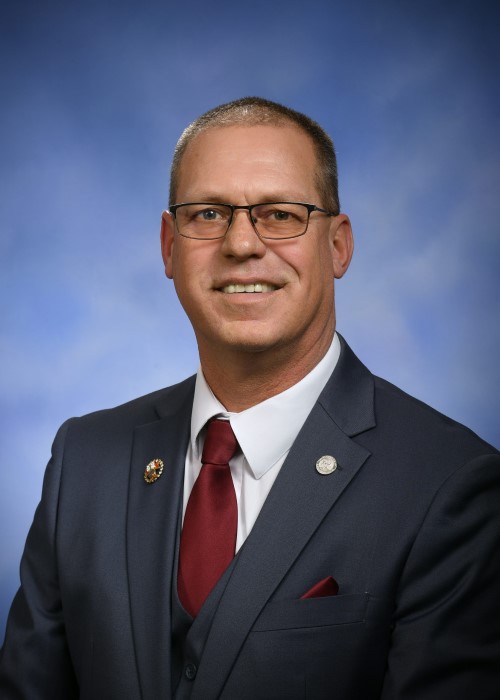
Rep. Greg Alexander
Sponsored bills
Maddy summaryThis resolution declares September 12, 2026, as Recovery Day in Michigan to honor individuals working toward long-term sobriety and the organizations that support them. It highlights the gap between the number of residents with substance use disorders and those receiving treatment, emphasizing the role of recovery community groups in providing ongoing assistance at a lower cost than clinical care. The measure also directs that a copy of the resolution be sent to the Blue Water Recovery and Outreach Center as a gesture of appreciation.
Maddy summaryHB 5940 allows electric utilities and other providers to install electronic transmission infrastructure, such as high-voltage power lines, within existing highway rights-of-way without needing separate consent from local governments. The bill establishes specific standards for underground placement to avoid increasing road maintenance costs and introduces a fee structure where utilities pay a one-time permit fee, with revenues dedicated to highway capital and maintenance. Additionally, the legislation creates a coordination process between the state transportation department and utilities to identify suitable routes and includes protections that prevent the state from relocating transmission lines for at least five years once a route is approved.
Maddy summaryHB 5803 amends Michigan's child care licensing law to update the definitions of various facilities and staff members, such as clarifying who counts as a "child care staff member" or what constitutes a "children's camp." The bill directly affects child care centers, group homes, and other organizations that provide care for minors by refining the rules used to classify them under state regulations. By revising these specific terms in the statute, the legislation aims to ensure that licensing standards apply consistently to different types of care settings. This change does not alter existing licensing requirements but rather clarifies the language used to describe the entities and individuals covered by the law.
Maddy summaryThis bill updates Michigan's Natural Resources and Environmental Protection Act to clarify definitions and procedures for commercial fishing in the state's Great Lakes waters. It directly affects licensed commercial fishermen, fish dealers, and the Department of Natural Resources by establishing precise meanings for terms like "abandoned gear," "quota," and various types of fishing nets. The legislation also adds new definitions to improve record-keeping requirements for fish production, storage, and sale, ensuring that all commercial activities are clearly regulated. By amending multiple existing sections and adding a new one, the bill aims to provide a more structured framework for managing allowable catch limits and enforcing fishing privileges.
Maddy summaryHB 5919 creates a new statewide school district called the Learner-First District to offer parents and students additional educational choices beyond traditional local school districts. The bill defines this new district as a public entity that covers the entire state and allows parents to hire independent contractors, such as teachers, directly to provide instruction to their children. Key provisions establish rules for mastery-based learning, where students progress based on demonstrating knowledge rather than time spent in class, and outline how the district will operate under the supervision of the state board of education.
Maddy summaryThis Michigan bill updates high school graduation requirements by allowing students to earn math credits through approved career and technical education programs in trades like welding, construction, and engineering. It adds a new section to the state school code that recognizes formal CTE programs as equivalent to traditional math courses when they cover the same content as state assessments. The legislation also clarifies how personal finance courses can count toward multiple subject requirements, including math, arts, and foreign language credits. These changes directly affect public school districts and academies in Michigan by providing more flexibility in how students meet graduation standards while maintaining core academic expectations.
Maddy summaryHB 5359 creates tax credits for Michigan retail dealers selling specific ethanol-blended fuels. It provides a $0.05 per gallon credit for E15 fuel (10-15% ethanol) and $0.085 per gallon for E85 fuel (50-83% ethanol) sold through metered pumps at their retail sites. The credit applies to tax years 2026-2030 and can be refunded if it exceeds the dealer's tax liability. This directly affects motor fuel retailers who sell these ethanol blends to the public, with eligibility defined under Michigan's motor fuel tax act.
Maddy summaryThis resolution declares August 2026 as Shooting Sports Month in Michigan to recognize the cultural, historical, and economic importance of hunting and firearms. It highlights that these activities support thousands of jobs and contribute significantly to state conservation efforts through specific taxes on ammunition. The bill encourages residents to participate in these sports safely and responsibly while acknowledging the role of the Department of Natural Resources in promoting ethical practices.
Maddy summaryHB 4202 amends Michigan's income tax code to update deductions for retirement benefits and education-related payments. It specifically adjusts the maximum deductible amount for retirement/pension benefits (currently $42,240 for singles/$84,480 for couples) to automatically increase annually based on the Consumer Price Index, and clarifies rules for deducting payments made to Michigan's education trust for tuition. The bill affects Michigan taxpayers who claim these deductions, particularly retirees and those using education trust programs. It does not create a new "fetus exemption" (a misstatement in the bill title), but refines existing tax code provisions for retirement income and education savings. The bill is currently in committee after its March 2025 introduction.