

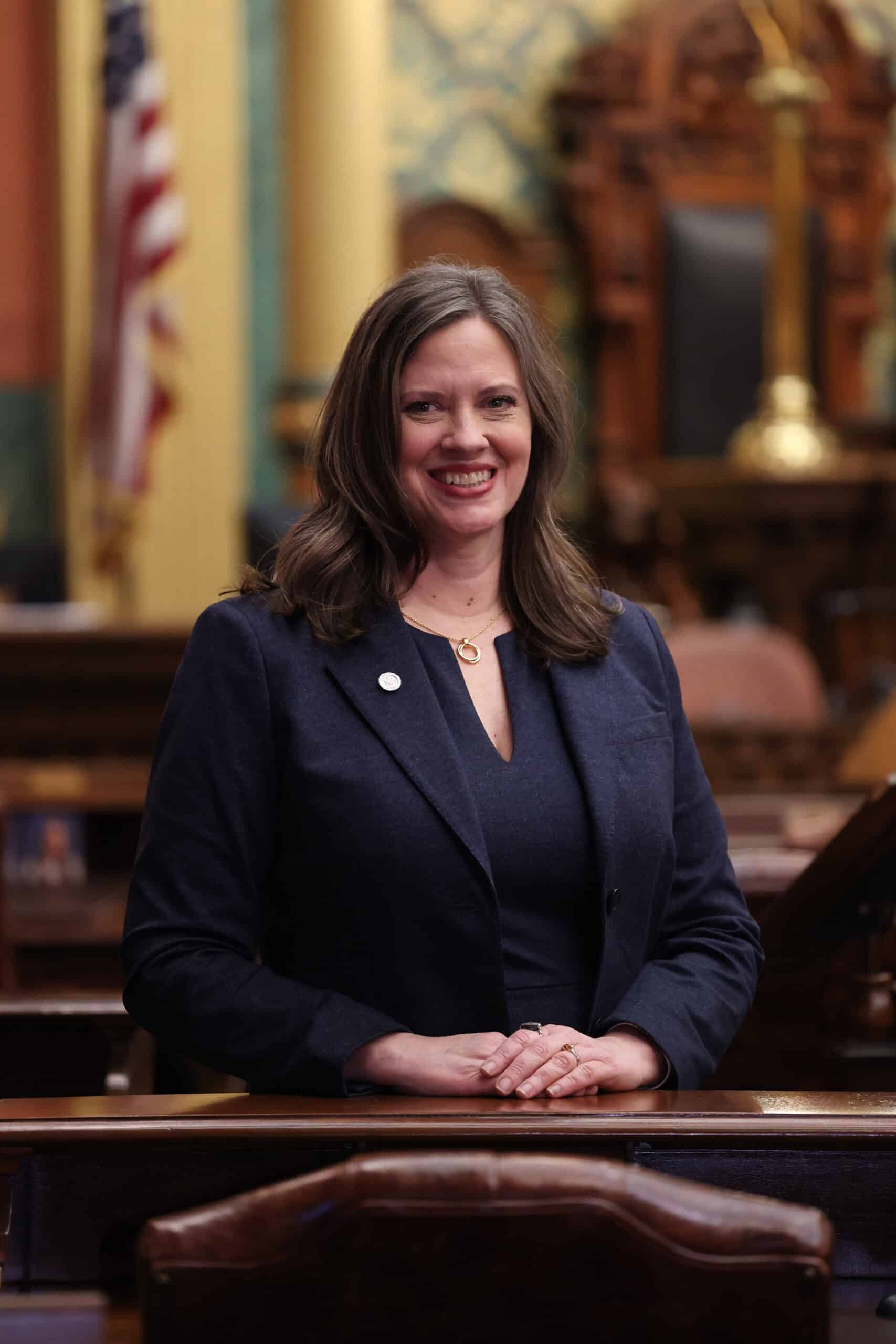
Photo of Carol Glanville
D Michigan House · District 84

Rep. Carol Glanville

Compare
Total votes
2,051
all sessions
Attendance
97%
61 missed
Lower than 83% of chamber peers
With party
97%
of cast votes
Near the chamber average
Bipartisan score
1%
crosses aisle rarely
Near the chamber average
Sponsored
1,163
bills & resolutions
Higher than 88% of chamber peers
Committees
1
assignment
1,163 bills and resolutions

Sponsored bills

Total
1,163
Primary
52
Co-sponsor
1,111
This page
1,163
matching current filters
Co-sponsor HB 5432
In committee · Michigan House · Co-sponsor
Appropriations: supplemental; appropriations for multiple departments and branches for the fiscal year 2025-2026; provide for. Creates appropriation act.

Maddy summaryHB 5432 is a supplemental appropriations bill that allocates additional state funding for multiple departments, agencies, and the legislative branch for the 2025-2026 fiscal year. It provides specific monetary amounts to cover budget gaps or new needs identified during the fiscal year, with conditions on how the funds may be spent. This bill directly affects state government operations by ensuring funding continuity for essential services and programs across various agencies. As a procedural funding measure, it does not change policy but adjusts financial resources for existing government functions.

In committee Dec 31, 2025 1 co-sponsor
Co-sponsor HB 5431
In committee · Michigan House · Co-sponsor
School aid: supplemental; supplemental appropriations in the school aid act; provide for. Amends secs. 11, 11s, 33, 201 & 236 of 1979 PA 94 (MCL 388.1611 et seq.) & adds secs. 27g, 97h, 201j, 201k & 236t.

Maddy summaryHB 5431 allocates supplemental funding for Michigan public schools, primarily targeting districts affected by drinking water emergencies. It provides $10 million from the state school aid fund and $4.8 million from the general fund (2025-2026) for districts with at least 4,500 students (or 2,600+ post-2016) in cities with declared water emergencies, to hire staff like nurses and mental health workers and provide related services. The bill also allocates $12.5 million for educator talent programs through intermediate districts. All funds require reporting on service usage and must be expended by 2030.

In committee Dec 31, 2025 1 co-sponsor
Co-sponsor HB 5436
In committee · Michigan House · Co-sponsor
Insurance: health insurers; coverage for hearing aids or hearing-related services for certain enrollees; require. Amends 1956 PA 218 (MCL 500.100 - 500.8302) by adding sec. 3406uu.

Maddy summaryHB 5436 requires health insurers in Michigan to cover hearing aids and related services for qualifying enrollees. It mandates coverage up to $3,000 per hearing aid every 36 months (adjusted annually using the Consumer Price Index starting in 2026), including evaluations, fittings, repairs, and related devices like earmolds. To qualify, an enrollee must be evaluated for hearing loss by an audiologist and medically confirmed as a hearing aid candidate by an otolaryngologist. Insurers may apply existing cost-sharing (like deductibles) but cannot exceed the $3,000 cap per device.

In committee Dec 31, 2025 1 co-sponsor
Co-sponsor HB 5429
In committee · Michigan House · Co-sponsor
Appropriations: supplemental; funding for the autism navigator program; provide for. Creates appropriation act.

Maddy summaryHB 5429 is a supplemental appropriations bill that allocates additional state funding for the autism navigator program. It directly affects the program by providing dedicated financial resources to support its operations and services. The bill creates a new appropriation act to fund this specific initiative within the state budget for fiscal year 2026. This is a procedural funding measure, not a policy change, and it remains pending in the Appropriations Committee after its introduction on December 23, 2025.

In committee Dec 31, 2025 1 co-sponsor
Co-sponsor HB 5400
In committee · Michigan House · Co-sponsor
Housing: residential; sunset for exemption under the residential housing facilities act; extend. Amends sec. 16 of 2022 PA 237 (MCL 207.966).

Maddy summaryHB 5400 extends the expiration date for existing exemptions under Michigan's Residential Housing Facilities Act from December 31, 2027, to December 31, 2037. This bill directly affects residential housing facilities that currently hold exemptions under the act, allowing them to maintain their status until their specific certificate expires. The key change is amending Section 16 of the law to prevent new exemptions after 2037 while ensuring current exemptions remain valid until their individual expiration dates. The bill makes no changes to new exemption applications but provides additional time for facilities already operating under existing exemptions.

In committee Dec 23, 2025 1 co-sponsor
Co-sponsor HB 5401
In committee · Michigan House · Co-sponsor
Housing: affordable; sunset for exemption under the attainable housing facilities act; extend. Amends sec. 16 of 2022 PA 236 (MCL 207.916).

Maddy summaryHB 5401 extends the deadline for granting new exemptions under Michigan's Attainable Housing Facilities Act from December 31, 2027, to December 31, 2037. This directly affects developers and property owners seeking new exemptions for affordable housing projects under the Act. Existing exemptions granted before the new deadline will continue until their certificate expires, ensuring no disruption to ongoing projects. The bill amends Section 16 of the 2022 Attainable Housing Facilities Act (MCL 207.916) to update the sunset provision.

In committee Dec 23, 2025 1 co-sponsor
Co-sponsor HB 5422
In committee · Michigan House · Co-sponsor
Labor: leave; permissible use for earned sick time; modify. Amends title & secs. 2 & 4 of 2018 PA 338 (MCL 408.962 & 408.964).

Maddy summaryHB 5422 amends Michigan's Earned Sick Time Act (2018 PA 338) to clarify and expand permissible uses of accrued sick time for workers. It specifically updates Section 4(1) to allow sick time for medical care related to domestic violence, sexual assault, or violent crime; school meetings about a child's health or disability; and public health emergencies. The bill also refines notice requirements for employers, permitting advance notice up to 7 days for foreseeable absences. This amendment directly affects Michigan workers covered under the existing sick time law, ensuring clearer access to time off for health, family, and safety needs.

In committee Dec 23, 2025 1 co-sponsor
Co-sponsor HB 5389
Failed · Michigan House · Co-sponsor
State finance: budgets; certain work project appropriations; modify legislative disapproval process of. Amends sec. 451a of 1984 PA 431 (MCL 18.1451a).

Maddy summaryHB 5389 modifies how Michigan manages state funds for specific projects (called "work projects"). It requires that such projects must have a clear purpose, specific plan, estimated cost, and completion date to qualify. The bill also changes the timeframe for unused funds to expire (48 months after the fiscal year ends) and gives the director authority to propose lapsing project accounts, but requires both legislative committees to disapprove such proposals within 30 days. Additionally, it mandates annual reports to committees detailing all active work project accounts, their balances, and any funds that lapsed.

Failed Dec 18, 2025 1 co-sponsor
Co-sponsor HB 5393
In committee · Michigan House · Co-sponsor
Employment security: benefits; recovery waiver of an improperly paid benefit; require after a certain amount of time elapses. Amends sec. 62 of 1936 (Ex Sess) PA 1 (MCL 421.62).

Maddy summaryHB 5393 amends Michigan's unemployment benefits law to change how overpaid benefits are recovered. It requires the unemployment agency to issue a repayment demand within 3 years of a final determination about overpayment, and prohibits recovery actions after that deadline (except for suspected identity fraud). The bill creates specific waiver conditions where repayment may be forgiven, including cases of agency errors, low household income (below 150% of federal poverty guidelines), or unintentional wage reporting mistakes by employers. This directly affects unemployed Michiganders who received incorrect benefits, ensuring they aren't required to repay overpayments after the 3-year window unless fraud is involved.

In committee Dec 18, 2025 1 co-sponsor
Co-sponsor HB 5392
In committee · Michigan House · Co-sponsor
Employment security: administration; recovery of improperly paid benefits; allow claimant to provide evidence of waiver eligibility. Amends sec. 62 of 1936 (Ex Sess) PA 1 (MCL 421.62).

Maddy summaryHB 5392 updates Michigan's unemployment benefits recovery process by expanding eligibility for claimants to request waivers of repayment for improperly paid benefits. It allows claimants 60 days after receiving an overpayment notice to submit evidence showing repayment would be "contrary to equity and good conscience," such as administrative errors by the agency, employer-provided incorrect wage data, or household income below 150% of the federal poverty level. The bill clarifies that waivers apply retroactively from the date of the error or application, and requires refunds for payments made after the waiver request. This directly affects individuals who received unemployment benefits they later had to repay due to agency or employer errors.

In committee Dec 18, 2025 1 co-sponsor
Showing 191 to 200 of 1,163 bills
Previous 1 … 19 20 21 … 117 Next