

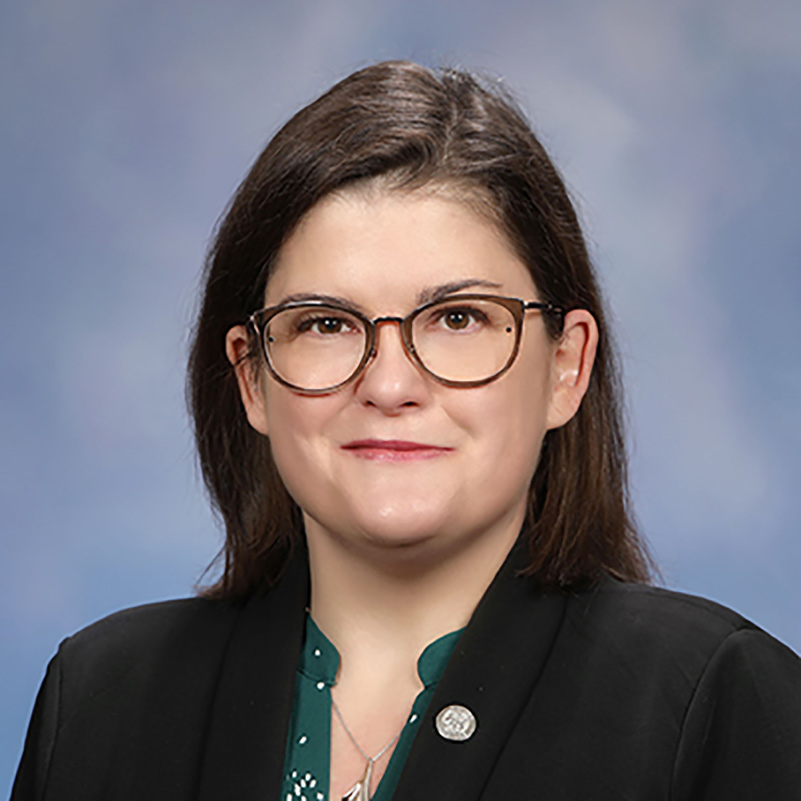
Photo of Kara Hope
D Michigan House · District 74

Rep. Kara Hope

Compare
Total votes
3,819
all sessions
Attendance
96%
145 missed
Lower than 91% of chamber peers
With party
95%
of cast votes
Near the chamber average
Bipartisan score
3%
crosses aisle rarely
Near the chamber average
Sponsored
2,381
bills & resolutions
Higher than 75% of chamber peers
Committees
2
assignments
2,381 bills and resolutions

Sponsored bills

Total
2,381
Primary
93
Co-sponsor
2,288
This page
2,381
matching current filters
Co-sponsor HB 5966
In committee · Michigan House · Co-sponsor
Civil procedure: civil actions; portion of fines in certain state civil infraction actions under NREPA; dedicate to grant program to assist farmers affected by PFAS. Amends sec. 8831 of 1961 PA 236 (MCL 600.8831).

Maddy summaryThis bill modifies the rules for how fines are handled in certain state civil infraction cases related to environmental protection. Instead of directing these specific fines to public libraries, the legislation allows a portion of the revenue to be dedicated to a grant program assisting farmers impacted by PFAS contamination. The change applies only to fines resulting from violations of the Natural Resources and Environmental Protection Act, leaving other civil fine distributions unchanged. This measure requires the passage of two other related bills before it can take effect.

In committee Oct 15, 2024 1 co-sponsor
Co-sponsor HB 5965
In committee · Michigan House · Co-sponsor
Environmental protection: other; grant program for farmers affected by polyfluoroalkyl (PFAS); create. Amends 1994 PA 451 (MCL 324.101 - 324.90106) by adding sec. 402.

Maddy summaryThis bill establishes a grant program within the Department of Environment, Great Lakes, and Energy to assist Michigan farmers whose land, crops, or water are contaminated with PFAS chemicals. The program would provide financial support for medical testing and care, purchasing or selling farmland, cleaning up contamination, and replacing lost income or mortgage payments. To receive funding, farmers must submit detailed applications outlining their financial history and a plan for how they intend to use the grant money, such as transitioning to alternative revenue streams or ceasing operations. The funds for these grants would come from a newly created state fund, potentially financed by increases in state civil infraction penalties. The legislation requires the department to create specific rules to administer the program and defines key terms like "agricultural land" and "contamination" to guide eligibility.

In committee Oct 15, 2024 1 co-sponsor
Co-sponsor HB 5975
In committee · Michigan House · Co-sponsor
Campaign finance: contributions and expenditures; certain donations by a contractor or prospective contractor under state contract; prohibit. Amends 1976 PA 388 (MCL 169.201 - 169.282) by adding sec. 30a.

Maddy summaryThis bill prohibits the owners and top executives of contractors seeking or holding state and local government contracts worth at least $250,000 from making political donations. The restrictions apply to contributions to candidates, political parties, and specific types of advocacy groups during a period starting 18 months before a contract is sought and ending 18 months after the contract concludes. If a contractor violates these rules, they face penalties including the cancellation of current contracts or disqualification from future contracts for up to three years. The law defines "contractor" to include businesses and nonprofits receiving significant government funding and specifies which individuals within those organizations are subject to the donation ban.

In committee Oct 15, 2024 1 co-sponsor
Primary HB 5393
Signed into law · Michigan House · Lead sponsor
Juveniles: other; default maximum time for a juvenile to complete the terms of a consent calendar case plan; increase to 6 months. Amends sec. 2f, ch. XIIA of 1939 PA 288 (MCL 712A.2f).

Maddy summaryThis bill updates Michigan law to increase the maximum time a juvenile has to complete a consent calendar case plan from three months to six months. It applies specifically to informal court proceedings where a juvenile agrees to a plan to avoid formal charges, affecting the juvenile, their family, and the court system. Under the new rule, courts can extend the completion period beyond six months only if they determine a longer time is necessary for a specific treatment program and document that decision. The legislation also clarifies that these case plans are not court orders and that violations can lead to the case being moved to a formal hearing.

Signed into law Oct 15, 2024 0 co-sponsors
Co-sponsor HB 5976
In committee · Michigan House · Co-sponsor
State management: purchasing; awarding contracts to entities that donate or contribute to certain political candidates or committees; prohibit. Amends 1984 PA 431 (MCL 18.1101 - 18.1594) by adding sec. 264b.

Maddy summaryThis bill prohibits state agencies from awarding contracts to companies whose principals have donated to specific political groups within 18 months before signing the agreement. The law defines "principals" to include company owners, executives, board members, and employees involved in government relations, while banning donations to candidate committees, party committees, and certain tax-exempt political organizations. To enforce this rule, contractors must sign an affidavit confirming no prohibited donations were made during the 18 months prior to the contract, throughout the contract term, and for 18 months after it ends. Violations would render the contract void and bar the company from future state contracts for three years, though the ban does not apply to small businesses with less than $250,000 in state contracts or to grants and loans.

In committee Oct 15, 2024 1 co-sponsor
Co-sponsor HB 5434
Signed into law · Michigan House · Co-sponsor
Highways: memorial; portion of M-11; designate as the "Korean War Veterans Memorial Drive". Amends 2001 PA 142 (MCL 250.1001 - 250.2092) by adding sec. 114.

Maddy summaryThis bill designates a specific section of highway M-11 in Kent County as the "Korean War Veterans Memorial Drive." The affected roadway stretches from the intersection with 3 Mile Road south to the bridge over the Grand River. By amending state highway naming laws, the legislation officially assigns this commemorative name to the route. The change applies immediately and does not alter any traffic rules or funding provisions.

Signed into law Oct 15, 2024 1 co-sponsor
Co-sponsor HB 6013
In committee · Michigan House · Co-sponsor
Crime victims: compensation; crime victim compensation for certain pet expenses; provide for. Amends sec. 11 of 1976 PA 223 (MCL 18.361).

Maddy summaryThis bill amends Michigan's crime victim compensation law to explicitly include reimbursement for pet boarding expenses when a victim must relocate immediately following a crime. The legislation allows victims to receive up to $45,000 total for various out-of-pocket losses, with specific sub-limits for categories such as medical care, counseling, relocation, and funeral costs. By adding pet boarding to the list of eligible expenses, the bill ensures that pet owners can access funds to board their animals while they move to a safer location. The amendment applies to claims filed under the state's existing crime victim services program without changing the overall funding structure or eligibility criteria for other types of compensation.

In committee Oct 15, 2024 1 co-sponsor
Co-sponsor HB 5997
In committee · Michigan House · Co-sponsor
Health occupations: marriage and family therapists; licensing requirements for marriage and family therapists; modify and require continuing education. Amends sec. 16909 of 1978 PA 368 (MCL 333.16909) & adds sec. 16914.

Maddy summaryThis bill updates the licensing requirements for marriage and family therapists in Michigan by modifying existing educational and clinical experience standards. It clarifies that applicants must hold a master's degree from an accredited program and complete specific graduate-level coursework in family studies, therapy methodology, and ethics. The legislation also adjusts the amount of supervised clinical hours needed, increasing the post-degree requirement to 1,000 hours with stricter supervision ratios and face-to-face contact mandates. Additionally, it allows for a waiver of certain clinical hour requirements for individuals who have earned a doctoral degree in the field.

In committee Oct 15, 2024 1 co-sponsor
Co-sponsor HB 5958
In committee · Michigan House · Co-sponsor
Criminal procedure: expunction; certain conditions allowing for setting aside convictions and certain implementation dates; amend. Amends sec. 1g of 1965 PA 213 (MCL 780.621g).

Maddy summaryThis bill amends Michigan law to automatically remove certain criminal convictions from public records without requiring individuals to file a formal application. It establishes specific timeframes and eligibility criteria for expunging misdemeanors and felonies, such as requiring seven or ten years to pass since sentencing or release from prison. The law includes strict limitations, such as capping the number of convictions that can be cleared and excluding serious offenses like assaultive crimes, crimes of dishonesty, and those involving minors. Implementation of these automatic expungements is scheduled to begin two years after the bill's effective date, pending necessary funding and technological setup by state agencies.

In committee Oct 15, 2024 1 co-sponsor
Co-sponsor HB 6014
In committee · Michigan House · Co-sponsor
Crimes: domestic violence; common household pets in certain shelter programs; provide for. Amends secs. 1 & 7 of 1978 PA 389 (MCL 400.1501 & 400.1507).

Maddy summaryThis bill amends Michigan's domestic violence prevention laws to explicitly allow shelters to accept common household pets, such as dogs and cats, alongside victims and their children. By updating the definition of a "family or household member" and revising shelter requirements, the legislation ensures that emergency housing programs can accommodate animals as part of their crisis support services. Prime sponsors, which include local governments and nonprofit organizations, may use state funds to establish or maintain these inclusive shelter programs that offer counseling, legal aid, and other essential resources. The changes aim to remove barriers for victims seeking immediate safety by recognizing the emotional and practical importance of keeping pets during domestic violence situations.

In committee Oct 15, 2024 1 co-sponsor
Showing 601 to 610 of 2,381 bills
Previous 1 … 60 61 62 … 239 Next