

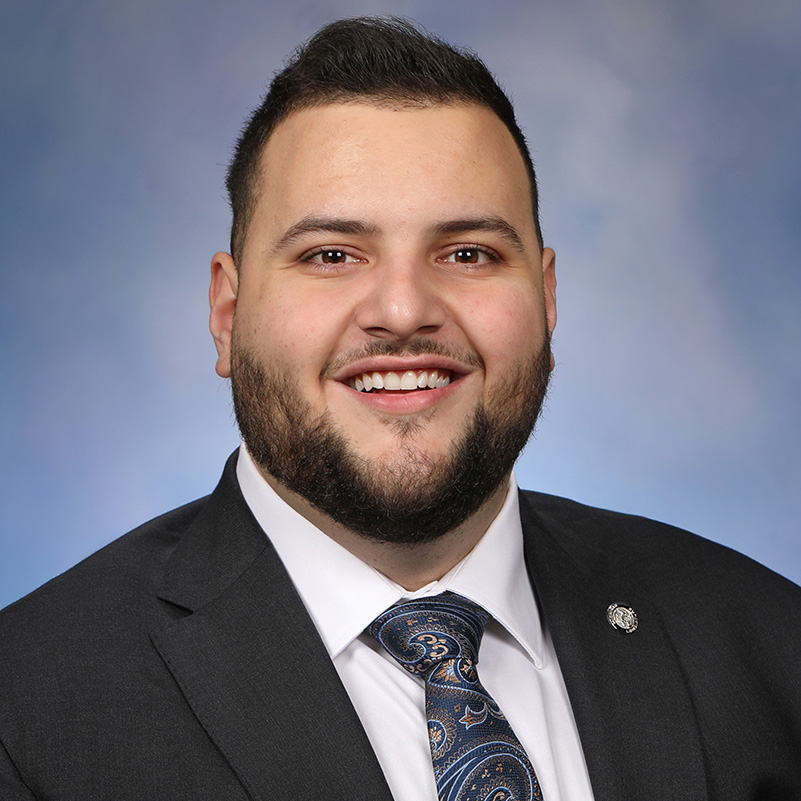
Photo of Alabas Farhat
D Michigan House · District 3 On the 2026 ballot

Rep. Alabas Farhat

Compare
Total votes
1,731
all sessions
Attendance
94%
105 missed
Lower than 92% of chamber peers
With party
95%
of cast votes
Lower than 82% of chamber peers
Bipartisan score
2%
crosses aisle rarely
Higher than 80% of chamber peers
Sponsored
554
bills & resolutions
Lower than 85% of chamber peers
Committees
3
assignments
554 bills and resolutions

Sponsored bills

Total
554
Primary
76
Co-sponsor
478
This page
554
matching current filters
Co-sponsor HB 4405
Passed · Michigan House · Co-sponsor
Labor: fair employment practices; deductions from wages without written consent of employee; revise notice period for certain deductions related to garnishment. Amends sec. 7 of 1978 PA 390 (MCL 408.477).

Maddy summaryHB 4405 updates Michigan's wage deduction laws by clarifying when employers can take money from employee paychecks without written permission. The bill specifically allows employers to deduct overpayments caused by mathematical or clerical errors and to satisfy court-ordered debt judgments without prior consent, provided they give employees written notice at least one pay period in advance. These deductions are limited to 15% of gross wages per pay period and cannot reduce an employee's pay below the applicable minimum wage. Additionally, the law requires employers to keep clear records for each deduction and prohibits prorating these amounts across multiple employees.

Passed Dec 11, 2024 1 co-sponsor
Co-sponsor HB 4402
In committee · Michigan House · Co-sponsor
Criminal procedure: sentencing guidelines; sentencing guideline for wage and fringe benefit payment violations; enact. Amends sec. 14b, ch. XVII of 1927 PA 175 (MCL 777.14b). TIE BAR WITH: HB 4403'23

Maddy summaryThis bill proposes adding a specific sentencing guideline to Michigan's criminal code for violations related to wage and fringe benefit payments. By amending the state's sentencing guidelines, it aims to provide judges with a standardized framework for determining penalties in cases where employers fail to pay workers correctly. The legislation does not create new crimes or change existing laws but instead offers a tool for courts to apply consistent sentencing in these specific employment disputes.

In committee Dec 11, 2024 1 co-sponsor
Co-sponsor HB 4403
In committee · Michigan House · Co-sponsor
Labor: fair employment practices; penalty for wage and fringe benefit payment violations with the intent to defraud; increase. Amends sec. 15 of 1978 PA 390 (MCL 408.485).

Maddy summaryThis bill increases penalties for employers in Michigan who intentionally fail to pay owed wages and fringe benefits to employees. The law establishes a tiered punishment system where the severity of the crime and the potential prison sentence depend on the total value of the unpaid money. Smaller unpaid amounts result in misdemeanor charges with shorter jail terms, while larger sums can lead to felony convictions with prison sentences of up to 20 years. Additionally, the bill allows fines to be up to three times the value of the unpaid wages, and repeat offenders face harsher penalties than first-time violators.

In committee Dec 11, 2024 1 co-sponsor
Co-sponsor HB 4404
In committee · Michigan House · Co-sponsor
Labor: hours and wages; employer violations regarding the payment of wages and fringe benefits; increase sanctions for. Amends sec. 18 of 1978 PA 390 (MCL 408.488).

Maddy summaryThis bill increases the financial penalties that employers in Michigan face for failing to pay owed wages or fringe benefits. Under the new rules, if an employer is found guilty of such violations, they must pay the employee the full amount owed plus a penalty equal to 100% of that amount for every year the payment is delayed. Additionally, the bill allows the state to award up to three times the owed amount as extra damages if the violation is considered flagrant or repeated, and it raises the maximum fine for breaking the law from $1,000 to $10,000. These changes apply to any employer who violates existing state laws regarding wage payment, record-keeping, or dispute resolution.

In committee Dec 11, 2024 1 co-sponsor
Primary HB 4406
In committee · Michigan House · Lead sponsor
Labor: fair employment practices; wage information of similarly situated employees; require an employer to disclose to an employee under certain circumstances. Amends sec. 13a of 1978 PA 390 (MCL 408.483a).

Maddy summaryThis bill requires employers in Michigan to provide wage information to employees who request it, specifically data on pay for similarly situated workers within the same job classification or with comparable duties. Under the new rules, employers must respond to such requests within 30 days and may share details like salary, bonuses, and overtime pay while redacting specific employee names but including their sex and seniority. The legislation also prohibits employers from forcing employees to sign nondisclosure agreements about their wages or from punishing workers who share their compensation information. These changes aim to increase transparency in the workplace by ensuring employees have access to comparative pay data and protecting them from retaliation when discussing their earnings.

In committee Dec 11, 2024 0 co-sponsors
Primary HB 5638
In committee · Michigan House · Lead sponsor
Fire: other; requirements for certain child care organizations and procedures for certain investigations; modify and make other revisions to 1973 PA 116. Amends secs. 2, 3, 5n, 10 & 11c of 1973 PA 116 (MCL 722.112 et seq.).

Maddy summaryThis bill updates Michigan's child care regulations by requiring the state to create advisory committees that include parents and affected organizations to help develop and review safety rules. These committees must consist of at least 12 members and will guide the creation of standards covering staff qualifications, facility safety, and operational practices for licensed child care centers and homes. The legislation also establishes a 90-day grace period for facilities to comply with new rules, unless there is an immediate health or safety risk. Additionally, it clarifies that schools operating child care centers on campus are exempt from certain fire safety rules if the building is already certified as safe for educational use.

In committee Dec 11, 2024 0 co-sponsors
Co-sponsor HB 5639
In committee · Michigan House · Co-sponsor
Children: child care; review and appeal process for certain violations of child care organization rules; require the department to establish. Amends 1973 PA 116 (MCL 722.111 - 722.128) by adding sec. 12a.

Maddy summaryThis bill requires the Michigan Department of Health and Human Services to create a written process for child care licensees to request a review and appeal of certain rule violations. The new procedure specifically applies to cases where a violation does not lead to the denial, revocation, or refusal to renew a license, or an injunction. The department must establish this system within 90 days of the bill's effective date and make the process publicly available on its website. By adding Section 12a to the existing child care licensing law, the legislation aims to provide a formal avenue for organizations to challenge specific regulatory determinations.

In committee Dec 11, 2024 1 co-sponsor
Co-sponsor HB 4918
Passed · Michigan House · Co-sponsor
Crimes: assaultive; assault or battery of certain vehicle operators and employees; prohibit under certain circumstances, and provide for penalties. Amends 1931 PA 328 (MCL 750.1 - 750.568) by adding sec. 81g.

Maddy summaryThis bill creates new criminal penalties for assaulting or battering public transit operators, including bus drivers, train conductors, and streetcar operators, while they are performing their duties. The law establishes different punishment levels based on the severity of the attack and whether a weapon is used, ranging from misdemeanors with fines up to $2,000 and jail time up to one year for unarmed assaults causing serious injury, to felonies with potential prison sentences up to eight years and fines up to $8,000 for attacks involving dangerous weapons. The legislation also mandates that transit vehicle owners post signs warning passengers that assaulting an operator can lead to prosecution and enhanced penalties, and it allows for increased charges if the offender has a prior conviction under this specific section.

Passed Dec 11, 2024 1 co-sponsor
Primary HB 5463
In committee · Michigan House · Lead sponsor
Economic development: other; center for microenterprise development; create. Amends 1984 PA 270 (MCL 125.2001 - 125.2094) by adding ch. 7A.

Maddy summaryThis bill creates a new chapter within the Michigan Strategic Fund Act to establish a formal Center for Microenterprise Development. The legislation defines a microenterprise as a small business with 10 or fewer employees and outlines the role of nonprofit organizations that provide training, technical assistance, or loans to these businesses. By adding specific definitions for terms like "economic development project" and "green chemistry," the bill sets the framework for the fund to support small-scale industrial, commercial, and agricultural ventures. The changes amend existing state laws to ensure the fund can officially recognize and assist these smaller enterprises through structured development programs.

In committee Dec 10, 2024 0 co-sponsors
Co-sponsor HB 5413
In committee · Michigan House · Co-sponsor
Economic development: Michigan strategic fund; good jobs for Michigan program; modify. Amends secs. 9, 90g & 90h of 1984 PA 270 (MCL 125.2009 et seq.).

Maddy summaryThis bill modifies the Michigan Strategic Fund Act to require the fund to submit a detailed annual report detailing its activities and financial assistance programs. The report must include specific data such as the number and average salary of new and retained jobs, the amount of money returned to the fund, and the status of all loans. Additionally, the legislation mandates that the fund immediately notify legislative leaders and relevant committees if any recipient receiving over $500,000 in assistance files for bankruptcy. The bill also requires an annual audit by the auditor general to assess the fund's ability to meet its obligations and makes these reports and audits available to the public online.

In committee Dec 10, 2024 1 co-sponsor
Showing 221 to 230 of 554 bills
Previous 1 … 22 23 24 … 56 Next