

Maddy summaryThis bill modifies Michigan's penal code to strengthen protections and procedures for minors involved in human trafficking cases. It establishes a legal presumption that children under 18 are coerced into sex or labor trafficking offenses, shifting the burden to the prosecution to prove otherwise if they wish to avoid this classification. The legislation also mandates that law enforcement immediately report suspected trafficking involving minors to the Department of Health and Human Services, which must then begin an investigation within 24 hours. Additionally, the bill clarifies how prior convictions affect sentencing severity and outlines specific evidence types courts can use to verify a defendant's criminal history. These changes directly impact law enforcement, prosecutors, courts, and the Department of Health and Human Services in handling cases involving child victims of trafficking.
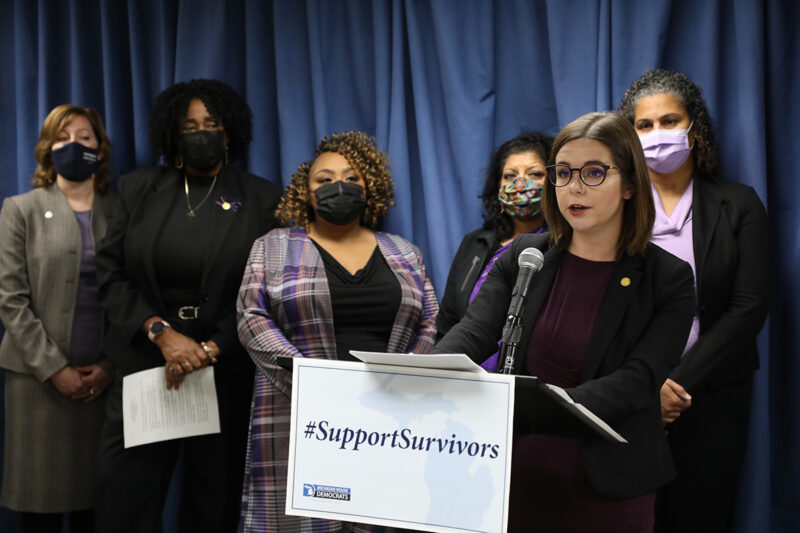
Rep. Laurie Pohutsky
Sponsored bills
Maddy summaryThis bill creates a legal defense for people charged with crimes if they can prove they committed those acts because they were victims of human trafficking. Under the new rule, a defendant must show by a "preponderance of the evidence" that their criminal behavior was a direct result of being trafficked. This provision applies to both felony and misdemeanor charges and allows courts to consider the trafficking victim status as a reason for the offense. The law takes effect 90 days after it is signed into legislation.
Maddy summaryThis bill requires that law enforcement disciplinary personnel records be made available to the public upon request under Michigan's Freedom of Information Act. It achieves this by explicitly removing an exemption that previously allowed agencies to withhold these records as an unwarranted invasion of privacy. Consequently, the legislation ensures that information regarding officer discipline is treated as a public record subject to disclosure, while maintaining other standard protections for sensitive investigative data and personal privacy.
Maddy summaryThis bill expands Michigan's workers' compensation rules to presume that certain heart and respiratory diseases are caused by work duties for a wider group of police, fire, and public safety employees. It specifically includes members of airport fire departments, county sheriff deputies, state police, conservation officers, and forest fire officers, alongside existing city and township personnel. Under the new provisions, these workers are automatically considered to have developed these conditions on the job unless there is clear scientific evidence that smoking or other non-work factors were the primary cause. The legislation also requires these individuals to apply for pension benefits before claiming workers' compensation for these specific illnesses.
Maddy summaryHB 5849 amends Michigan's Revised Judicature Act to update the legal definitions and references regarding prostitution within the state's nuisance laws. The bill modifies specific sections of the law to ensure consistency with current terminology and statutes concerning commercial sexual activity and related offenses. It classifies buildings, vehicles, and other locations used for prostitution as nuisances and holds owners or operators accountable for maintaining such spaces. This change is a technical update to existing legal frameworks rather than a new criminal prohibition, and it requires the passage of a companion bill to become effective.
Maddy summaryThis bill directs the Michigan Department of Health and Human Services to create a comprehensive lead poisoning prevention program aimed at protecting children and reducing exposure to lead-based paint. Key provisions require the department to develop educational materials for healthcare providers, schools, and parents, while also establishing a system to track blood lead test results and automatically notify local health officials when a child under three is found to have elevated levels. Upon receiving such a notification, the department must initiate contact with the child's doctor or local health department and ensure the child is referred to the Early On program for support. Additionally, the bill mandates annual reports to the legislature detailing the number of children screened and diagnosed with high lead levels, as well as a financial accounting of the program's expenditures.
Maddy summaryThis bill directs the Michigan Department of Health and Human Services to create a new funding system that pays certified community behavioral health clinics in advance for their expected costs. The law applies to clinics, nonprofit groups, and private organizations that provide mental health services and meet specific federal and state certification standards. To ensure fair treatment, the bill requires the department to establish rules that prevent retaliation against these providers and creates a process for resolving payment disputes through an independent adjudicator. Implementation of this payment system must be completed by October 1, 2027, but the bill will only take effect if a companion bill is also passed into law.
Maddy summaryThis bill amends Michigan's Sex Offender Registration Act to clarify how certain legal statuses are defined for registration purposes. It expands the definition of "convicted" to include specific juvenile adjudications and orders of disposition for individuals aged 14 or older who would be classified as tier III offenders, while excluding convictions that have been expunged or set aside. Additionally, the legislation updates the definition of "custodial authority" to explicitly cover a broader range of relationships and positions, including specific roles within schools, correctional facilities, and county probation programs where an individual might have access to or authority over a victim. These changes aim to ensure that sex offenders with these specific backgrounds are properly identified and registered under the state's tracking system.
Maddy summaryThis bill updates Michigan's child care laws to strengthen background check requirements for staff, household members, and license applicants. It establishes specific rules that automatically disqualify individuals from working in child care if they refuse background checks, provide false information, or have convictions for crimes such as child abuse, sexual offenses, domestic violence, and certain felonies involving harm or fraud. The legislation also sets time limits on how long past felony or misdemeanor convictions must have occurred before an individual becomes eligible to work in a child care setting.
Maddy summaryThis bill updates Michigan's public health code to clarify and expand testing and counseling requirements for individuals charged with or convicted of prostitution and related offenses. It mandates that courts order medical examinations for sexually transmitted infections, hepatitis B, hepatitis C, and HIV for defendants at various stages of the legal process, including arrest, pre-trial release, and after conviction. The law also requires that test results be shared with defendants and health departments for partner notification, while ensuring that counseling and testing services are provided confidentially. Additionally, the bill specifies that victims of sexual offenses can request expedited testing within 48 hours of a defendant's custody or indictment.