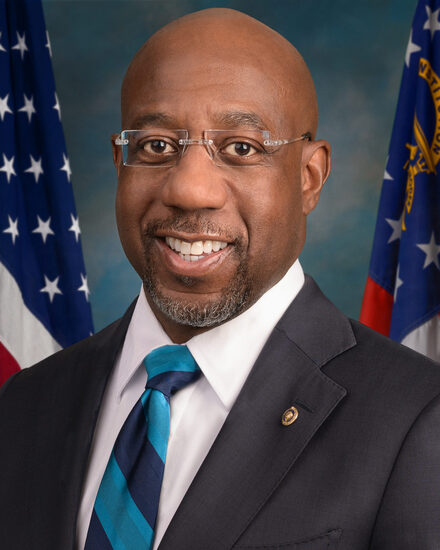
Photo of Raphael G. Warnock
D United States Senate · Georgia

Sen. Raphael G. Warnock

Compare
Total votes
1,037
all sessions
Attendance
97%
32 missed
Near the chamber average
With party
95%
of cast votes
Lower than 78% of chamber peers
Bipartisan score
2%
crosses aisle rarely
Higher than 75% of chamber peers
Sponsored
1,262
bills & resolutions
Near the chamber average
Committees
13
assignments
1,262 bills and resolutions

Sponsored bills

Total
1,262
Primary
120
Co-sponsor
1,142
This page
1,262
matching current filters
Co-sponsor SRES 83
Passed · Massachusetts Senate · Co-sponsor
A resolution expressing support for the designation of February 20 through February 27, 2021, as "National FFA Week", recognizing the important role of the National FFA Organization in developing the next generation of leaders who will change the world, and celebrating 50 years of National FFA Organization Alumni and Supporters.

This resolution supports the designation of February 20-February 27, 2021, as National FFA Week. It also (1) recognizes the important role of the National FFA Organization (Future Farmers of America) in developing the next generation of leaders who will change the world, and (2) celebrates 50 years of National FFA alumni and supporters.

Passed Mar 1, 2021 1 co-sponsor
Co-sponsor S 505
In committee · Massachusetts Senate · Co-sponsor
Forced Arbitration Injustice Repeal Act

Forced Arbitration Injustice Repeal Act This bill prohibits a predispute arbitration agreement from being valid or enforceable if it requires arbitration of an employment, consumer, antitrust, or civil rights dispute.

In committee Mar 1, 2021 1 co-sponsor
Co-sponsor S 464
In committee · Massachusetts Senate · Co-sponsor
Safe Step Act

Safe Step Act This bill requires a group health plan to establish an exception to medication step-therapy protocol in specified cases. A medication step-therapy protocol establishes a specific sequence in which prescription drugs are covered by a group health plan or a health insurance issuer.  A request for such an exception to the protocol must be granted if (1) an otherwise required treatment has been ineffective, (2) such treatment is expected to be ineffective and delaying effective treatment would lead to irreversible consequences, (3) such treatment will cause or is likely to cause an adverse reaction to the individual, (4) such treatment is expected to prevent the individual from performing daily activities or occupational responsibilities, (5) the individual is stable based on the prescription drugs already selected, or (6) there are other circumstances as determined by the Employee Benefits Security Administration. The bill requires a group health plan to implement and make readily available a clear process for an individual to request an exception to the protocol, including required information and criteria for granting an exception. The bill further specifies timelines under which plans must respond to such requests.

In committee Feb 25, 2021 1 co-sponsor
Co-sponsor S 425
In committee · Massachusetts Senate · Co-sponsor
Complete Streets Act of 2021

Complete Streets Act of 2021 This bill directs each state to establish a competitive program to provide technical assistance and grants for the design and construction of complete streets to make transit routes safer and more accessible. Specifically, the bill directs the Department of Transportation (DOT) to establish benchmarks and guidance by which states can implement complete streets programs and eligible entities can carry out complete streets policies and principles; eligible entities seeking technical assistance or funds for a complete streets program to adopt policies using complete streets principles that are approved by the state or metropolitan planning organizations (MPOs) with jurisdiction over such entites; states and MPOs to certify that their complete street policies meet the minimum requirements set out by DOT; states to set aside 5% of their federal highway money to implement a complete streets program; and states and MPOs to adopt design standards for federal surface transportation projects that provide for the safe and adequate accommodation of all users of the surface transportation network, including motorized and non-motorized users, in all phases of project planning, development, and operation.

In committee Feb 24, 2021 1 co-sponsor
Co-sponsor S 435
In committee · Massachusetts Senate · Co-sponsor
Secure Rural Schools Reauthorization Act of 2021

Secure Rural Schools Reauthorization Act of 2021 This bill extends through FY2023 payments made to states and eligible counties containing certain federal land under the Secure Rural Schools and Community Self-Determination Act of 2000. The Department of the Interior and the Department of Agriculture shall carry out a pilot program to allow the Chief of the Forest Service or the Director of the Bureau of Land Management to nominate members of resource advisory committees. County funds may be used to provide or expand access to (1) broadband telecommunications services at local schools, or (2) the technology and connectivity necessary for students to use a digital learning tool at or outside of a local school campus. Any county funds that were obligated by a county before October 1, 2017, but are unspent on October 1, 2020, may be used by the county for any authorized use and shall be available for projects initiated after October 1, 2020. No county funds may be used for lobbying activity, regardless of the purpose for which the funds are obligated on or before the enactment of this bill.

In committee Feb 24, 2021 1 co-sponsor
Co-sponsor S 377
In committee · Massachusetts Senate · Co-sponsor
Living Donor Protection Act of 2021

Living Donor Protection Act of 2021 This bill prohibits certain insurance carriers from discriminating against, and provides other protections for, living organ donors. Specifically, carriers may not deny, cancel, or otherwise impose conditions on policies for life insurance, disability insurance, or long-term care insurance based on an individual's status as a living organ donor. The bill also expressly specifies that recovery from organ-donation surgery constitutes a serious health condition that entitles eligible employees to job-protected medical leave. In addition, the Department of Health and Human Services must update educational materials on live organ donation to include information about the benefits of live organ donation and about access to insurance for living organ donors.

In committee Feb 23, 2021 1 co-sponsor
Co-sponsor S 386
In committee · Massachusetts Senate · Co-sponsor
Medicare-X Choice Act of 2021

Medicare-X Choice Act of 20 21 This bill establishes and funds the Medicare Exchange health plan, which allows individuals who are not otherwise eligible for Medicare to enroll in a government-administered health insurance plan. The Centers for Medicare & Medicaid Services (CMS) must offer such plan in certain individual health insurance exchanges beginning plan year 2022 and offer it in all individual health insurance exchanges beginning plan year 2025. CMS must offer the plan in the small group market in all geographic areas for plan year 2025. The plan must cover primary care services without cost sharing and meet the same requirements, including essential health benefits, as existing health insurance exchange plans. Unless they opt out, health care providers enrolled under Medicare or under a state Medicaid plan must participate in the plan and are reimbursed at Medicare rates. The bill establishes a grants program for community organizations, educational institutions, and health agencies to create service partnerships and establish interactive data systems for health care providers. Additionally, the bill expands the premium tax credit available for plans purchased through an exchange and eliminates the restriction on the Department of Health and Human Services negotiating prescription drug prices for Medicare.

In committee Feb 23, 2021 1 co-sponsor
Co-sponsor S 393
In committee · Massachusetts Senate · Co-sponsor
Equality Act

Equality Act This bill prohibits discrimination based on sex, sexual orientation, and gender identity in areas including public accommodations and facilities, education, federal funding, employment, housing, credit, and the jury system. Specifically, the bill defines and includes sex, sexual orientation, and gender identity among the prohibited categories of discrimination or segregation. The bill expands the definition of public accommodations to include places or establishments that provide (1) exhibitions, recreation, exercise, amusement, gatherings, or displays; (2) goods, services, or programs; and (3) transportation services. The bill allows the Department of Justice to intervene in equal protection actions in federal court on account of sexual orientation or gender identity. The bill prohibits an individual from being denied access to a shared facility, including a restroom, a locker room, and a dressing room, that is in accordance with the individual's gender identity.

In committee Feb 23, 2021 1 co-sponsor
Co-sponsor S 385
In committee · Massachusetts Senate · Co-sponsor
Full-Service Community School Expansion Act of 2021

Full-Service Community School Expansion Act of 2021 This bill reauthorizes through FY2025 and expands the Full-Service Community Schools program. The program provides support for full-service community schools that serve children and their families, particularly for children who attend high-poverty elementary and secondary schools. Specifically, the bill directs the Department of Education (ED) to award grants to eligible entities to plan, implement, expand, and support full-service community schools. An eligible entity is a consortium of (1) one or more local educational agencies or the Bureau of Indian Education; and (2) one or more community-based organizations, nonprofit organizations, Indian tribes, tribal organizations, or other entities. A community school refers to a public elementary or secondary school that incorporates the four pillars of community schools. These four pillars are defined by the bill as (1) integrated student supports that address out-of-school barriers to learning (e.g., medical care and assistance with housing, transportation, or nutrition); (2) expanded and enriched learning time and opportunities (e.g., before- and after-school programs); (3) family and community engagement (e.g., adult education); and (4) collaborative leadership and practices, which must include a school-based leadership team, a community school coordinator, and a community-wide leadership team. Further, the bill directs ED to award grants to states to plan, implement, and expand community schools. A state educational agency that receives a grant must meet certain requirements, such as providing subgrants to local educational agencies, establishing a state-level steering committee, and establishing goals for the implementation and expansion of community schools throughout the state.


In committee Feb 23, 2021 1 co-sponsor
Showing 1,231 to 1,240 of 1,262 bills