

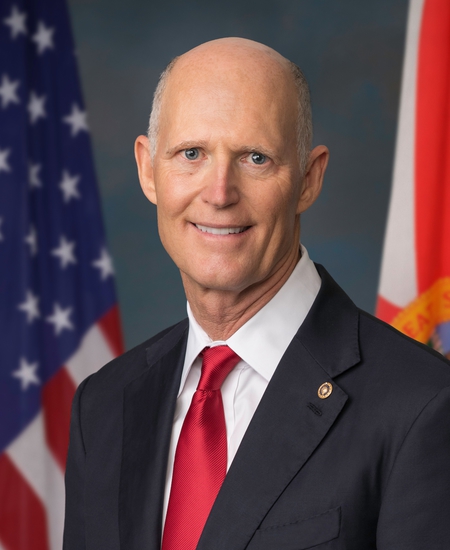
Photo of Rick Scott
R United States Senate · Florida

Sen. Rick Scott

Compare
Total votes
1,037
all sessions
Attendance
98%
23 missed
Higher than 92% of chamber peers
With party
92%
of cast votes
Lower than 82% of chamber peers
Bipartisan score
5%
crosses aisle rarely
Higher than 80% of chamber peers
Sponsored
1,801
bills & resolutions
Higher than 82% of chamber peers
Committees
13
assignments
1,801 bills and resolutions

Sponsored bills

Total
1,801
Primary
421
Co-sponsor
1,380
This page
1,801
matching current filters
Co-sponsor S 3295
In committee · Massachusetts Senate · Co-sponsor
A bill to amend the Internal Revenue Code of 1986 to establish a credit for adult child caregivers.

Maddy summaryThis bill creates a $2,000 annual tax credit for adult children who live with and provide care to aging relatives meeting specific criteria. To qualify, the caregiver must be at least 18 (or 16 if legally emancipated), live with the relative for 6+ months, and provide 10+ hours/week of care, verified by a healthcare provider. The care recipient must be age 55+, unable to perform 1 activity of daily living and 3 instrumental activities (like meal prep or managing finances) without substantial help, requiring care for at least 180 days. The credit phases out for single filers earning over $75,000 ($150,000 for joint filers) and cannot be claimed alongside the existing child care credit.

In committee Dec 2, 2025 1 co-sponsor
Co-sponsor SJRES 97
In committee · Massachusetts Senate · Co-sponsor
A joint resolution proposing a balanced budget amendment to the Constitution of the United States.

This joint resolution proposes a constitutional amendment that requires federal expenditures and receipts to be balanced, which may occur over more than one year. Under the amendment, expenditures include all federal expenditures except those for payment of debt. Receipts do not include receipts derived from borrowing. The amendment requires Congress to achieve balance within 10 years of the ratification of the amendment. In an emergency situation, Congress may authorize additional expenditures that are not otherwise permitted by the amendment if two-thirds of the House of Representatives and the Senate agree to pass the bill. The additional expenditures must be for a limited time, and debts incurred from the expenditures must be paid as soon as practicable.

In committee Nov 20, 2025 1 co-sponsor
Primary SRES 517
In committee · Massachusetts Senate · Lead sponsor
A resolution expressing opposition to congressional spending on earmarks.

Maddy summarySRES 517 is a Senate resolution opposing congressional spending on earmarks - special spending projects directed by lawmakers for specific local projects. It condemns the use of earmarks to allocate taxpayer funds, reaffirms previous bans on such spending (including a 2019 permanent ban), and urges Congress to focus on reducing the national debt instead. The resolution does not change current spending rules but expresses the Senate’s position against earmarks as a way to curb deficit spending and debt growth. It directly affects how Congress manages federal budget allocations, emphasizing fiscal responsibility over targeted project funding.

In committee Nov 20, 2025 0 co-sponsors
Co-sponsor S 3267
In committee · Massachusetts Senate · Co-sponsor
ASAP Act

Maddy summaryS 3267, the ASAP Act, would require Medicare to cover early detection screening tests for Alzheimer's disease and related dementias starting January 1, 2028. The bill defines these tests as FDA-cleared or approved blood, genomic, or imaging-based screenings for pre-symptomatic or early-stage detection. It directly affects Medicare beneficiaries aged 65+ who may be at risk for Alzheimer's, ensuring coverage for these specific tests once approved. The key provision adds these screenings to Medicare's payment system under Section 1833(h)(1)(A) of the Social Security Act.

In committee Nov 20, 2025 1 co-sponsor
Co-sponsor S 3259
In committee · Massachusetts Senate · Co-sponsor
RECAPTURE Act

Maddy summaryThe RECAPTURE Act (S 3259) changes how leftover federal broadband funding is handled under the Infrastructure Investment and Jobs Act. It requires that any unspent funds from the Broadband Equity, Access, and Deployment (BEAD) program not specifically designated for a project must be deposited into the federal Treasury to reduce the deficit, while funds designated for specific projects remain available to the grant recipient. This applies directly to states and local governments that received BEAD grants but have unused funds. The bill ensures unallocated broadband funds are redirected toward deficit reduction rather than remaining unspent.

In committee Nov 20, 2025 1 co-sponsor
Primary S 3244
In committee · Massachusetts Senate · Lead sponsor
Anti-Communism Week Act

Maddy summaryThis bill designates November 2-8 each year as "Anti-Communism Week" and requests the President issue an annual proclamation encouraging the public to observe the week with ceremonies. It does not create new laws or affect specific groups; the primary action is the ceremonial designation of a week for remembrance. The bill’s key mechanism is the formal date designation in the U.S. Code, with no direct policy changes or obligations beyond the President’s annual proclamation. The language in the findings section reflects historical views on communism but does not alter legal rights or government functions.

In committee Nov 20, 2025 0 co-sponsors
Primary S 3264
In committee · Massachusetts Senate · Lead sponsor
More Affordable Care Act

Maddy summaryThis bill establishes a "Health Freedom Waiver Program" that would allow states to opt out of certain Affordable Care Act requirements for health insurance starting in 2026. States choosing this option would need to maintain a high-risk insurance pool, and the federal government would instead fund "Trump Health Freedom Accounts" for eligible residents, replacing premium tax credits and cost-sharing reductions. These accounts would provide funds for health insurance but restrict coverage for gender transition procedures and abortion services. The bill also includes modified tax credits for small businesses in waiver states and requires better price transparency in health care through updated reporting requirements.

In committee Nov 20, 2025 0 co-sponsors
Co-sponsor S 3237
In committee · Massachusetts Senate · Co-sponsor
Terrorist Inadmissibility Codification Act

Maddy summaryThis bill amends U.S. immigration law to expand the definition of "aliens engaged in terrorist activity" under the Immigration and Nationality Act. It adds specific groups - Hamas, Palestine Islamic Jihad, Hezbollah, Al-Qaeda, and ISIS - to the list of entities whose members or supporters would be barred from entering the U.S. The change replaces a prior reference to the Palestine Liberation Organization's spokesperson with a broader inclusion of these designated groups and their affiliates. Individuals who are members of these groups, act as their spokespersons, or endorse their terrorist activities would now be subject to immigration inadmissibility. This directly affects foreign nationals associated with these organizations seeking U.S. visas or entry.

In committee Nov 20, 2025 1 co-sponsor
Co-sponsor S 3238
In committee · Massachusetts Senate · Co-sponsor
Conscience Protections for Medical Residents Act

Maddy summaryThis bill prohibits Medicare-approved medical residency programs from requiring residents to undergo abortion-related training without their voluntary opt-in. It specifically bans programs from mandating such training or discriminating against residents who choose not to participate in abortion care (including counseling or referrals). The law applies directly to medical residents in Medicare-funded postgraduate training programs. Key provisions ensure residents can opt out without penalty and prevent programs from penalizing those who decline abortion-related instruction.

In committee Nov 20, 2025 1 co-sponsor
Co-sponsor S 3220
In committee · Massachusetts Senate · Co-sponsor
VISIT USA Act

Maddy summaryThis bill transfers $160 million from the Travel Promotion Fund to Brand USA (the Corporation for Travel Promotion) to support international tourism marketing. The funds come from unobligated balances of fees collected under the Immigration and Nationality Act before October 1, 2025. The transfer is exempt from standard spending limits under the Travel Promotion Act of 2009 and requires Brand USA to follow existing matching fund rules. The bill directly affects Brand USA's funding for promoting U.S. travel internationally.

In committee Nov 19, 2025 1 co-sponsor
Showing 191 to 200 of 1,801 bills
Previous 1 19 20 21 181 Next