

Maddy summaryMassachusetts bill SD 956 requires employers with state business licenses to verify all new employees' work authorization using the federal E-Verify program. It prohibits employers from intentionally or knowingly hiring unauthorized workers, including those contracted through independent contractors. The law establishes a complaint process where workers or others can report violations without providing Social Security numbers, with investigations handled by the Attorney General or District Attorneys. Employers found violating the law must terminate unauthorized employees' work and face penalties, while all immigration status checks must be confirmed through federal authorities, not state officials.
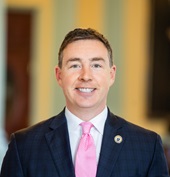
Sen. Ryan Fattman
Sponsored bills
By Mr. Feeney, a petition (accompanied by bill) (subject to Joint Rule 12) of Paul R. Feeney for legislation to support families who experience the birth of a stillborn child. Revenue.
By Mr. Fattman, a petition (accompanied by bill, Senate, No. 353) of Ryan C. Fattman and Bruce E. Tarr for legislation to prevent discrimination in interscholastic athletic and extracurricular activities. Education.
Maddy summarySD 1519 modernizes Massachusetts' competitive electricity market by requiring energy marketers (companies selling electricity to customers) to follow new rules. It mandates that customers can switch suppliers within 3 business days, eliminates interim rates for moves within a utility's area, and requires a single bill format showing both energy and distribution charges by 2025. The bill also introduces licensing requirements, including a $10,000 fee and a $5 million bond per license for energy marketers, plus mandatory training for their representatives. Additionally, it sets rules for in-person door-to-door sales, requiring language verification and third-party phone number tracking. These changes directly affect energy suppliers, distributors, and residential and small commercial electricity customers in Massachusetts.
Maddy summaryThis bill requires purchasers of 40B affordable condominium units to pay all common expenses (like maintenance or utilities) as outlined in their condo's master deed. It also mandates the state's Executive Office of Housing to create a reimbursement program for these buyers to cover those costs. The bill explicitly prohibits other unit owners in the same condo complex from subsidizing the common expenses of 40B affordable units. This directly affects buyers of 40B-affordable units and changes how their housing costs are structured.
Maddy summaryThis bill exempts Massachusetts towns with fewer than 30,000 residents from Chapter 40B housing requirements. It requires any proposed 40B housing project in these small towns to gain approval from at least 70% of voters in a town election. Current Chapter 40B projects in qualifying communities would be paused until the legislature acts. The bill directly affects small towns and housing developers seeking to build under Chapter 40B. It changes the process by adding voter approval as a mandatory step for new projects.
By Mr. Fattman, a petition (accompanied by bill, Senate, No. 1689) of Ryan C. Fattman for legislation to eliminate no cost calls for violent incarcerated individuals. Public Safety and Homeland Security.
By Mr. Fattman, a petition (accompanied by bill, Senate, No. 349) of Ryan C. Fattman for legislation relative to fair educational practices. Education.
By Mr. Fattman, a petition (accompanied by bill, Senate, No. 1840) of Ryan C. Fattman, Joseph D. McKenna and Bruce E. Tarr for legislation to reform sick leave buybacks. Public Service.
Maddy summaryThis bill (S 1528) would repeal the existing state law banning the sale of menthol-flavored tobacco products, such as menthol cigarettes. It directly affects tobacco retailers who currently cannot sell these products and consumers who purchase them. The key mechanism is removing the prohibition from state law, allowing menthol tobacco products to be legally sold again within the state.