

Maddy summaryThis bill aims to stop nonprofit organizations from using the Dover Amendment to bypass rules that protect wetlands and natural resources. It directly affects these nonprofits by changing how they can use land for their projects. The key mechanism involves amending state law to explicitly state that the Dover Amendment cannot be used to avoid wetland or natural resource protections. This change ensures that environmental safeguards remain in place even when nonprofits seek tax benefits for their land use.
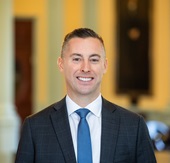
Sen. Brendan Crighton
Sponsored bills
Maddy summaryThis bill requires tobacco retailers in Massachusetts to carry at least one FDA-approved nicotine replacement therapy product to help customers quit smoking. It directly affects businesses that sell tobacco by mandating they stock cessation aids alongside their existing inventory. Retailers who fail to comply face fines of $100 for the first violation, $200 for a second, and $300 for any subsequent offenses. The state Department of Public Health is authorized to create specific rules to enforce this requirement.
Maddy summaryThis bill updates the official name of Massachusetts' oversight body from the "Disabled Persons Protection Commission" to the "Commission for the Protection of Persons with Disabilities" across multiple state laws. The legislation also redefines key terms used in investigations, such as "abuse" and "caretaker," to clarify what constitutes harmful actions by those responsible for a person's well-being. Additionally, it specifies that the commission's authority applies to adults aged 18 to 59 who have intellectual, developmental, or other mental or physical disabilities that make them dependent on others for daily living needs. These changes aim to modernize language and ensure that investigative practices clearly reflect the specific needs of the population the commission protects.
Maddy summaryThis bill expands access to behavioral health services for children involved with state agencies in Massachusetts by clarifying the Department of Mental Health's role in providing specialized care and allowing it to offer non-mental health services to the Department of Developmental Services. It requires the creation of a model emergency response plan for group care settings that prioritizes behavioral health interventions and limits police involvement to situations involving imminent danger. Additionally, the legislation ensures that children in foster care can return to their living arrangements after medical or behavioral leaves, provided they are stable and the facility has the capacity to care for them.
Maddy summaryThis bill establishes a new legal framework for setting payment rates for workers who provide support services to individuals with disabilities in Massachusetts. It creates two distinct categories of staff: entry-level workers with minimal experience and more experienced staff who have supervisory duties or advanced training. The legislation requires the state's Department of Developmental Services to use these specific definitions when calculating how much to pay these direct care professionals. By clarifying these roles, the bill aims to ensure that rate-setting processes accurately reflect the different levels of responsibility and skill required in disability support jobs.
By Mr. Crighton, a petition (accompanied by bill, Senate, No. 2415) of Brendan P. Crighton and Jennifer Balinsky Armini (by vote of the town) for legislation to change the elected term for select board members from 1 year to 3 years in the town of Marblehead. Municipalities and Regional Government. [Local approval received]
By Mr. O'Connor, a petition (accompanied by bill, Senate, No. 2496) (subject to Joint Rule 12) of Patrick M. O'Connor, Hannah Kane, Marc R. Pacheco, Ryan C. Fattman and other members of the General Court for legislation to improve pediatric cancer research. Public Health.
Maddy summaryThis bill requires public buildings in Massachusetts that are newly built, reconstructed, or remodeled on or after January 1, 2026, to include at least one universal changing station. The law defines these stations as enclosed restroom facilities accessible to people of any sex and designed for individuals of any age who need help with diapering. It expands the definition of public accommodations to include public parks and rest stops, ensuring these spaces also comply with the new requirement. The Architectural Access Board is tasked with creating specific rules to enforce this mandate by January 1, 2024.
Maddy summaryThis bill establishes a new Climate Change Adaptation Cost Recovery Fund in Massachusetts to finance infrastructure projects that help communities prepare for and respond to climate change impacts. The law defines eligible projects broadly, including coastal protections, upgraded drainage systems, resilient energy grids, and health programs to treat climate-related illnesses. Under the bill, entities responsible for greenhouse gas emissions between 2000 and 2018 would be charged to contribute to this fund based on their historical fossil fuel use. The collected payments would be used to cover the costs of building and maintaining the specified adaptive infrastructure.
Senate, February 5, 2024 --The committee on Education, to whom was referred the petitions (accompanied by bill, Senate, No. 253) of Brendan P. Crighton, Angelo J. Puppolo, Jr., Vanna Howard, Jason M. Lewis and other members of the General Court for legislation relative to the training, assessment, and assignment of qualified school interpreters in educational settings, report the accompanying bill (Senate, No. 2587).