

April 1, 2024 -- The committee on Education, to whom was referred the petitions (accompanied by bill, Senate, No. 239) of Michael D. Brady, James K. Hawkins, Patrick M. O'Connor and Patricia D. Jehlen for legislation to establish a special commission on creating a more diversified teaching workforce in the Commonwealth; (accompanied by bill, Senate, No. 252) of Brendan P. Crighton for legislation to promote racially integrated schools; (accompanied by bill, Senate, No. 254) of Brendan P. Crighton for legislation to promote racially and culturally inclusive K-12 curriculum; (accompanied by bill, Senate, No. 259) of Julian Cyr, Jack Patrick Lewis, Vanna Howard and Rebecca L. Rausch for legislation relative to LGBTQ+ inclusive curriculum; (accompanied by bill, Senate, No. 286) of Adam Gomez and Vanna Howard for legislation to ensure diversity in public education; (accompanied by bill, Senate, No. 288) of Adam Gomez, Tram T. Nguyen, Steven Ultrino, Jack Patrick Lewis and others for legislation to promote racially inclusive curriculum in schools; (accompanied by bill, Senate, No. 299) of Robyn K. Kennedy, Steven Owens and Rebecca L. Rausch for legislation to address racial and cultural bias training in educator professional development; (accompanied by bill, Senate, No. 311) of Jason M. Lewis, Manny Cruz, Joanne M. Comerford, Jack Patrick Lewis and other members of the General Court for legislation relative to educator diversity; (accompanied by bill, Senate, No. 318) of Liz Miranda, Joanne M. Comerford, Lydia Edwards, Jack Patrick Lewis and other members of the General Court for legislation to establish a permanent commission on American Indian and Alaska Native education; (accompanied by bill, Senate, No. 340) of Pavel M. Payano for legislation to enable all students to thrive: protecting a high quality, diverse educator workforce; and (accompanied by bill, Senate, No. 344) of Rebecca L. Rausch, Jack Patrick Lewis, Joanne M. Comerford, Vanna Howard and other members of the General Court for legislation relative to celebrate and teach Native American culture and history, report the accompanying bill (Senate, No. 2709).
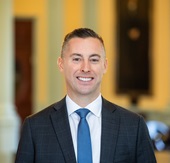
Sen. Brendan Crighton
Sponsored bills
Maddy summaryThis bill updates Massachusetts school construction laws to allow districts with aging or unsafe buildings to use up to 1 percent of their state aid for repairs before their construction debt is fully paid. It also adjusts funding formulas to ensure reimbursement rates keep pace with recent construction costs and expands eligibility for the Accelerated Repair Program to include projects with budgets under $100,000. Additionally, the legislation introduces new incentives that award extra funding points to projects demonstrating significant improvements in racial integration and modifies poverty-based funding calculations to better reflect district needs.
Maddy summaryThis bill amends Massachusetts hunting laws to restrict where migratory game birds can be hunted from boats near the coast. It prohibits hunters using motorized or sail-powered watercraft from discharging firearms within 1,000 feet of the shoreline and requires hunting blinds on boats to be kept at least 1,000 feet away from the coast. The changes directly affect recreational hunters who operate boats in coastal waters and aim to reduce noise disturbances for nearby residents.
Maddy summaryThis bill grants Massachusetts municipalities the authority to remove or relocate utility poles, wires, and attachments if utility companies fail to do so within a required timeframe or agreed-upon deadline. It allows towns to charge reasonable fees for this non-performance and to adopt local laws regarding fees, fines, taxes, and licensing for utilities operating in public spaces. Additionally, the legislation permits municipalities and public utilities to buy utility poles from investor-owned companies at a price that accounts for the poles' reduced value. These changes aim to give local governments more control over public rights of way while establishing clear consequences for delayed utility work.
Maddy summaryThis bill expands Massachusetts' existing Bottle Bill to include more types of drinkable liquids and larger containers, aiming to increase recycling rates. It defines "beverage" to cover most liquids for human consumption while excluding items like milk, infant formula, and small-scale fruit juices, and it raises the size limit for eligible containers to 2.5 liters for non-carbonated drinks and 3 liters for carbonated ones. The legislation also updates the refund value for returned containers to $2.75 for smaller items and $3.75 for larger ones, while exempting dealers with businesses under 2,000 square feet from certain immediate payment rules. Additionally, it requires the state secretary to review handling fees and refund values every three years to ensure they meet specific recycling targets, such as recycling 65% of containers by 2025 and 95% by 2031.
Maddy summaryThis bill modifies Massachusetts environmental laws to streamline the approval process for publicly beneficial climate resiliency projects, such as those designed to prevent flooding or storm damage. It establishes a mechanism for conservation commissions, town selectmen, and mayors to designate these projects, which would then qualify for a general license from the state department, bypassing the need for individual case-by-case reviews. Additionally, the legislation clarifies that these specific projects do not require the same resource loss mitigation rules applied to other developments, provided they are officially designated as beneficial for climate protection. By updating language in existing statutes, the bill aims to reduce bureaucratic hurdles and accelerate the implementation of infrastructure intended to help communities adapt to climate change.
Maddy summaryThis bill creates a new legal framework allowing chiropractic students in their final year to practice under the direct supervision of licensed preceptors. To qualify, students must have completed their academic coursework and passed at least three of four national board exams. Under the program, these externs can work in licensed offices for a minimum of four weeks and up to 16 weeks during their final academic year, though they cannot sign legal documents independently. The Massachusetts Board of Registration of Chiropractors retains the authority to designate specific facilities where this supervised practice may occur.
Maddy summaryThis bill creates a PFAS Remediation Trust Fund to help Massachusetts residents and local governments address contamination from per- and polyfluoroalkyl substances in drinking water, groundwater, and soil. The fund is designed to cover remediation costs for municipalities, private well owners, and public water systems without requiring additional annual appropriations from the state budget. Money for the fund will come from settlements related to claims against manufacturers of PFAS-containing aqueous film-forming foam, and any unused funds at the end of a fiscal year will roll over to the next year. The executive office of energy and environmental affairs is responsible for administering the fund and ensuring expenditures align with existing legal settlements.
Maddy summaryThis bill modifies Massachusetts state tax law to exclude student loan forgiveness from taxable income for veterans who are permanently and totally disabled. Currently, when these individuals receive loan forgiveness, the amount they would have otherwise had to pay is treated as income, but this legislation removes that requirement for this specific group. The change directly affects disabled veterans in Massachusetts by ensuring they do not have to pay state taxes on the portion of their student loans that is forgiven. By amending a specific section of the state's tax code, the bill creates a targeted exemption rather than changing the general rules for student loan forgiveness.
Maddy summaryThis bill increases the funding cap for neighborhood stabilization projects from $10 million to $30 million to support economic development in distressed areas. It updates legal definitions for terms like "decadent area" and "sub-standard area" to better identify properties that are unsafe, dilapidated, or unlikely to be redeveloped by private enterprise. The legislation also formally adds "neighborhood stabilization" as a specific category of work eligible for state assistance. By clarifying these definitions and raising the financial limit, the bill aims to provide clearer guidelines and more resources for communities seeking to rehabilitate vacant or deteriorating buildings.