

Maddy summaryThis bill creates the Alternative Housing Voucher Program to provide rental assistance for low-income individuals with disabilities in Massachusetts. It directly affects disabled adults aged 18-62 with household incomes at or below 80% of the area median income (as set by HUD). The program offers mobile or project-based vouchers covering rent, with households paying 25-30% of their income (depending on utilities), while payments cannot exceed 120% of HUD's fair market rent for the unit size. Unspent funds from the designated budget line (7004-9030) carry over annually to support the program.
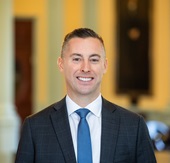
Sen. Brendan Crighton
Sponsored bills
By Mr. Crighton, a petition (accompanied by bill, Senate, No. 961) of Brendan P. Crighton and John F. Keenan for legislation to provide upstream homelessness prevention assistance to families, youth, and adults. Housing.
Maddy summarySD 114 requires the Executive Office of Housing and Livable Communities to create a mandatory training program for elected or appointed municipal board members who handle land-use decisions. The training covers fair housing law, zoning authority, and municipal land-use laws, developed with input from planning and housing organizations. Members must complete the training within six months of starting their term or every four years thereafter, with membership terminating if they fail to comply. Municipalities may hold annual or biannual trainings to meet this requirement. This bill directly affects local planning boards, zoning commissions, and similar bodies across Massachusetts.
Maddy summaryThis bill creates the Home Works Program to provide funding for out-of-school time and summer programs for children aged 5-14 living in households receiving Emergency Assistance (a state aid program for low-income families). The program allocates "slots" covering program costs (at least 75% of local market value) and transportation, distributed based on areas with the highest number of Emergency Assistance children and program capacity. Eligible programs must meet transportation requirements or partner with Emergency Assistance residences for on-site services, and all staff must pass background checks including National Sexual Offender Registry checks. Funding is new and separate from existing Emergency Assistance resources.
Maddy summarySD 1771 establishes a statewide Access to Counsel Program in Massachusetts to provide free legal representation to low-income tenants and owner-occupants facing housing-related legal actions, such as evictions or termination of housing subsidies. Eligible individuals must qualify as indigent (e.g., receiving public assistance, earning ≤80% of area median income, or unable to afford legal fees without hardship). The program, funded by dedicated state appropriations and administered by the Massachusetts Legal Assistance Corporation, requires landlords to provide a standardized form explaining legal aid eligibility to tenants. Designated nonprofit organizations will deliver full legal counsel through partner attorneys, with oversight from an advisory committee and a phased 5-year implementation.
Maddy summaryThis bill establishes a clean fuel standard requiring transportation fuel providers to reduce the carbon intensity of their fuels by 80% from 1990 levels by 2050. It creates a credit-trading system where providers using low-carbon fuels (like electricity or sustainable aviation fuel) earn credits, while those exceeding the annual carbon intensity standard must purchase credits or face deficits. The Department of Energy Resources will set yearly standards based on full lifecycle emissions, with exceptions for aviation, rail, military, and small-volume fuel providers (though aviation can opt in). Crucially, public entities like utilities generating credits must invest a portion of their credit value into clean energy and accessible transportation projects in disadvantaged communities.
Maddy summarySD 1540 requires Massachusetts local governments to create streamlined permitting processes for electric vehicle (EV) charging stations, with permit approvals required within 30 days. The bill mandates that all EV charging stations be classified as permitted uses in every zoning district and changes parking minimum rules to count EV spaces as standard parking spaces (with van-accessible spaces counting as two). Local governments must limit permit reviews to health/safety compliance, not discretionary approvals. The state energy and transportation departments will create and update a model ordinance for local adoption within six months. This bill directly affects municipalities, developers, and EV station installers by standardizing and accelerating EV infrastructure deployment.
By Mr. Crighton, a petition (accompanied by bill, Senate, No. 319) of Brendan P. Crighton for legislation to access after school and out-of-school time programs. Education.
By Mr. Crighton, a petition (accompanied by bill, Senate, No. 1810) of Brendan P. Crighton for legislation relative to ordinary disability retirements. Public Service.
By Mr. Crighton, a petition (accompanied by bill, Senate, No. 1813) of Brendan P. Crighton for legislation relative to underperforming pension systems. Public Service.