

Maddy summaryThis bill expands Massachusetts' existing bottle deposit law to include a wider range of drinkable liquids, such as water and sports drinks, while explicitly excluding items like milk, infant formula, and small-scale juice producers. Under the new rules, the refundable deposit on beverage containers would increase from five cents to ten cents, applying to most prepackaged containers up to 2.5 liters for non-carbonated drinks and 3 liters for carbonated ones. The legislation also adjusts the size requirement for businesses to qualify for exemptions from refunding requirements, raising the threshold from 1,000 to 2,000 square feet. Additionally, it clarifies that redemption centers and reverse vending machines must pay the refund immediately unless a customer opts into an account system.
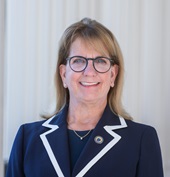
Sen. Joan Lovely
Sponsored bills
Maddy summaryThis bill requires applicants seeking permits from the Massachusetts Department of Public Utilities to notify nearby communities about their projects. Specifically, applicants must email local government officials within 30 days of filing, while the department must send written notices to officials within 60 days, including details on public hearings. The law also mandates that applicants appear at public hearings if requested by local governments, and failure to do so could result in granting intervenor status to previously excluded entities. These changes directly affect utility project developers and the local towns and cities where projects are proposed.
Maddy summaryThis bill amends Massachusetts education laws to update high school graduation requirements and improve support for struggling schools. It establishes a new competency determination based on mastery of core skills in math, science, technology, and English, allowing districts to include history, social science, and foreign languages. Students who do not meet these standards would receive an educational assistance plan to help them achieve mastery, while parents would have the chance to review these plans. Additionally, the bill changes how schools identified for comprehensive support are selected, requiring that student growth be weighted as heavily as student achievement in the evaluation formula.
By Representative Philips of Sharon, a petition (accompanied by bill, House, No. 2250) of Edward R. Philips and others for legislation to improve outcomes for sudden cardiac arrest by providing additional safeguards and resources. Public Health.
Maddy summaryThis bill requires every high school in Massachusetts that offers interscholastic sports to employ a licensed athletic trainer. It also mandates that any athletic trainer or coach providing head injury safety training must complete annual certification. Additionally, the law updates terminology to explicitly include athletic trainers alongside coaches in relevant sections of existing statutes. These changes aim to improve student safety by ensuring professional medical oversight during school sports activities.
By Representative Balser of Newton, a petition (accompanied by bill, House, No. 2290) of Ruth B. Balser relative to clarifying the standards for requiring the installation of automatic sprinkler systems in rehabilitated buildings. Public Safety and Homeland Security.
By Representatives Balser of Newton and Donato of Medford, a petition (accompanied by bill, House, No. 2289) of Ruth B. Balser, Paul J. Donato and others relative to the installation of automatic sprinkler systems in certain new family dwellings. Public Safety and Homeland Security.
Maddy summaryThis bill requires state and municipal agencies to specify that iron, steel, and manufactured goods used in public construction projects must be made in the United States. While the law generally mandates domestic materials, it allows agencies to request waivers if using American products would harm the public interest, result in insufficient supply or quality, or increase project costs by more than 25 percent. Agencies must provide public notice and justification for any such waivers, and the law imposes penalties, including contract ineligibility, on individuals who falsely label non-domestic goods as American. Additionally, the bill sets a $500,000 threshold for contracts requiring this domestic preference and ensures the rules remain valid even if specific parts are later found unconstitutional.
By Representative Walsh of Peabody and Senator Lovely, a joint petition (accompanied by bill, House, No. 3472) of Thomas P. Walsh, Joan B. Lovely and Sally P. Kerans relative to loading and alighting vehicles from car carriers on public ways. Transportation.
Maddy summaryThis bill proposes changes to how cider is taxed, directly affecting cider producers and consumers. The legislation would adjust the revenue collection process related to cider sales, though the specific tax rates or exemptions are not detailed in the available summary. The measure has been referred to the Revenue committee for review and a hearing was scheduled to discuss its details.