

Maddy summaryThis bill establishes the Massachusetts Education-to-Career Data Center within the Executive Office of Technology Services and Security to create a unified system for education and workforce data. The center will be led by an executive director and tasked with collecting, maintaining, and auditing data from various public agencies while strictly adhering to federal and state privacy laws. Key provisions include developing secure methods to anonymize personal information, building tools for public data access, and facilitating research through a secure data enclave that allows analysis without transferring raw records. Ultimately, the legislation aims to provide reliable information on educational and workforce outcomes to help families, educators, and policymakers make informed decisions.
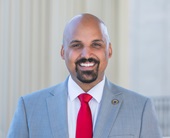
Sen. Pavel Payano
Sponsored bills
By Mr. Payano, a petition (accompanied by bill, Senate, No. 1819) (subject to Joint Rule 12) of Pavel M. Payano for legislation to advance fairness, integrity, and excellence in higher education admissions. Higher Education.
April 1, 2024 -- The committee on Higher Education to whom was referred the petition (accompanied by bill, Senate, No. 160) of Sal N. DiDomenico, Manny Cruz, Susannah M. Whipps, Jack Patrick Lewis and other members of the General Court for legislation relative to Social Work Uplifting Practices and Exam Removal (“The SUPER Act”), report the accompanying bill (Senate, No. 2673).
April 1, 2024 -- The committee on Education, to whom was referred the petitions (accompanied by bill, Senate, No. 239) of Michael D. Brady, James K. Hawkins, Patrick M. O'Connor and Patricia D. Jehlen for legislation to establish a special commission on creating a more diversified teaching workforce in the Commonwealth; (accompanied by bill, Senate, No. 252) of Brendan P. Crighton for legislation to promote racially integrated schools; (accompanied by bill, Senate, No. 254) of Brendan P. Crighton for legislation to promote racially and culturally inclusive K-12 curriculum; (accompanied by bill, Senate, No. 259) of Julian Cyr, Jack Patrick Lewis, Vanna Howard and Rebecca L. Rausch for legislation relative to LGBTQ+ inclusive curriculum; (accompanied by bill, Senate, No. 286) of Adam Gomez and Vanna Howard for legislation to ensure diversity in public education; (accompanied by bill, Senate, No. 288) of Adam Gomez, Tram T. Nguyen, Steven Ultrino, Jack Patrick Lewis and others for legislation to promote racially inclusive curriculum in schools; (accompanied by bill, Senate, No. 299) of Robyn K. Kennedy, Steven Owens and Rebecca L. Rausch for legislation to address racial and cultural bias training in educator professional development; (accompanied by bill, Senate, No. 311) of Jason M. Lewis, Manny Cruz, Joanne M. Comerford, Jack Patrick Lewis and other members of the General Court for legislation relative to educator diversity; (accompanied by bill, Senate, No. 318) of Liz Miranda, Joanne M. Comerford, Lydia Edwards, Jack Patrick Lewis and other members of the General Court for legislation to establish a permanent commission on American Indian and Alaska Native education; (accompanied by bill, Senate, No. 340) of Pavel M. Payano for legislation to enable all students to thrive: protecting a high quality, diverse educator workforce; and (accompanied by bill, Senate, No. 344) of Rebecca L. Rausch, Jack Patrick Lewis, Joanne M. Comerford, Vanna Howard and other members of the General Court for legislation relative to celebrate and teach Native American culture and history, report the accompanying bill (Senate, No. 2709).
Maddy summaryThis bill modifies Massachusetts environmental laws to streamline the approval process for publicly beneficial climate resiliency projects, such as those designed to prevent flooding or storm damage. It establishes a mechanism for conservation commissions, town selectmen, and mayors to designate these projects, which would then qualify for a general license from the state department, bypassing the need for individual case-by-case reviews. Additionally, the legislation clarifies that these specific projects do not require the same resource loss mitigation rules applied to other developments, provided they are officially designated as beneficial for climate protection. By updating language in existing statutes, the bill aims to reduce bureaucratic hurdles and accelerate the implementation of infrastructure intended to help communities adapt to climate change.
Maddy summaryThis bill establishes a temporary halt on approving new or expanded gas infrastructure projects across Massachusetts until at least 2026. The measure specifically targets facilities that process, store, transmit, or distribute combustible fuels like natural gas, renewable natural gas, and hydrogen. Under the new rules, regulators cannot grant permits for these projects unless they are strictly necessary for public safety. Additionally, the legislation prevents towns without existing gas service from digging up streets to build new fuel systems.
Maddy summaryThis bill authorizes Massachusetts municipalities to create electricity load aggregation programs, allowing towns and cities to group their residents together to purchase power directly from suppliers. Under the new rules, these programs operate on an opt-out basis, meaning all customers in the area are included unless they choose to leave, and they can negotiate for lower rates or renewable energy options that individuals might not access alone. The legislation requires local governments to develop detailed plans for these programs and obtain approval through a majority vote at town or city meetings before implementation. Importantly, the law clarifies that these municipal groups are not considered utilities and are exempt from certain wholesale regulations, while also ensuring that existing municipal lighting plants are not required to participate in such aggregations.
By Representative Scanlon of North Attleborough and Senator Payano, a joint petition (accompanied by bill, House, No. 3533) of Adam Scanlon, Pavel M. Payano and others relative to courtesy retail parking spaces designed for non-handicapped veterans. Veterans and Federal Affairs.
Maddy summaryThis bill creates a PFAS Remediation Trust Fund to help Massachusetts residents and local governments address contamination from per- and polyfluoroalkyl substances in drinking water, groundwater, and soil. The fund is designed to cover remediation costs for municipalities, private well owners, and public water systems without requiring additional annual appropriations from the state budget. Money for the fund will come from settlements related to claims against manufacturers of PFAS-containing aqueous film-forming foam, and any unused funds at the end of a fiscal year will roll over to the next year. The executive office of energy and environmental affairs is responsible for administering the fund and ensuring expenditures align with existing legal settlements.
Maddy summaryThis bill increases the Massachusetts conservation land tax credit, which allows landowners and conservation groups to reduce their property taxes when they donate land for public use. The legislation expands eligibility to include private nonprofit trusts organized specifically for land conservation that hold 501(c)(3) tax-exempt status. It also raises the maximum credit amount from $2 million to $5 million, with the increase happening in steps over three years. The changes apply to donations made starting in 2024 and remain in effect until the end of 2033.