

Maddy summaryThis bill requires energy facility developers to create a detailed preliminary statement before applying for permits, specifically analyzing risks to public health, the environment, and climate within a five-mile radius of the proposed site. The proposal mandates that applicants identify nearby environmental justice populations, share the project details with local community groups and officials, and hold a review meeting to address concerns before submitting a formal petition. Additionally, the legislation establishes an independent energy facilities siting board to oversee the permitting process, ensuring that projects minimize negative impacts on communities and the environment while maintaining a reliable energy supply.
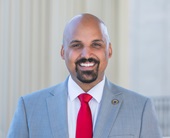
Sen. Pavel Payano
Sponsored bills
Maddy summaryThis bill aims to promote solar energy projects on developed sites like parking lots, brownfields, and landfills instead of open natural areas. It achieves this by allowing larger solar systems on built land to qualify for specific net metering benefits and by directing the state to offer financial incentives for such projects. The legislation also requires the state to investigate how existing federal and state funds can support these developments and to create new incentives for repairing roofs damaged during solar installation, with a deadline for implementation or explanation by December 2024.
By Mr. Tarr, a petition (accompanied by bill, Senate, No. 2558) (subject to Joint Rule 12) of Bruce E. Tarr, Barry R. Finegold and Pavel M. Payano for legislation relative to renewable energy production technologies. Telecommunications, Utilities and Energy.
Senate, March 14, 2024 --The committee on Financial Services, to whom was referred the petitions (accompanied by bill, Senate, No. 678) of Liz Miranda and Lydia Edwards for legislation to improve sickle cell care, report the accompanying bill (Senate, No. 2640).
Maddy summaryThis bill creates an independent Correctional Oversight Office to help implement recommendations from the Special Legislative Commission on Structural Racism in Massachusetts correctional facilities. The new office will focus on addressing four specific forms of racism identified in the legislation: institutional policies, systemic interactions between agencies, interpersonal treatment, and internalized biases affecting Black, Indigenous, and People of Color. By establishing this office, the state aims to improve transparency and equity in areas such as healthcare access, job training, and data tracking for both incarcerated individuals and correctional staff. The law also defines key terms like "correctional facility" and "correctional community members" to ensure clear application of these oversight measures.
Maddy summaryThis bill allows individuals who are not U.S. citizens to apply for professional licenses in Massachusetts without providing a Social Security number. It achieves this by permitting applicants to submit an Individual Taxpayer Identification Number or other identity verification documents instead. The law specifically applies to licensing boards overseen by the Division of Occupational Licensure and the Department of Public Health. This change aims to remove a barrier for non-citizens seeking to work in regulated professions while maintaining identity verification standards.
Maddy summaryThis bill amends Massachusetts election laws to allow candidates to use campaign funds for child-care services required because of their political activities. It defines these services broadly to include care from individuals, non-profits, and for-profit organizations, while restricting payments to family members unless they operate a professional daycare or babysitting service. The legislation also permits candidates to claim expenses for child-care that would not otherwise exist but for their campaign. Finally, it requires the director of campaign and political finance to create specific regulations outlining these rules by December 31, 2023.
Maddy summaryThis bill allows eligible Massachusetts residents to register and vote immediately at their local polling place or early voting site by presenting proof of residence and signing an affidavit, rather than waiting for their name to appear on the official voter roll. To qualify, individuals must show a valid photo ID or other documents like utility bills or lease agreements that confirm their name and address, and they must swear they are not already registered elsewhere. If a person cannot provide proof of residence at the time of registration, the bill permits them to cast a provisional ballot and submit the required documentation within two business days after a primary or six days after a general election. The legislation also requires election officials to add these new registrants to the official voter list as soon as practicable and restricts voters who register under this method from changing their party affiliation at that specific primary.
By Mr. Oliveira, a petition (accompanied by bill) (subject to Joint Rule 12) of Jacob R. Oliveira for legislation to protect survivors of spousal abuse from alimony liability. The Judiciary.
Maddy summaryThis bill updates Massachusetts election laws to improve voter registration accuracy and ensure polling places are accessible for people with disabilities. It requires registrars to automatically move voters who change addresses to an inactive list unless they respond to a mailed notice, while also protecting individuals in domestic violence situations from having their information publicly disclosed. Additionally, the bill mandates that state officials inspect polling sites every four years to verify compliance with accessibility requirements and provides a mechanism for the state secretary to enforce these standards. These changes aim to streamline the voter roll maintenance process and guarantee that all voters can access their polling locations without barriers.