

Maddy summaryThis bill aims to improve the sustainability of birth centers and the midwifery workforce by ensuring that midwives receive payment rates equal to those of physicians for the same services. It directly affects certified nurse-midwives and licensed certified professional midwives who provide care to employees of the Commonwealth and individuals covered by various health insurance plans. The key mechanism requires insurance companies, Medicaid managed care organizations, and other health plans to pay midwifery services at rates no lower than what would be paid if a doctor performed them, regardless of where the care is given. Additionally, the legislation mandates that these payment standards apply to both prenatal, childbirth, and postpartum care provided by midwives. By establishing these parity rules across different types of insurance and service agreements, the bill seeks to support the financial viability of midwifery practices.
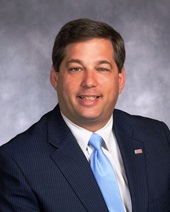
Sen. Bruce Tarr
Sponsored bills
By Mr. Feeney, a petition (accompanied by bill, Senate, No. 1856) of Paul R. Feeney, Joanne M. Comerford and Marcus S. Vaughn for legislation relative to Massachusetts certified emergency telecommunicators. Public Service.
Maddy summaryThis bill (SD 1673) is a constitutional amendment proposal introduced by Senator Comerford regarding agricultural and horticultural land classification. It seeks to amend the state constitution to address how these lands are defined or treated, with an associated revenue component. The abstract does not specify the exact policy changes, such as new protections, tax treatments, or land use restrictions. As a constitutional amendment proposal, it does not directly affect specific individuals or entities but would change foundational legal standards for land classification. The summary reflects only the procedural nature of the bill as described in the official abstract.
Maddy summaryThis bill proposes a constitutional amendment requiring a supermajority vote (such as two-thirds) in the state legislature to access rainy day funds, rather than a simple majority. It directly affects the legislative process for using these designated emergency savings reserves. The key mechanism would change the voting threshold needed for lawmakers to authorize withdrawals from the rainy day fund, making it harder to spend these funds without broader consensus. This is a procedural change to the state constitution, not a direct policy affecting citizens or programs.
Maddy summaryThis bill proposes a constitutional amendment to establish a maximum limit on the state income tax rate. If adopted, it would prevent the state legislature from raising the income tax rate above a set cap without requiring another constitutional amendment. The measure would directly affect all individuals and businesses subject to the state income tax. The amendment must first pass the legislature and then be approved by voters to become part of the state constitution.
By Ms. Lovely, a petition (accompanied by bill, Senate, No. 784) of Joan B. Lovely, Susannah M. Whipps, Bruce E. Tarr, Hannah Kane and others for legislation to promote and enhance the sustainability of birth centers and the midwifery workforce. Financial Services.
By Representatives Scanlon of North Attleborough and Kushmerek of Fitchburg, a petition (accompanied by bill, House, No. 691) of Adam J. Scanlon, Michael P. Kushmerek and others relative to the special education reimbursement program and for an investigation by a special commission (including members of the General Court) relative to the long-term fiscal health and sustainability of special education funding. Education.
Maddy summaryThis bill (HD 552) amends Massachusetts law to support municipal light plants during emergencies. It allows these plants to sell, rent, or lease equipment (like generators or tools) used for emergency mutual aid with other communities. It also ensures employees providing such emergency aid are covered under workers' compensation (Chapter 32), including the same rights as if performing regular duties. The changes directly affect municipal light plants and their workers during coordinated emergency responses.
Maddy summaryHD 1292 amends Massachusetts law to allow municipal light plants (local government-run electricity utilities) to provide services to other public utilities. Specifically, it authorizes municipal light boards to assist state, tribal, or other publicly-owned utilities with constructing, maintaining, and repairing infrastructure like poles, wires, streetlights, and traffic signals, both within and outside the Commonwealth. The bill also permits these municipalities to sell, rent, or lease related equipment and ensures employees working on such projects receive the same labor protections as regular municipal workers under Chapter 32. This expands collaboration between local and broader public utility entities while clarifying service boundaries.
Maddy summaryThis bill creates a $300 million Zero Carbon Renovation Fund to support energy upgrades in existing buildings across Massachusetts. It directly affects affordable housing, low/moderate income homes, public schools, municipal buildings, and certified small businesses by funding renovations that must include all-electric systems, on-site renewable energy, and low-carbon materials. The fund covers costs for energy efficiency improvements and necessary pre-renovation repairs like lead paint removal or electrical upgrades. Administered by multiple state agencies, the fund prioritizes environmental justice communities and gateway cities while ensuring unspent funds carry over annually.