

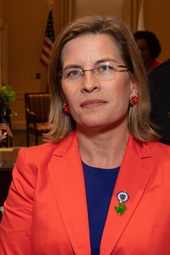
Photo of Marjorie Decker
D Massachusetts House · District 25th Middlesex On the 2026 ballot

Rep. Marjorie Decker

Compare
Total votes
1,241
all sessions
Attendance
97%
38 missed
Lower than 97% of chamber peers
With party
99%
of cast votes
Near the chamber average
Bipartisan score
0%
crosses aisle rarely
Near the chamber average
Sponsored
2,151
bills & resolutions
Higher than 96% of chamber peers
Committees
1
assignment
2,151 bills and resolutions

Sponsored bills

Total
2,151
Primary
335
Co-sponsor
1,816
This page
2,151
matching current filters
Co-sponsor H 2227
Passed · Massachusetts House · Co-sponsor
An Act replacing archaic and stigmatizing language for substance use

Maddy summaryThis bill replaces stigmatizing terms like "substance abuse" and "alcohol abuse" with clinical terms like "substance use disorder" across 20+ Massachusetts statutes. It directly affects state laws, healthcare records, treatment programs, and law enforcement protocols by updating terminology in statutes related to treatment, prevention, and law enforcement training. Key provisions include changing phrases such as "substance abuse treatment" to "substance use disorder treatment" in healthcare, legal, and public health contexts. The bill makes no new policy or funding changes - only revises language to align with modern medical terminology used by healthcare providers.

Passed Mar 12, 2026 1 co-sponsor
Co-sponsor H 1003
Passed · Massachusetts House · Co-sponsor
An Act relative to maintaining adequate water supplies through effective drought management

Maddy summaryHD 1423 creates a statewide drought management task force within the Massachusetts Office of Environmental Affairs. The task force, co-chaired by the Secretary and the Emergency Management Director, includes agency heads and water sector representatives, and must develop and update a statewide drought management plan every 5-10 years. It authorizes the Secretary to implement water conservation measures (like limiting nonessential outdoor use) during droughts, applying to all water users in designated drought regions. Cities and towns must enforce these Secretary-ordered restrictions, overriding local rules that conflict with drought management. The bill directly affects all Massachusetts water users during drought conditions.

Passed Mar 12, 2026 1 co-sponsor
Co-sponsor H 965
Passed · Massachusetts House · Co-sponsor
An Act restricting the use of rodenticides in the environment

Maddy summaryThis bill restricts the use of certain rodent poisons (like Warfarin and Brodifacoum) to only short-term public health emergencies. It requires licensed pest control professionals to first use non-chemical methods, limits emergency use to 14 days, and mandates detailed reporting on locations, amounts used, and follow-up rodent control plans. The law directly affects pest control applicators and public health agencies managing rodent-related health risks. It also requires annual public reporting of all emergency rodenticide use by the state department. The restrictions take effect January 1, 2027.

Passed Mar 12, 2026 1 co-sponsor
Co-sponsor H 1564
Passed · Massachusetts House · Co-sponsor
An Act relative to preventing algorithmic rent fixing in the rental housing market

Maddy summaryHD 2226 prohibits real estate landlords and their agents from using third-party services that algorithmically set rents or coordinate rent increases among landlords. It bans service providers from collecting rental data, analyzing it with algorithms, or recommending pricing terms to landlords, and prevents them from facilitating non-competition agreements between landlords. Violations are treated as unfair competition under existing antitrust laws, allowing tenants to pursue class-action lawsuits in court instead of being forced into arbitration. Successful plaintiffs can recover damages, interest, and legal costs, with the law explicitly invalidating pre-dispute arbitration agreements for these cases.

Passed Mar 12, 2026 1 co-sponsor
Co-sponsor H 952
Passed · Massachusetts House · Co-sponsor
An Act relative to watershed forest protection

Maddy summaryThis bill designates all Commonwealth watershed lands as either "Parks" (for recreation with strict resource protection) or "Reserves" (for minimal human interference to protect ecosystems). It establishes a Reserves Scientific Advisory Council of eight scientific experts to oversee Reserve management and provide biennial reports to the governor. The bill requires the commissioner to develop public-input watershed management plans every five years, focusing on forest protection, climate resilience, carbon storage, and water quality. These plans must align with the new land classifications and prohibit selling or removing natural resources except for specific management needs like erosion control or public safety. The bill directly affects how Massachusetts manages its watershed systems, including the Quabbin Reservoir area.

Passed Mar 12, 2026 1 co-sponsor
Co-sponsor H 1264
Passed · Massachusetts House · Co-sponsor
An Act promoting responsible investment

Maddy summaryHD 3001 requires the state's pension fund (managing retirement savings for public employees) to identify and sell all investments in companies that manufacture, sell, or support weapons of mass destruction (WMDs) within 12 months of the law's effective date. The bill defines WMDs broadly to include nuclear, chemical, biological weapons, and related technologies under federal law. State agencies must also stop contracting with WMD-related companies and publicly report such contracts. The law exempts the pension fund from conflicting investment rules and provides legal protection for officials implementing the divestment.

Passed Mar 12, 2026 1 co-sponsor
Co-sponsor H 953
Passed · Massachusetts House · Co-sponsor
An Act relative to forest protection

Maddy summaryThis bill creates a new "Reserves Scientific Advisory Council" to guide Massachusetts' forest reserve system. The eight-member council, including experts from environmental organizations and universities, will oversee reserve management, recommend new acquisitions, and ensure minimal human intervention in reserves. It requires public hearings for major changes and mandates that management plans for all reserves include public input and protect natural resources. The bill directly affects how state forests and protected lands are managed across Massachusetts, particularly within the urban parks district areas defined in the law.

Passed Mar 12, 2026 1 co-sponsor
Co-sponsor H 1048
Passed · Massachusetts House · Co-sponsor
An Act relative to increased protection of wildlife management areas

Maddy summaryThis bill requires Massachusetts to designate at least 30% of its Wildlife Management Area lands as "Reserves" by January 1, 2030, maintaining this percentage as new lands are acquired. Reserves must be selected based on ecological criteria like old-growth forests, contiguous habitats, wetlands, and carbon storage capacity, and will be managed to preserve natural conditions with minimal human intervention. A new Scientific Advisory Council of eight environmental experts will oversee Reserve designations, submit biennial reports to the governor, and advise on management, while prohibiting new commercial infrastructure like solar farms, pipelines, or cell towers in Reserves (except for limited public facility upgrades with minimal environmental impact). The bill defines Reserves as protected areas for scientific research, habitat conservation, and carbon storage, banning resource extraction except for specific management needs like erosion control or invasive species removal.

Passed Mar 12, 2026 1 co-sponsor
Co-sponsor H 3380
Passed · Massachusetts House · Co-sponsor
An Act to strengthen the taxpayer protection act

Maddy summaryHD 3259 amends Massachusetts' Taxpayer Protection Act to clarify and strengthen oversight of government contracts with private companies. It defines "privatization contract" as agreements for services valued at $500,000 or more (adjusted annually for inflation), excluding certain IT contracts with union agreements and professional service agreements. The bill requires agencies to cover increased costs for residents if privatized services become more expensive, bans revenue-based payments (like tuition sharing), and mandates state auditor reviews before renewing such contracts. This directly affects Massachusetts government agencies, school districts, transportation authorities, and private contractors providing services valued above the threshold.

Passed Mar 9, 2026 1 co-sponsor
Primary H 3314
Passed · Massachusetts House · Lead sponsor
An Act relative to financial transparency

Maddy summaryThis bill modifies financial disclosure rules for public officials in Massachusetts. It changes how monetary amounts are reported (rounding to the nearest $10,000 or $1,000 for smaller amounts), updates public access to financial reports (requiring free online downloads or in-person viewing during office hours at cost-recovery fees), and adds a provision exempting filers' home addresses from public disclosure. It also revises the threshold for reporting investments to use "aggregate fair market value" above $1,000. These changes directly affect individuals required to file financial interest statements with the state commission.

Passed Mar 9, 2026 0 co-sponsors
Showing 201 to 210 of 2,151 bills
Previous 1 … 20 21 22 … 216 Next