

Maddy summaryHD 1314 creates a special commission to study Massachusetts' gasoline sales-below-cost (SBC) laws, which currently prevent gas stations from selling fuel below cost. The commission will analyze how these laws affect gasoline prices, wholesale costs, and competition using data and comparisons with states without SBC laws. It will examine potential consumer savings and recommend whether to keep, modify, or eliminate the current SBC laws. The study, focused solely on gathering data and making recommendations, does not change existing law and will report findings to legislative committees within one year. This bill directly affects gas station operators and consumers by evaluating a policy that influences fuel pricing.
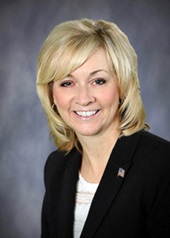
Rep. Kim Ferguson
Sponsored bills
By Representative Pease of Westfield, a petition (subject to Joint Rule 12) of Kelly W. Pease and Lindsay N. Sabadosa for legislation to establish buffer zones for battery storage facilities. Telecommunications, Utilities and Energy.
Maddy summaryHD 2264 changes Massachusetts' process for selecting presidential electors. It requires one elector to be chosen from each congressional district and two electors to be chosen statewide ("at-large"). The bill also specifies that district electors must vote for the presidential ticket that won their specific district, while at-large electors must vote for the ticket that won statewide. These changes affect how Massachusetts's 11 presidential electors are selected and cast their votes in the Electoral College.
Maddy summaryHD 3512 modifies Massachusetts property tax rules for manufacturing corporations. It phases out the tax on manufacturing corporations' tangible property (like raw materials) over time, reducing the rate from $2.00 per $1,000 in 2026 to $0.00 by 2030. Non-manufacturing corporations remain subject to a flat $2.60 per $1,000 rate. The bill directly affects manufacturing businesses operating in Massachusetts, altering how they calculate state property tax liability. The change applies to property held as raw materials for manufacturing within the state.
Maddy summaryHD 2265, titled "An Act relative to pay-to-play schemes," prohibits investment advisers from providing services to state or local government entities within two years of making campaign contributions to officials who influence those contracts. It also bans advisers from soliciting contributions to secure contracts and bars officials from accepting contributions before awarding contracts to the same adviser. Small contributions (up to $350 per official for whom the contributor could vote) are exempt, and violations carry fines up to $1,000 or six months in jail. The bill directly affects investment advisers, government officials, and the process for awarding government investment advisory contracts.
Maddy summaryThis bill establishes new contribution limits for campaign financing in Massachusetts. It caps individual contributions to a single candidate or their committee at $1,000 per election, to political party committees at $10,000 per election, and to other political committees at $1,000 per election - with no limit for ballot question committees. Government agents (e.g., legislators or executive employees) face lower limits of $200 per election for contributions to candidates or political committees. The limits will automatically adjust for inflation every two years starting in 2026, using the Boston area consumer price index, rounded to the nearest $50.
Maddy summaryHD 1915, "An Act relative to the occupational therapist interstate licensure compact," creates a system allowing occupational therapists licensed in one participating state (the "Home State") to practice in other participating states ("Remote States") without obtaining a separate license. It establishes a "Compact Privilege" for licensed therapists, requiring participating states to share disciplinary information, conduct background checks, and maintain a central data system. This directly affects occupational therapists and assistants seeking to practice across state lines, particularly those with military service or who relocate. The bill standardizes requirements like background checks and continuing education while enabling reciprocal practice rights under the compact.
Maddy summaryThis bill (HD 4125) creates a standardized sick leave bank system for state employees in Massachusetts. It requires state agencies to establish rules allowing employees to donate unused sick leave, which can then be accessed by colleagues facing non-work-related illness. Key rules include verifying no prior sick leave abuse, requiring proof of the employee’s own illness (not family), and mandating employees use all other accrued leave first. Unused leave in the bank reverts to the donor by December 31, with a maximum cap of 25 days per employee, without overriding existing union agreements.
Maddy summaryThis bill requires the Group Insurance Commission to transfer eligible retirees (age 65+ without free Medicare Part A coverage) to Medicare Part A and Part B by July 1, 2026. The Commission must pay all Medicare Part A premiums and any federal penalties resulting from the transfer. Retirees must provide required information and enroll in a Commission-offered Medicare supplement plan that provides coverage of comparable value to their current benefits. This directly affects retirees, their spouses, and dependents currently covered under specific sections of the state's retirement insurance program.
Maddy summaryThis bill creates a commission to study whether Massachusetts should join the counseling compact, an interstate agreement that would allow licensed mental health counselors to practice across state lines more easily. The commission includes legislative leaders, mental health agency representatives, and members from professional associations like the Massachusetts Mental Health Counselors Association. It must study feasibility, make recommendations, and submit a report to the legislature within six months of the bill's passage. The bill itself does not change current licensure rules but sets up a process to evaluate potential future policy changes affecting mental health counselors and their clients.