

By Representative Jones of North Reading, a petition (accompanied by bill, House, No. 489) of Bradley H. Jones, Jr., and others for legislation to establish a student entrepreneurial and economic investment fund. Economic Development and Emerging Technologies.
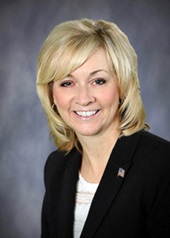
Rep. Kim Ferguson
Sponsored bills
By Representative Jones of North Reading, a petition (accompanied by bill, House, No. 847) of Bradley H. Jones, Jr., and others relative to voter information provided by the State Secretary. Election Laws.
Maddy summaryThis bill creates a refundable tax credit for adoptive parents in Massachusetts. It provides $2,500 per adopted child from foster care and $2,000 per adopted child from private or public adoption agencies, refundable against state income taxes. The credit covers expenses like agency fees, attorney fees, court costs, and medical copayments directly related to adopting a minor child. It directly affects adoptive parents who pay these costs through licensed agencies or foster care systems. The change modifies existing tax law to expand and clarify eligible adoption-related expenses.
Maddy summaryHD 2267 defines "rolling stock" in Massachusetts law as trucks, tractors, and trailers used by common carriers for interstate goods transport. The bill amends sections of the General Laws to insert this definition and add new provisions about the sales, storage, and use of such equipment. This is a technical definitional change affecting how existing tax and regulatory laws apply to commercial vehicles in interstate commerce. It does not create new taxes or regulations but clarifies terminology for current legal frameworks. The bill directly affects common carriers transporting goods across state lines using these vehicles.
Maddy summaryHD 2235 creates a commission to study ways to increase voluntary organ donation in Massachusetts, directly affecting the state's organ donation system and potential future policy. The commission, composed of legislative leaders, health officials, and department representatives, will examine incentives - including monetary programs used in other states - to boost donation rates. It must assess existing state and out-of-state incentive models and submit recommendations with draft legislation within 12 months. The bill does not implement new policies but sets up a formal process for evaluating potential changes to organ donation programs.
Maddy summaryHD 3737 establishes a commission to study direct primary care services in Massachusetts, where patients pay doctors directly for care without insurance involvement. The commission will examine benefits like lower costs, cost transparency, better access to care, and improved health outcomes, then develop strategies to promote these services. Composed of state health officials, legislative leaders, healthcare industry representatives, and patient advocates, the commission must hold at least three public hearings and submit a report with recommendations within 12 months. This bill does not change current law but creates a study to inform future policy decisions about expanding direct primary care. The commission's work aims to ease pressure on the healthcare system and improve patient access.
Maddy summaryThis bill requires general acute care hospitals in Massachusetts to include fentanyl testing in standard urine drug screenings when treating patients for diagnosis. It directly affects hospitals that conduct such screenings, mandating they test for fentanyl alongside other drugs like opioids and cocaine. The key provision specifies that "urine drug screening" must now include fentanyl, with the Department of Public Health authorized to create necessary regulations for implementation. This policy change aims to improve detection of fentanyl exposure in medical settings without altering existing screening protocols for other substances.
Maddy summaryThis bill establishes a state-wide program to collect and redistribute unused, unopened, tamper-evident medicines from authorized donors (like pharmacies, hospitals, and manufacturers) to eligible patients who are indigent, uninsured, underinsured, or enrolled in public health programs. Donated medicines must be in unopened packaging (with limited exceptions for certain orally administered cancer medicines), not controlled substances, and meet safety standards like proper storage and labeling. Recipients must verify donor eligibility and maintain minimal records but can store donated medicine separately, repackage it as needed, and administer it to eligible patients with proper documentation. The program aims to reduce medicine waste while expanding access to affordable medications for vulnerable populations.
Maddy summaryThis bill gradually eliminates the inventory tax on business property in Massachusetts. It reduces the tax rate from $2.60 per $100 of inventory value to $0.50 over multiple steps, with final implementation by 2030. The key mechanism shifts the tax from a flat rate to a declining percentage of net income (starting at 9.5% for 2020-2021 and decreasing to 8.0% for 2022+). These changes directly affect businesses that pay the inventory tax, primarily commercial entities holding physical inventory. The phased approach spans from 2026 through 2030, with specific effective dates for each rate reduction step.
Maddy summaryHD 3755 allows licensed funeral establishments to own and operate crematories directly, removing previous restrictions. It clarifies that funeral directors licensed under Chapter 112 may serve on cemetery boards in their municipality if they reside there. The bill explicitly prohibits funeral establishments from owning cemeteries and cemetery owners from owning funeral establishments, creating a clear separation between these services. This directly affects funeral homes, cemetery operators, and funeral directors by changing ownership rules and operational permissions for cremation services. The law updates existing regulations to permit integrated cremation services within funeral establishments while preventing conflicts of interest between the two sectors.