

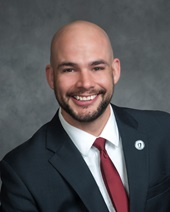
By Representative Jones of North Reading, a petition (accompanied by bill, House, No. 2851) of Bradley H. Jones, Jr., and others for legislation to establish a fund to be known as the fair share transparency and accountability fund to be used for education and transportation purposes. Revenue.
Rep. Joe McKenna
Sponsored bills
By Representative McKenna of Webster, a petition (accompanied by bill, House, No. 2887) of Joseph D. McKenna for legislation to allow taxpayers to have the option to indicate on their income tax return that they do not want any portion of their income tax liability to be utilized for abortion services. Revenue.
By Representative McKenna of Webster, a petition (accompanied by bill, House, No. 2888) of Joseph D. McKenna, Angelo L. D'Emilia and Michael J. Soter for legislation to ensure that state payments in lieu of taxes (PILOT) to cities and towns not be less than the previous fiscal year. Revenue.
Maddy summaryThis bill creates a new high school trade partnership program that allows public high schools to partner with private employers to provide vocational-technical education and apprenticeships. To encourage participation, the legislation offers tax credits to qualifying employers who spend money on this program, with a maximum credit of $100,000 per employer per year. The program must include both classroom and on-site training, and participating schools will form advisory committees to review applications from students and businesses. Additionally, the bill requires the state education department to set rules for employer criteria, student academic requirements, safety standards, and support for English language learners.
Maddy summaryThis bill proposes to prohibit the retail sale of dogs, cats, and rabbits in new pet shops in Massachusetts. It achieves this by amending state laws to ban licensed pet shops from selling or offering these specific animals for adoption. The legislation directly affects businesses that operate as new pet shops and would prevent them from acting as sources for these pets. By restricting sales in this manner, the bill aims to reduce the number of animals sold in commercial settings.
Senate, 13, 2024 -- The committee on Environment and Natural Resources, to whom was referred the petitions (accompanied by bill, Senate, No. 549) of Patrick M. O'Connor, Adam Scanlon, Jack Patrick Lewis, Michael O. Moore and other members of the General Court for legislation to ban the retail sale of dogs, cats, and rabbits in new pet shops; (accompanied by bill, Senate, No. 550) of Patrick M. O'Connor, Angelo J. Puppolo, Jr., Steven S. Howitt, John F. Keenan and other members of the General Court for legislation banning the retail sale of dogs, cats, and rabbits in pet shops; and (accompanied by bill, House, No. 826) of Natalie M. Higgins, Kimberly N. Ferguson and others for legislation to further regulate the retail sale of certain domestic animals in new pet shops, report the accompanying bill (Senate, No. 2820).
By Representative Jones of North Reading, a petition (accompanied by bill, House, No. 2842) of Bradley H. Jones, Jr., and others relative to the corporate minimum excise tax. Revenue.
Maddy summaryThis bill prohibits the Commonwealth of Massachusetts and its entities from requiring proof of COVID-19 vaccination as a condition for entry into the state, public buildings, schools, colleges, and private businesses. It also prevents private businesses from mandating vaccination for employment and bars public accommodations, such as resorts and amusement venues, from requiring vaccination for entry. By amending existing state laws, the legislation ensures that no government agency, educational institution, or private entity can enforce vaccination rules for access to these locations.
Maddy summaryThis bill requires the Massachusetts Department of Elementary and Secondary Education to create a digital system called an "electronic backpack" for every child in foster care. The system will store and share key educational records, such as transcripts, attendance logs, and individualized education plans, to help ensure stability as these students move between schools. Access to this information will be granted to teachers, authorized decision-makers, and medical providers who need it to support the child's well-being. The law mandates that the department and the Department of Children and Families work together to set up the system and establish rules for its use within one year of the bill's passage.
Maddy summaryThis bill allows the Office of the Child Advocate to directly represent children and the state in legal proceedings related to child welfare. It grants the office the authority to appear, intervene, or file lawsuits in state and federal courts, tribunals, and agencies without needing permission from other laws that might currently restrict this power. The change is designed to give the Child Advocate stronger tools to enforce its existing duties by ensuring it can actively participate in relevant legal cases.