

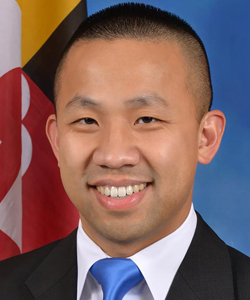
Photo of Clarence Lam
D Maryland Senate · District 12 On the 2026 ballot

Sen. Clarence Lam

Compare
Total votes
11,240
all sessions
Attendance
96%
399 missed
Near the chamber average
With party
99%
of cast votes
Near the chamber average
Bipartisan score
0%
crosses aisle rarely
Near the chamber average
Sponsored
857
bills & resolutions
Higher than 89% of chamber peers
Committees
4
assignments
857 bills and resolutions

Sponsored bills

Total
857
Primary
565
Co-sponsor
292
This page
857
matching current filters
Primary SB 1099
Signed into law · Maryland Senate · Lead sponsor
Emergency Services - Automated External Defibrillator and Naloxone Co-Location Initiative - Requirements for Public Buildings

Maddy summaryThis Maryland bill requires that naloxone, a medication used to reverse opioid overdoses, be placed in the same location as automated external defibrillators within all public buildings. The State Emergency Medical Services Board, working with the Department of Health, will manage this initiative using existing funds from the Opioid Restitution Fund. To encourage participation, the law grants legal protection from lawsuits to building owners and individuals who provide or administer this naloxone in good faith. These changes aim to increase the availability of life-saving equipment and medication in public spaces to address both cardiac arrest and drug overdoses.

Signed into law May 16, 2024 0 co-sponsors
Primary SB 59
Signed into law · Maryland Senate · Lead sponsor
Hospitals - Care of Infants After Discharge (Safe Sleep Act of 2024)

Maddy summarySB 59, known as the Safe Sleep Act of 2024, requires Maryland hospitals and birthing centers to educate parents on safe infant sleep practices before discharge and to obtain written confirmation that this education occurred. The law mandates that healthcare facilities provide both oral and written resources explaining how to create a safe sleep environment, which includes using a firm mattress, avoiding soft bedding, and keeping the baby in a smoke-free area. Additionally, the bill establishes the Maryland Safe Sleep Certification Program, which will require all child care centers to be certified to ensure they follow these safety guidelines. To support these efforts, the state health department must launch a public awareness campaign and create a list of local resources that help families purchase necessary items like safe sleep sacks.

Signed into law May 16, 2024 0 co-sponsors
Primary SB 473
Signed into law · Maryland Senate · Lead sponsor
Economic Development - Entrepreneurial Innovation Programs - Establishment (Pava LaPere Legacy of Innovation Act of 2024)

Maddy summaryThis bill establishes two new programs within the Maryland Technology Development Corporation to support technology-based start-up companies in the Baltimore area. The first program provides grants of up to $50,000 to startups founded by students or faculty at local universities, requiring that at least 20% of the funds be used to hire third-party consultants for planning and technical assistance. The second program, a pilot initiative, offers incentives to eligible universities to foster entrepreneurship, industry partnerships, and commercialization projects, particularly those involving artificial intelligence or machine learning in healthcare and biotechnology. Additionally, the legislation repeals a previous mandated appropriation for a telework assistance grant program and requires annual budget allocations for these new innovation initiatives.

Signed into law May 16, 2024 0 co-sponsors
Primary SB 718
Signed into law · Maryland Senate · Lead sponsor
Maryland Pathway to Nursing Pilot Program and Advisory Committee - Establishment

Maddy summaryThis bill establishes the Maryland Pathway to Nursing Pilot Program within the Department of Health Higher Education Commission to address nursing shortages and increase workforce diversity. The program aims to support Licensed Practical Nursing and Registered Nursing students by providing financial assistance for tuition, textbooks, computers, and essential wraparound services like transportation and childcare. To guide the initiative, the legislation creates an advisory committee composed of representatives from nursing schools, healthcare organizations, labor groups, and current students to help design and evaluate the pilot. The Secretary of Higher Education must launch grants to at least two diverse pilot sites by July 1, 2025, and submit annual reports to the Governor and General Assembly through 2029.

Signed into law May 16, 2024 0 co-sponsors
Primary SB 474
Signed into law · Maryland Senate · Lead sponsor
Certificate of Public Convenience and Necessity and Related Approvals - Definition of Generating Station (Critical Infrastructure Streamlining Act of 2024)

Maddy summaryThis bill defines specific types of small-scale electricity generators as exempt from the requirement to obtain a state Certificate of Public Convenience and Necessity. It directly affects owners of facilities that build backup power systems for critical infrastructure, such as hospitals and data centers, as well as those installing small solar arrays. The legislation allows these projects to proceed without the usual regulatory approvals if they produce no more than 14 megawatts of power and include safety features that prevent electricity from flowing back into the main grid during outages. Additionally, the law adjusts how income tax revenue is calculated for corporations operating certain data centers.

Signed into law May 9, 2024 0 co-sponsors
Primary SB 818
Signed into law · Maryland Senate · Lead sponsor
Information Technology - Artificial Intelligence - Policies and Procedures (Artificial Intelligence Governance Act of 2024)

Maddy summaryThis bill establishes a framework for the responsible use of artificial intelligence within Maryland state government by creating a new subcabinet and requiring agencies to conduct annual inventories of their AI systems and impact assessments. It mandates that the Department of Information Technology develop policies for the development, procurement, and deployment of AI while prohibiting certain agencies from using AI in specific high-risk scenarios until further guidelines are set. The legislation also introduces a formal competitive procurement method called "proof of concept" to test new AI products and services, while exempting certain financial and higher education offices from some of these requirements.

Signed into law May 9, 2024 0 co-sponsors
Primary SB 482
Signed into law · Maryland Senate · Lead sponsor
Governor's Office for Children - Engaging Neighborhoods, Organizations, Unions, Governments, and Households (ENOUGH) Grant Program (ENOUGH Act of 2024)

Maddy summaryThis bill establishes the Governor's Office for Children and creates a new ENOUGH Grant Program to support community organizations working with children and families. It mandates that the Children's Cabinet meet at least four times a year, be chaired by the Special Secretary, and submit annual reports on its activities and future plans. Additionally, the legislation requires the office to develop a database and submit a detailed report analyzing different methods for calculating neighborhood poverty indicators to improve eligibility for state education grants. The bill also creates a special, nonlapsing fund for the ENOUGH grants and ensures that interest earnings from this fund remain within it rather than going to the state's general fund.

Signed into law May 9, 2024 0 co-sponsors
Showing 141 to 150 of 857 bills
Previous 1 … 14 15 16 … 86 Next