

Maddy summaryHB 1123 amends Maryland's criminal code to impose misdemeanor penalties for adults who store or leave a loaded firearm in a location where they knew or should have known an unsupervised minor could access it. The law directly affects adult firearm owners responsible for storage safety, with penalties including up to 5 years in prison, a $1,000 fine, or both. Key exemptions include supervised access by an adult, unlawful entry, law enforcement use during duty, or minors with valid hunter safety certificates. The bill explicitly states violations cannot be used as evidence of negligence in civil cases involving firearm-related injuries or property damage. This bill is scheduled to take effect October 1, 2026.
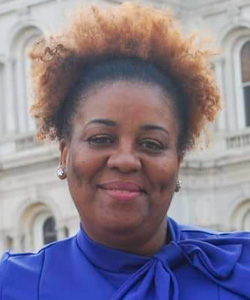
Del. Jackie Addison
Sponsored bills
Maddy summaryHB 1468 requires hospitals in Maryland to create a written "safe discharge labor plan" before discharging or transferring any patient in active labor (defined as a pregnant person showing labor signs per medical standards). The plan must include clinical justification for the discharge, travel safety assessment, a plain-language explanation of risks and warning signs, and proof the patient understands the plan. Hospitals must maintain these records for 21 years, provide annual staff training on maternal care and patient communication, and prominently post patient rights in labor departments. The bill also mandates annual reports to the health department tracking discharge practices and any adverse outcomes following discharge.
Maddy summaryHB 1553 modifies Maryland's guardianship laws for disabled adults to improve family access and streamline petitions. It requires courts to include a schedule for family members (by blood or marriage) to visit the disabled person in all guardianship orders, unless the court determines it is not in their best interest. The bill allows family members to petition for guardianship if the current guardian is neglecting the disabled adult (medically or physically) and authorizes temporary guardianship petitions. Additionally, it mandates health care evaluations within 21 days before filing petitions and requires courts to handle these cases on an expedited basis.
Maddy summaryHB 1334, the Maryland Public Education Parental Partnership Act, requires each county board of education to create a written parent and family engagement policy by the start of the 2027-2028 school year. This policy must include parental input, provide translation services, and outline how schools will collaborate with families. Additionally, starting in the 2028-2029 school year, every public school must develop a Parent-School Compact detailing shared responsibilities - such as school curriculum quality, parental support for learning, teacher qualifications, and regular communication between parents and staff. The bill directly affects all Maryland public school systems and their families by mandating structured, written frameworks for parental involvement.
Maddy summaryThis House Joint Resolution (HJ 9) is a formal statement by the Maryland General Assembly condemning violence against civilians and violations of international humanitarian law in the Democratic Republic of the Congo, Gaza, and Sudan. It specifically addresses ongoing crises involving mass civilian harm, displacement, and credible reports of war crimes and genocide risk, urging the U.S. government to take four concrete actions: secure immediate ceasefires, ensure unhindered humanitarian access, release unlawfully detained civilians, and support independent accountability mechanisms. The resolution does not create new laws but formally expresses Maryland’s position and urges federal action, emphasizing the protection of civilians and adherence to international law. It was introduced by multiple Maryland delegates and aligns with the state’s prior statements on global humanitarian crises.
Maddy summaryHB 1282 prohibits licensed tobacco sellers from advertising or marketing tobacco products, electronic smoking devices, or vaping liquids to anyone under 21 years old. It bans specific tactics like using cartoons, superheroes, food images targeting minors, or symbols associated with youth in advertisements. The bill also restricts advertising in media where 15% or more of the audience is under 21, or within 500 feet of schools. This directly affects retailers and manufacturers licensed to sell tobacco products in Maryland.
Maddy summaryHB 884 requires Maryland to appropriate at least $5 million annually to the University of Maryland Eastern Shore (UMES) starting in fiscal year 2028, continuing until a total of $321,181,312 is funded. This addresses a historical funding disparity between UMES (Maryland's 1890 land-grant university for historically Black students) and the University of Maryland, College Park (the 1862 land-grant institution), which received less state funding per student from 1987-2020. Funds must supplement - never replace - existing state budget allocations and can be used for infrastructure, faculty investment, scholarships, or other institutional needs identified by UMES. The bill mandates annual appropriations that cannot decrease year-over-year, aiming to fully remediate the identified funding gap.
Maddy summaryHB 932 requires the Maryland Transit Administration (MTA) to complete construction of its fifth bus division facility by June 30, 2032. The bill directly affects the MTA, mandating it to identify necessary funding in the 2027-2033 Consolidated Transportation Program to ensure the facility is operational by the deadline. Key provisions include a fixed completion date and annual funding planning requirements for the MTA’s capital budget. This bill does not alter service operations but sets a concrete timeline and funding process for a new infrastructure project.
Maddy summaryHB 1299 requires appraisers to notify buyers, sellers, or their designated point of contact if an appraisal value may be below the contract price or refinance estimate. Interested parties (like lenders or real estate agents) can then submit verified sales data or pending sale documentation within 48 hours for the appraiser to consider. The final appraisal report must include an addendum detailing the notification, submitted data, and whether the additional information changed the valuation. This applies to residential property transactions in Maryland and aims to standardize communication during the appraisal process.
Maddy summaryHB 1371 establishes the Maryland-Africa and the Caribbean Investment and Development Program within the Department of Commerce to study and promote trade and investment between Maryland's African diaspora communities and Africa/Caribbean nations. The program creates an Advisory Board (with members from diaspora businesses, community groups, academic institutions, labor, and finance) to study trade opportunities and recommend actions to the Department. It also creates the Maryland African Diaspora Investment and Development Fund, a permanent fund providing grants, low-interest loans, and business support services to diaspora-owned businesses for expansion, startup capital, and job creation - particularly focusing on Northeast Baltimore communities. The bill directly affects businesses owned by Maryland residents of African or Caribbean descent, defined as first-generation immigrants and their descendants.