

Maddy summaryHB 374 revises Maryland's acupuncture licensing rules to clarify that "manual therapies" (like acupressure) are included under licensed acupuncture practice. It requires the State Acupuncture Board to provide proof of license renewal instead of issuing physical renewal certificates. The bill also explicitly prohibits employers from hiring unlicensed practitioners and bans aiding or abetting unauthorized acupuncture practice. These changes directly affect licensed acupuncturists, their employers, and individuals seeking acupuncture services in Maryland. The revisions aim to modernize licensing procedures while strengthening enforcement against unlicensed activity.
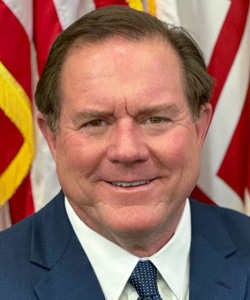
Del. Tom Hutchinson
Sponsored bills
Maddy summaryHB 613 requires property owners in Calvert and St. Mary's Counties to use natural erosion control methods (like marsh creation, native plants, and oyster reefs) instead of hard structures (such as seawalls) for shoreline stabilization. It exempts these counties from general state requirements for nonstructural measures and creates a new waiver process where owners must demonstrate to the Department of Natural Resources that natural methods are not feasible due to factors like extreme erosion or narrow shorelines. The bill defines "living shorelines" as projects using natural materials and ecological principles to absorb wave energy and restore habitats, while still allowing structural measures in specific high-energy areas. This directly affects property owners along navigable waters in those two counties, changing how they must address shoreline erosion.
Maddy summaryHB 395 repeals a requirement that new Concentrated Animal Feeding Operations (CAFOs) must obtain a general discharge permit from Maryland's Department of the Environment before beginning construction. This directly affects developers and operators planning new CAFO facilities by removing a pre-construction permitting step. The bill modifies Maryland's Environment Article by deleting Section 9-323(a)(2), which previously mandated this permit for new CAFO construction. The change only applies to the construction phase, not to operating permits or existing CAFOs.
Maddy summaryHB 427 extends the deadline for the Task Force on Responsible Use of Natural Psychedelic Substances to complete its work. The bill modifies existing law (Chapter 793 of the 2024 Acts) to delay the Task Force's report submission date from July 31, 2025, to a new date specified in the bill. This procedural extension affects the Task Force members (including state health officials, university representatives, and community experts) and the Maryland General Assembly, which will receive the final report. The Task Force's duties remain unchanged: studying psychedelic substances like psilocybin, making recommendations for legal access programs, and addressing criminal justice impacts.
Maddy summaryHB 698 transfers regulatory authority for crematories and "reduction facilities" (natural organic reduction of human remains) from the Office of Cemetery Oversight to the State Board of Morticians, Funeral Directors, and Crematories. The bill renames the board to explicitly include crematories, alters procedures for removing board members, and changes quorum requirements to allow action with a simple majority vote. This transfer affects cremation and reduction facility operators by shifting their oversight to the new board, while also updating related code sections in Maryland’s Business Regulation and Health Occupations articles. The bill makes organizational and procedural changes without introducing new operational requirements for these facilities.
Maddy summaryHB 672 amends the Maryland Pediatric Cancer Fund to specify that only nonprofit hospitals, educational institutions, and other nonprofit organizations may receive grants for pediatric cancer research, removing previous eligibility for physicians, laboratories, and individuals. The bill requires grant funds to be used exclusively for direct research costs, prohibiting use for administrative overhead or community-based services. It also mandates annual reporting to the General Assembly on fund administration, promotional efforts, and detailed fund usage.
Maddy summaryHB 1094 requires Maryland health insurers to reimburse individuals for services provided by graduate-level clinical interns in counseling, social work, and psychology under specific conditions. It applies to insureds covered by policies meeting Maryland’s jurisdictional requirements (e.g., issued in-state or covering Maryland residents). Reimbursement is mandated only when interns work under direct supervision of licensed professionals at outpatient facilities and services are billed by the supervising clinician. The bill amends existing insurance codes to ensure coverage for these supervised intern services, directly affecting insurers, interns, and patients seeking mental health care.
Maddy summaryHB 1221 requires short-term rental hosts (for stays under 30 days) to post evacuation diagrams and emergency contact numbers, provide working fire extinguishers, and install interconnected smoke alarms that meet specific sound and placement standards in their units. Booking services must notify hosts of these requirements and collect verification documentation. Counties and Baltimore City must enforce inspections through local regulations and report data to the State Fire Marshal, who will then submit an annual report to the General Assembly. The bill directly affects hosts, booking platforms, local governments, and fire safety oversight bodies. It amends Maryland law to establish these fire safety standards for short-term rentals.
Maddy summaryHB 1002 prohibits nursing facilities from involuntarily discharging or transferring residents to temporary housing (like hotels) without confirmation from the receiving facility that it can accept the resident. It requires facilities to provide residents with clear written notices at least 10 days before a discharge or transfer, including the reason, new location, and contact information for hearings. The bill also bans facilities from discharging Medicaid-eligible residents solely because they qualify for Medicaid benefits, and mandates that post-discharge plans include specific care details. These changes aim to protect residents' rights and ensure smoother transitions during involuntary moves.
Maddy summaryHB 838 repeals a requirement that prescribers submit prescriber-pharmacist agreements to their regulating health board. Instead, it allows pharmacists (with specific qualifications, registrations, and training) to directly enter agreements authorizing them to treat opioid use disorder using controlled substances. A key provision requires pharmacists to check the Prescription Drug Monitoring Program (PDMP) for relevant patient data before starting or changing such therapy. This bill directly affects pharmacists, prescribers, and patients with opioid use disorder by expanding pharmacists' role in medication management under defined safeguards.