

Maddy summaryHB 632 removes psychiatry and all subcategories of psychiatric services from the definition of "medical service" requiring a Certificate of Need (CON) in Maryland. This exempts psychiatric health care facilities and providers of psychiatric or mental health services from needing state approval before establishing or operating these services. The bill amends Maryland law by deleting "psychiatry" from the list of medical services subject to CON requirements, which currently includes services like surgery, pediatrics, and rehabilitation. This change directly affects psychiatric hospitals, clinics, and mental health programs seeking to expand or open without prior state review. The policy shift simplifies regulatory requirements for mental health service providers.
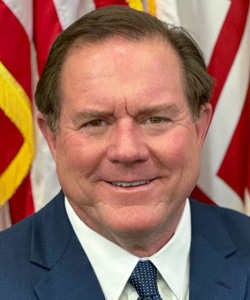
Del. Tom Hutchinson
Sponsored bills
Maddy summaryHB 655 requires public school principals to send written notice to parents or guardians when a student has two or more incidents of violent or disruptive behavior on school property or during school activities in a single school year. This notice mandates that parents/guardians seek and participate in counseling with their child, warns that failure to do so is unlawful under new Section 3-8A-30.1, and provides referrals to counseling resources. The bill directly affects parents/guardians of students exhibiting such behavior, with non-compliance potentially leading to court-ordered community service. It takes effect July 1, 2026, and amends Maryland’s Education Article (§ 7-304.2) and Courts Article (§ 3-8A-30.1).
Maddy summaryHB 726 requires the Maryland Transportation Authority to name a new bridge replacing the collapsed Francis Scott Key Bridge the "Francis Scott Key Memorial Bridge" upon its completion. This bill directly affects the Maryland Transportation Authority, which must implement the naming after the new bridge opens to traffic. The law amends state transportation codes to include the bridge's official name and sets a deadline: if the bridge opens by December 31, 2031, the naming takes effect immediately after notification to the legislature. The bill is procedural, focusing solely on the bridge's official designation with no additional policy changes.
Maddy summaryHB 652 creates a property tax credit for first-time homebuyers in Maryland. It defines a "first-time homebuyer" as a Maryland resident who has never owned a dwelling in any state. The bill changes how the taxable assessment is calculated for this credit: for the first year a first-time homebuyer owns a home, the credit uses the previous owner's assessment (adjusted for revaluation) instead of the new owner's current assessment. This directly affects eligible first-time homebuyers by lowering their initial property tax burden. The change applies to all taxable years beginning after June 30, 2026.
Maddy summaryHB 508 requires Maryland police departments to remove certain investigation records from an officer’s personnel file 3 years after a determination that the officer was not administratively charged, the complaint was deemed unfounded, or the officer was exonerated. It directly affects police officers whose misconduct complaints were cleared through administrative or trial processes. The key provision mandates this removal for records related to internal affairs investigations, disciplinary decisions, or hearing records, excluding cases where formal charges were filed. This change aims to limit the long-term impact of unsubstantiated or cleared complaints on officers’ records. The bill takes effect October 1, 2026.
Maddy summaryHB 544 prohibits smoking, vaping, or consuming cannabis in the passenger area of a motor vehicle when a minor (under 18) is present. This applies to all occupants, including drivers and passengers, and creates a new misdemeanor offense for violations. Penalties include up to one year in jail, a $1,000 fine, or both. The bill, introduced in January 2026, will take effect on October 1, 2026.
Maddy summaryHB 463 prohibits incarcerated individuals serving sentences for specific first-degree murder convictions from earning time-off credits (diminution credits) that reduce their prison terms. It directly affects people convicted of murder under Maryland law, including those convicted of murder involving a child under 16 (under older statutes), repeat child murder offenders, or any first-degree murder (§2-201 of the Criminal Law Article). The bill amends Maryland’s Correctional Services law to block these credits for the specified offenses, effective October 1, 2026. This change applies only to sentences for offenses committed on or after that date, not past cases.
Maddy summaryHB 475, the Juvenile Offender Protection Act, prohibits Maryland's Department of Juvenile Services from hiring or retaining employees convicted of specific serious crimes, including abduction, kidnapping, murder, rape, sexual offenses against minors, and certain assaults. It directly affects individuals seeking or holding jobs with the Department of Juvenile Services who have prior convictions for the listed offenses. The law adds these restrictions to Maryland's Code, with an exception allowing hiring if the conviction was reversed or vacated. The bill takes effect October 1, 2026.
Maddy summaryHB 460 limits solar energy generating station construction in Maryland's priority preservation areas (protected lands established before 2025) to 2% of the total acreage, down from a previous 5% cap. It requires counties to report when this 2% limit is reached and prohibits local zoning laws from blocking solar projects meeting specific criteria. The bill also mandates the Maryland Department of the Environment to study the environmental impact of disposing of solar panels at end-of-life and report findings by September 2027. This directly affects counties, developers, and landowners in priority preservation areas by restricting solar development space and creating new reporting requirements. The policy change aims to balance renewable energy growth with conservation of sensitive lands.
Maddy summaryHB 482, the "Fair Districts for Maryland Act," proposes constitutional changes to overhaul Maryland's redistricting process. It establishes an independent Legislative and Congressional Redistricting and Apportionment Commission to draw both state legislative and congressional districts, replacing the current Governor-led process. The bill mandates new boundary rules requiring districts to respect natural geography, community interests, and geographic compactness, while explicitly prohibiting consideration of voter registration, past voting patterns, or political party affiliation. If the General Assembly fails to adopt a redistricting plan within 45 days of the census, the Commission would submit a plan to the Supreme Court for approval. This directly affects all Maryland residents by changing how voting districts are drawn, aiming to reduce partisan influence in the redistricting process.