

Maddy summaryHB 450 protects victims of sexual assault or stalking by requiring courts and parties in criminal or juvenile cases to redact identifying information (like names or addresses) from public court records and filings. It directly affects victims, courts, and legal parties by prohibiting disclosure of such information to nonparties unless the court finds "clear and convincing evidence" of good cause to allow it. The bill mandates redaction of victim identifiers in all filings - including charging documents - and requires courts to redact existing records upon written request from the victim. Exceptions only apply when a court specifically authorizes disclosure after reviewing evidence of necessity. The law takes effect October 1, 2026.
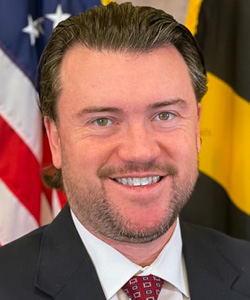
Del. Kevin Hornberger
Sponsored bills
Maddy summaryHB 1353 exempts homeless individuals in Maryland from specific fees and requirements. It prohibits the Maryland Department of Health from charging for vital records (like birth or death certificates) issued to homeless people, waives vehicle registration fees for vehicles owned by homeless individuals, and eliminates driver’s license fees for homeless applicants. The bill also allows unaccompanied homeless youth under 18 to take certain driver’s license exams sooner and exempts homeless individuals from mandatory vehicle emissions inspections. Homeless individuals must provide a written statement proving their homelessness to access these exemptions.
Maddy summaryHB 627 establishes the Commission on History, Culture, and Civics in Education to improve how Maryland public schools teach U.S. and Maryland history, culture, and civics. The commission, composed of 16 members representing diverse groups (including Indigenous tribes, LGBTQIA+ communities, disabled individuals, teachers, and racial/ethnic communities), must examine contributions of marginalized groups and make recommendations to the State Board of Education. Key provisions require the commission to examine topics like Native American contributions, LGBTQIA+ history, and disability community impacts, while ensuring recommendations promote equitable learning for all students. The commission must publicly share meeting materials, reports, and livestream sessions online, with members serving four-year terms without pay but receiving travel reimbursements. This bill directly affects Maryland public school curricula and student learning experiences through its recommendations.
Maddy summaryHB 531 establishes a task force to study existing STEM and robotics programs in Maryland public schools and other states. The task force, composed of state officials, school representatives, and nonprofit leaders, will collect data on program structures, funding, and impacts to assess the feasibility of creating statewide competitive robotics programs in public high schools. It must submit recommendations by December 15, 2026, including whether robotics should be established as a varsity sport in all public high schools. The bill directly affects Maryland public schools by initiating a formal review process for potential program expansion.
Maddy summaryHB 1370 authorizes the use of stop sign monitoring systems (camera systems that capture vehicles failing to stop completely at stop signs) on State highways within the Town of Rising Sun. It requires approval from the Cecil County Council for specific locations and mandates public notice through local government websites and newspapers. The bill modifies existing traffic law to clarify that these systems can only be deployed on State highways in Rising Sun with local council authorization, not in other areas. It does not create new penalties but formalizes the process for using these systems in the Town of Rising Sun. This directly affects drivers in Rising Sun who may receive citations for stop-sign violations captured by the systems.
Maddy summaryHB 1439 amends Maryland law governing property partition actions to clarify lien notification and adjust purchase prices for cotenants (co-owners). It requires parties to notify courts of outstanding liens (like mortgages or tax liens) if they don’t obtain a title report, and mandates courts to adjust purchase prices based on actual costs (e.g., property taxes, maintenance) or income (e.g., rent) incurred by a cotenant without equitable distribution. These adjustments must be supported by documentation and allow all cotenants to review the proposed price or request a hearing. The bill applies only to partition cases filed after October 1, 2026, and directly affects co-owners resolving property division disputes.
Maddy summaryHB 844 exempts unemployable disabled veterans with service-connected disabilities from Maryland's vehicle registration fees for one personally used vehicle. The bill amends Maryland's vehicle registration code to add a new exemption category (Section 13-903(a)(11)) specifically for veterans deemed unemployable due to a service-connected disability. This change directly affects qualifying veterans who own or lease a vehicle for personal use, removing a recurring cost. The exemption takes effect October 1, 2026, and does not apply to additional vehicles. The bill replaces the previous exemption for veterans with specific physical disabilities under Section 13-903(a)(8).
Maddy summaryHB 1325 authorizes licensed clinical social workers to evaluate permanent impairments involving behavioral or mental disorders in Maryland workers' compensation claims. It requires these social workers to meet specific qualifications, including training in mental/behavioral conditions, rehabilitation counseling registration, two years of post-licensure experience, and COMAR authorization. The bill directly affects workers seeking compensation for mental/behavioral impairments and licensed clinical social workers who wish to provide these evaluations. It amends Maryland’s workers’ compensation law (Article 9, Section 9-721) to expand evaluation eligibility beyond psychologists and physicians. The changes take effect October 1, 2026.
Maddy summaryHB 1274 authorizes Maryland public school systems to award three types of diplomas to deceased students: standard diplomas (for students near graduation in 12th grade), posthumous honorary diplomas (for students in 11th/12th grade close to graduation), and in memoriam diplomas (for students in grades K-10 or county residents). To qualify, students must have been enrolled in a Maryland public school, met credit requirements, and been in good standing at the time of death. Schools may only issue these diplomas upon written request from a parent, guardian, or next of kin, and all awarded diplomas are ceremonial with no academic credit or impact on graduation rates. The bill amends Maryland’s education code to establish these specific eligibility criteria and procedures.
Maddy summaryHB 628 establishes a program providing $1,000 monthly payments for three years to young adults who were in out-of-home care (like foster care) on their 18th birthday, with birthdays on or after October 1, 2026. Payments cannot be counted as income for Medicaid, the Maryland Earned Income Tax Credit, or state/federal financial aid for education. The Department of Human Services must report annually on participants' income, location, employment, and housing status starting October 2027. The program will run from October 1, 2026, through September 30, 2031, with automatic termination after that date.