

Maddy summaryHB 863 reclassifies the theft of a firearm as a felony under Maryland law, previously treated as a lower-level offense. It establishes felony penalties based on the firearm's value: up to 5 years in prison or a $10,000 fine for theft valued at $1,500-$25,000, up to 10 years for $25,000-$100,000, and up to 20 years for $100,000 or more. Convicted individuals must also return the firearm or pay its value to the owner. The bill directly affects anyone who steals a firearm or knowingly possesses stolen firearms, raising penalties for these offenses under Section 7-104 of Maryland’s Criminal Law.
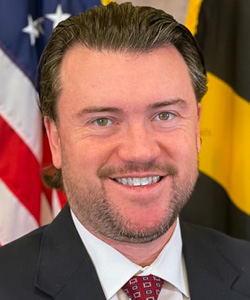
Del. Kevin Hornberger
Sponsored bills
Maddy summaryHB 820 would require Maryland's Secretary of State Police to add a special endorsement to handgun permits for current or retired U.S. government employees who hold or held Top Secret or Sensitive Compartmented Information (SCI) security clearance. This endorsement allows permit holders to carry a handgun in any location where law enforcement officials are permitted to carry while performing their duties. The bill specifies that eligibility requires either current employment with such clearance or 10 consecutive years of clearance prior to retirement. It directs the Secretary to adopt implementing regulations and takes effect October 1, 2026.
Maddy summaryHB 935 requires Maryland to establish a dedicated prerelease facility for female incarcerated individuals, directly affecting women eligible for prerelease programs at the Maryland Correctional Institution for Women. The bill mandates a separate facility meeting specific criteria: at least 3 acres, not within 1 mile of other prisons, and designed to house 1.25 times the 2024 prerelease-eligible population. It requires the Department of Public Safety and Correctional Services to provide comprehensive rehabilitative services (including gender-responsive programming) and report progress to legislative committees by a specified deadline. The facility must operate by June 1, 2023, with the Department of General Services directing procurement for its construction.
Maddy summaryHB 806 creates a formal certification process for facilities conducting vehicle emissions inspections in Maryland. It requires the Motor Vehicle Administration and Environment Secretary to establish application rules and standards to certify these facilities, replacing previous provisions. The bill directly affects auto repair shops and inspection stations seeking to legally perform emissions tests under the state program. Key provisions include defining "Certified Emissions Inspection Facility" and mandating that all such facilities must meet the new certification requirements. This changes how facilities qualify to operate, without altering emissions standards or testing procedures themselves.
Maddy summaryHB 455 requires Maryland's State Department of Education to certify nonprofit organizations meeting specific criteria as scholarship granting organizations (SGOs). It mandates the Department to annually submit a list of certified SGOs to the U.S. Treasury starting in 2027 and requires the Comptroller to provide online guidance for taxpayers claiming federal tax credits for donations to SGOs. The bill directly affects nonprofit SGOs seeking certification, eligible students receiving scholarships, and Maryland taxpayers claiming federal tax credits. Key provisions include standardized application processes for SGOs, annual financial reporting requirements, and public reporting of scholarship data like recipient schools and award amounts.
Maddy summaryHB 632 removes psychiatry and all subcategories of psychiatric services from the definition of "medical service" requiring a Certificate of Need (CON) in Maryland. This exempts psychiatric health care facilities and providers of psychiatric or mental health services from needing state approval before establishing or operating these services. The bill amends Maryland law by deleting "psychiatry" from the list of medical services subject to CON requirements, which currently includes services like surgery, pediatrics, and rehabilitation. This change directly affects psychiatric hospitals, clinics, and mental health programs seeking to expand or open without prior state review. The policy shift simplifies regulatory requirements for mental health service providers.
Maddy summaryHB 815 proposes constitutional amendments requiring Cecil County to elect both its County Council members and Board of Education members from specific single-member districts starting in 2032. Under this bill, each council member would represent a defined geographic district, with the winner determined by the most votes cast within that district (a plurality). Similarly, Board of Education members would be elected from the same council districts, with residency requirements and term limits remaining unchanged. This change would shift elections from the current system to district-based voting for both bodies, affecting all Cecil County residents who vote in these local elections.
Maddy summaryHB 726 requires the Maryland Transportation Authority to name a new bridge replacing the collapsed Francis Scott Key Bridge the "Francis Scott Key Memorial Bridge" upon its completion. This bill directly affects the Maryland Transportation Authority, which must implement the naming after the new bridge opens to traffic. The law amends state transportation codes to include the bridge's official name and sets a deadline: if the bridge opens by December 31, 2031, the naming takes effect immediately after notification to the legislature. The bill is procedural, focusing solely on the bridge's official designation with no additional policy changes.
Maddy summaryHB 652 creates a property tax credit for first-time homebuyers in Maryland. It defines a "first-time homebuyer" as a Maryland resident who has never owned a dwelling in any state. The bill changes how the taxable assessment is calculated for this credit: for the first year a first-time homebuyer owns a home, the credit uses the previous owner's assessment (adjusted for revaluation) instead of the new owner's current assessment. This directly affects eligible first-time homebuyers by lowering their initial property tax burden. The change applies to all taxable years beginning after June 30, 2026.
Maddy summaryHB 644 amends Maryland's property tax law to simplify the application process for surviving spouses of disabled veterans seeking a property tax exemption on their primary residence. The bill updates the required documentation, allowing surviving spouses to submit either a VA disability certification or a VA rating decision (including the effective date) instead of previous, more complex forms. This change directly affects unmarried surviving spouses of veterans who were honorably discharged with a 100% service-connected disability, ensuring they can more easily qualify for the exemption on their current home or a newly acquired home meeting specific conditions. The exemption remains tied to the property's use as a primary residence and the veteran's qualifying disability status.