

Maddy summaryThis bill clarifies that Maryland vehicle emissions inspections can only result in a failure for three specific reasons: missing required emissions equipment, misfueling, or failing to meet emissions standards. It restricts inspectors from citing other grounds for failure during biennial exhaust emissions tests or emissions equipment/misfueling inspections. The law applies to all vehicles subject to Maryland's emissions testing program, effective October 1, 2026. This change standardizes inspection outcomes by limiting failure determinations to these defined technical issues.
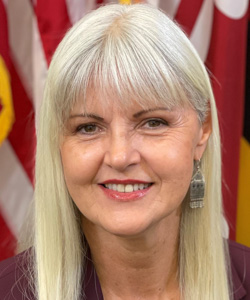
Del. Teresa Reilly
Sponsored bills
Maddy summaryMaryland's HB 1388 establishes a 5-year pilot program for rotational oyster harvesting in four designated Chesapeake Bay areas: the Lower Choptank River, Lower Main Stem Chesapeake Bay, Herring Bay, and Lower Chester. The bill requires the Department of Natural Resources to open one different oyster bed in these areas each oyster season (2026-2029), conduct baseline surveys before opening, and monitor areas after closing. Harvesters must replace oyster shells where they were taken to support habitat recovery. The program directly affects commercial oyster harvesters and the state agency managing Chesapeake Bay resources.
Maddy summaryHB 1525 would require Maryland to withdraw from the Regional Greenhouse Gas Initiative (RGGI) by January 1, 2027, ending the state's participation in a regional program that sets carbon emission limits for power plants. The bill eliminates a surcharge utilities used to recover costs for energy efficiency programs (EmPOWER), directly affecting how these programs are funded. It also limits the amount of electricity that can be purchased or credited under community solar programs. Maryland could rejoin RGGI if all other PJM Interconnection states become full members or if the state becomes a net electricity exporter.
Maddy summaryHB 1535 requires Maryland's Department of Natural Resources to develop a mobile application for anglers holding licenses for nontidal waters (under § 4-604) or Chesapeake Bay/coastal fishing (under § 4-745) to submit required reports. It directly affects all licensed recreational fishermen who currently must submit reports under existing regulations. The bill mandates the app be created by July 1, 2026, but does not change what reports are required or who must submit them - only the submission method. The app will allow license holders to report via mobile device instead of traditional methods.
Maddy summaryHB 1451 requires Maryland's Department of Health to create a standardized system for collecting and reporting annual data on the costs of specific women's health services. It mandates hospitals, licensed health providers, and other entities to submit aggregated, anonymized data on prenatal care, birth, postpartum care, pregnancy care, abortion services (excluding procedure-level details), and menopausal care. The bill explicitly prohibits collecting patient-identifiable information or violating privacy laws, focusing only on budgetary and expenditure data. This data will be used to analyze costs, evaluate funding effectiveness, and identify gaps in women's health care services, without specifying policy outcomes.
Maddy summaryHB 1256 creates an Angel Investor Tax Credit in Maryland, allowing investors to claim a credit against their state income tax for qualifying investments in Maryland companies. The credit applies to investments in companies operating in specific economic sectors (to be designated by the Department of Commerce), with the Department required to maintain an online portal for applications and evaluate additional qualifying sectors. Investors must make their investment within a set timeframe after receiving a tax credit certificate, and the bill establishes a reserve fund for the credit program that earns interest. The credit directly affects angel investors who fund qualifying Maryland businesses and the state's economic development efforts, with provisions for recapturing credits if requirements aren't met.
Maddy summaryHB 1244 allows residential property owners within 300 feet of where overhead transmission lines are constructed to sue for diminished property value caused by the project. It modifies Maryland law to let these owners recover damages and seek reasonable attorney fees if they win their case. The bill also requires courts to award defendant attorney fees and costs to the property owner if the final court decision finds the property's assessed value exceeded the appraised value in transmission line condemnation cases. This applies specifically to cases involving overhead transmission lines under Maryland's Public Utilities Article. The law would take effect October 1, 2026.
Maddy summaryHB 964, the Secure the Vote Act of 2026, repeals existing requirements for ballot drop boxes (including those at Baltimore City's centralized booking facility) and modifies election rules. It adds new requirements: voters must provide proof of U.S. citizenship to register (per Section 3-201.1), obtain photo ID for in-person voting (Section 2-111), and restricts absentee voting to those unable to vote in person due to specific circumstances. The bill also mandates signature verification for absentee ballots, establishes new audit procedures for voter registration lists, and prohibits non-citizens from registering to vote in municipal elections. These changes apply to all Maryland voters and election officials statewide.
Maddy summaryHB 1044 prohibits the release of defendants after conviction but before sentencing or final appeals for specific crimes resulting in the death of a child under 14. It applies directly to individuals convicted of either a violent crime (as defined in Maryland’s Criminal Law §14-101) or a violation of child neglect law (§3-602.1) that caused the death of a victim under age 14. The bill amends Maryland’s Criminal Procedure Article to bar courts from granting pre-sentencing or pre-appeal release in these cases. The law would take effect October 1, 2026.
Maddy summaryHB 970 renames Maryland's "Renewable Energy Portfolio Standard" to the "Clean Energy Portfolio Standard" and changes related terms like "renewable energy credits" to "clean energy credits." The bill explicitly adds electricity generated from certain nuclear power plants as an eligible Tier 2 source for meeting the standard, expanding the types of energy that can count toward compliance. This change directly affects utilities and energy providers required to meet the state's clean energy targets, applying retroactively to prior compliance periods. The bill focuses on updating terminology and eligibility criteria within existing energy policy frameworks.