

Maddy summaryHB 354 requires the Maryland Port Administration to provide written notice to Anne Arundel County's state legislative delegation at least two weeks before announcing a public hearing on land acquisition in the county. This procedural change applies to any land or improvements the Port Administration seeks to acquire. The bill amends existing law to mandate this notice period, ensuring the county delegation is informed prior to hearings. It does not alter land acquisition rules but adds a formal step for county input.
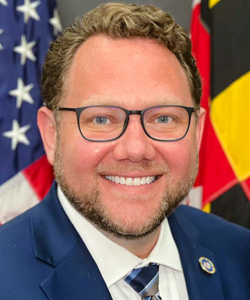
Del. Nic Kipke
Sponsored bills
Maddy summaryHB 988 repeals Maryland's existing building energy performance standards for commercial and multifamily buildings over 35,000 square feet. It removes requirements for these buildings to achieve a 20% reduction in greenhouse gas emissions by 2030 and net-zero emissions by 2040, as well as annual reporting of emissions data. The bill specifically repeals Sections 2-1601 and 2-1602 of the Environment Article and amends Section 4-211(d)(1) and (2) of the Housing and Community Development Article. This eliminates the state's regulatory framework for building energy efficiency, directly affecting owners of covered commercial and multifamily properties.
Maddy summaryHB 967 prohibits Maryland electric companies from collecting certain environmental surcharges or fees during the year following any year when residential electricity bills rise faster than the Consumer Price Index (CPI) for urban consumers. It directly affects residential electricity customers by preventing additional charges if their bills outpace general inflation. The bill requires the Public Service Commission to annually calculate the annual growth in both the CPI and average residential electricity bills (using data ending June 30) and to block environmental fees if bill growth exceeds CPI growth. This applies to most environmental fees but excludes three specific fee types listed in the bill.
Maddy summaryThis bill directs the Maryland Department of Health to create regulations ensuring that drug and alcohol treatment programs discharge patients only when it is appropriate for their mental health or substance use disorder diagnosis. It specifically prohibits discharging patients who would become homeless or need residential care, while requiring programs to refer such individuals to halfway houses or recovery residences if they agree to that level of care. The legislation also mandates that treatment programs establish referral agreements for medical, mental health, legal, and social services within three working days after creating an individualized treatment plan, and ensures these agreements remain valid even if a patient is discharged. These standards apply to medium-intensity and high-intensity residential treatment programs in Maryland.
Maddy summaryHB 459 modifies Maryland's education enforcement procedures by changing how the State Board of Education reviews county school board decisions. It establishes that appeals of county board actions must be judged based on whether the decision was an "abuse of discretion" (e.g., unreasonable, without guiding rules, or illogical) or illegal. The bill also limits the State Superintendent’s temporary halts to county actions to a maximum of 90 days. These changes directly affect county school boards, the State Board of Education, and the State Superintendent when enforcing education rules under Maryland law.
Maddy summaryHB 449, the Juvenile Justice Restoration Act, requires law enforcement officers to consult with an attorney before questioning a child (under 18) in custody. It mandates that officers first notify the child’s parent/guardian and ensure the child speaks with an attorney - either one retained by the parent or provided by the Office of the Public Defender - before any interrogation. Exceptions only apply if an officer believes immediate public safety is threatened (with limited questions) or if a parent consents to skip the attorney consultation. The bill also requires detailed records of notifications and attorney contact, and creates a strong presumption that any statement obtained without compliance is inadmissible in court. The Office of the Public Defender must develop policies to guide attorneys on these new requirements.
Maddy summaryHB 1594, the Veterans' Discounts Act, requires Maryland government agencies to waive certain statutory fees for veterans. It applies to fees related to agricultural licenses, business permits, environmental regulations, natural resources access, and public safety services across multiple departments. Agencies must adopt specific regulations before implementing these fee waivers. The bill formalizes existing practices by creating a clear process for veterans to access reduced fees on government services, without expanding eligibility or creating new benefits.
Maddy summaryHB 964, the Secure the Vote Act of 2026, repeals existing requirements for ballot drop boxes (including those at Baltimore City's centralized booking facility) and modifies election rules. It adds new requirements: voters must provide proof of U.S. citizenship to register (per Section 3-201.1), obtain photo ID for in-person voting (Section 2-111), and restricts absentee voting to those unable to vote in person due to specific circumstances. The bill also mandates signature verification for absentee ballots, establishes new audit procedures for voter registration lists, and prohibits non-citizens from registering to vote in municipal elections. These changes apply to all Maryland voters and election officials statewide.
Maddy summaryHB 970 renames Maryland's "Renewable Energy Portfolio Standard" to the "Clean Energy Portfolio Standard" and changes related terms like "renewable energy credits" to "clean energy credits." The bill explicitly adds electricity generated from certain nuclear power plants as an eligible Tier 2 source for meeting the standard, expanding the types of energy that can count toward compliance. This change directly affects utilities and energy providers required to meet the state's clean energy targets, applying retroactively to prior compliance periods. The bill focuses on updating terminology and eligibility criteria within existing energy policy frameworks.
Maddy summaryHB 454, the "SAVE Our Elections Act of 2026," requires Maryland to join the federal SAVE Program (Systematic Alien Verification of Entitlement) to verify U.S. citizenship for voter registration applicants. It directly affects individuals applying to register to vote in Maryland, mandating that the State Board of Elections use the federal SAVE system to confirm citizenship during the registration process. Key provisions include requiring the State Administrator to enroll in SAVE, establishing a verification process for applicants, and creating an appeal mechanism for voters who dispute citizenship determinations. The bill replaces current self-declaration requirements with federal verification, amending election law sections governing voter registration eligibility and processing.