

Maddy summaryHB 1302 removes a requirement that disabled public safety/judicial officers, their surviving spouses, or cohabitants must have been domiciled in Maryland for 5 years before a disability or death event to qualify for a property tax credit. The bill directly affects disabled officers (e.g., law enforcement, firefighters) who became disabled on duty, surviving spouses who haven’t remarried, and cohabitants who lived with a fallen officer for 180+ days. Key changes eliminate the 5-year residency rule while keeping other eligibility criteria, such as the dwelling being their primary residence and acquired within 10 years of the qualifying event. This makes the credit more accessible to qualifying residents without requiring long-term Maryland residency prior to the qualifying incident.
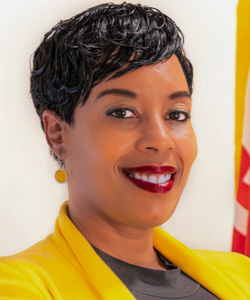
Del. LaToya Nkongolo
Sponsored bills
Maddy summaryHB 964, the Secure the Vote Act of 2026, repeals existing requirements for ballot drop boxes (including those at Baltimore City's centralized booking facility) and modifies election rules. It adds new requirements: voters must provide proof of U.S. citizenship to register (per Section 3-201.1), obtain photo ID for in-person voting (Section 2-111), and restricts absentee voting to those unable to vote in person due to specific circumstances. The bill also mandates signature verification for absentee ballots, establishes new audit procedures for voter registration lists, and prohibits non-citizens from registering to vote in municipal elections. These changes apply to all Maryland voters and election officials statewide.
Maddy summaryHB 970 renames Maryland's "Renewable Energy Portfolio Standard" to the "Clean Energy Portfolio Standard" and changes related terms like "renewable energy credits" to "clean energy credits." The bill explicitly adds electricity generated from certain nuclear power plants as an eligible Tier 2 source for meeting the standard, expanding the types of energy that can count toward compliance. This change directly affects utilities and energy providers required to meet the state's clean energy targets, applying retroactively to prior compliance periods. The bill focuses on updating terminology and eligibility criteria within existing energy policy frameworks.
Maddy summaryHB 454, the "SAVE Our Elections Act of 2026," requires Maryland to join the federal SAVE Program (Systematic Alien Verification of Entitlement) to verify U.S. citizenship for voter registration applicants. It directly affects individuals applying to register to vote in Maryland, mandating that the State Board of Elections use the federal SAVE system to confirm citizenship during the registration process. Key provisions include requiring the State Administrator to enroll in SAVE, establishing a verification process for applicants, and creating an appeal mechanism for voters who dispute citizenship determinations. The bill replaces current self-declaration requirements with federal verification, amending election law sections governing voter registration eligibility and processing.
Maddy summaryThis bill updates Maryland election laws to require voters presenting their names at the polls to prove their identity before receiving a regular ballot. To do this, voters must show a valid government-issued photo ID or, if they lack one, provide a non-government photo ID along with a document like a utility bill or bank statement that shows their name and address. If a voter cannot provide the required identification, the election judge must refer them to vote using a provisional ballot instead. The legislation also clarifies rules for assistance, allowing voters to bring written materials into the polling place and specifying who may help those with disabilities or language barriers.
Maddy summaryHB 885 prohibits knowingly causing another person to ingest a drug that induces abortion when the person knows the other is pregnant and acts without consent, through fraud or coercion, or by force. It directly affects individuals who attempt to compel another person to take such medication under these conditions. The law creates a felony offense punishable by up to 10 years in prison for violations. The bill, titled the "Women’s Freedom From Coercion Act," takes effect October 1, 2026.
Maddy summaryHB 863 reclassifies the theft of a firearm as a felony under Maryland law, previously treated as a lower-level offense. It establishes felony penalties based on the firearm's value: up to 5 years in prison or a $10,000 fine for theft valued at $1,500-$25,000, up to 10 years for $25,000-$100,000, and up to 20 years for $100,000 or more. Convicted individuals must also return the firearm or pay its value to the owner. The bill directly affects anyone who steals a firearm or knowingly possesses stolen firearms, raising penalties for these offenses under Section 7-104 of Maryland’s Criminal Law.
Maddy summaryHB 924, the "Safe Kids Act," creates a new civil legal remedy allowing parents or legal guardians of minors depicted in or exposed to child exploitation material to sue online platforms directly. It prohibits platforms from knowingly distributing such material - including AI-generated images defined as "computer-generated" under the law - and requires them to remove it. The bill updates definitions to explicitly include AI-created images in child pornography laws and increases the age threshold for victims in certain criminal cases. This allows civil lawsuits for damages (including attorney fees) without needing prior criminal convictions, targeting platforms that facilitate distribution rather than just criminalizing possession.
Maddy summaryHB 455 requires Maryland's State Department of Education to certify nonprofit organizations meeting specific criteria as scholarship granting organizations (SGOs). It mandates the Department to annually submit a list of certified SGOs to the U.S. Treasury starting in 2027 and requires the Comptroller to provide online guidance for taxpayers claiming federal tax credits for donations to SGOs. The bill directly affects nonprofit SGOs seeking certification, eligible students receiving scholarships, and Maryland taxpayers claiming federal tax credits. Key provisions include standardized application processes for SGOs, annual financial reporting requirements, and public reporting of scholarship data like recipient schools and award amounts.
Maddy summaryHB 632 removes psychiatry and all subcategories of psychiatric services from the definition of "medical service" requiring a Certificate of Need (CON) in Maryland. This exempts psychiatric health care facilities and providers of psychiatric or mental health services from needing state approval before establishing or operating these services. The bill amends Maryland law by deleting "psychiatry" from the list of medical services subject to CON requirements, which currently includes services like surgery, pediatrics, and rehabilitation. This change directly affects psychiatric hospitals, clinics, and mental health programs seeking to expand or open without prior state review. The policy shift simplifies regulatory requirements for mental health service providers.