

Citizenship for Essential Workers Act This bill establishes a mechanism for eligible aliens who worked as essential workers during the declared COVID-19 (i.e., coronavirus disease 2019) public health emergency to apply for and obtain permanent resident status. The bill also narrows certain grounds for deportability and inadmissibility. To be eligible for permanent resident status under this bill, an alien must have earned income at any point during the COVID-19 emergency period doing work deemed essential by the Department of Homeland Security (DHS) or a state or local government. An alien may also be eligible if that alien is a parent, spouse, or child of (1) an eligible alien who died from COVID-19, or (2) a member of the Armed Forces. Certain aliens shall be ineligible, such as an alien who was a refugee on January 1, 2021. To obtain permanent resident status under this bill, an applying alien must satisfy additional requirements, including by passing a background check. Furthermore, the bill repeals provisions providing for three-year bars and permanent bars to admission into the United States. (Generally, these bars apply to aliens who were previously removed or unlawfully present in the United States.) The bill also narrows the scope of certain crime-based grounds for inadmissibility or deportability, such as by redefining the term conviction to exclude expunged convictions. The Department of Justice or DHS may waive certain grounds of inadmissibility or deportability (1) for humanitarian purposes, (2) to ensure family unity, or (3) for the public interest.
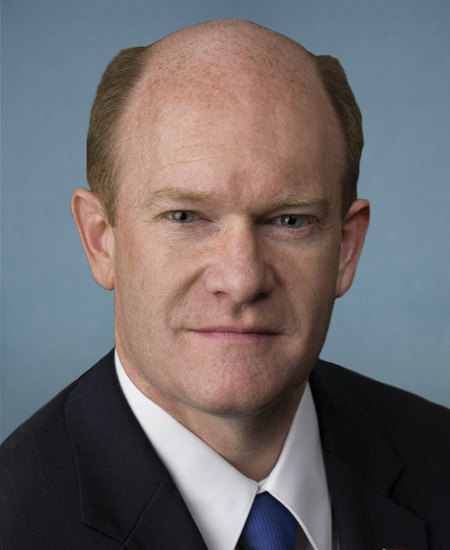
Sen. Christopher A. Coons
Sponsored bills
Foreign Service Families Act of 2021 This bill increases access to career and educational opportunities for eligible family members of foreign service employees. Specifically, the Department of State must use additional hiring preferences and apply appropriate hiring standards to eligible family members seeking employment in certain civil service positions overseas. Additionally, the State Department may take other steps to improve job portability and otherwise support employment of eligible family members who work in the federal civil service or private sector jobs. The State Department must also report on the implementation of the Foreign Service Family Reserve Corps, a program that expedites hiring and onboarding processes for family members who are eligible for appointment to positions overseas. Furthermore, each federal agency must include in its telework policy the circumstances under which an employee may temporarily work from an approved location overseas. The bill also makes foreign service employees (or their spouses and dependent children) who are domiciled or assigned to a duty station in a given state eligible for in-state tuition at public institutions of higher education in that state. Such individuals retain their eligibility for in-state tuition provided they maintain continuous enrollment even if their domicile or duty station changes. Additionally, the bill entitles members of the Foreign Service who are posted abroad to terminate residential and motor vehicle leases and telephone service contracts without being subject to early termination fees.
Technical Reset to Advance the Instruction of Nurses Act or the TRAIN Act This bill modifies the methodology and application of Medicare Advantage nursing and allied health education payments for hospitals. Specifically, for 2010-2019, the bill eliminates the annual cap on total payments and excludes any resulting increase from factoring into calculations for graduate medical education payments for such hospitals. (The Centers for Medicare & Medicaid Services recently issued guidance providing for the recalculation and correction of certain payments to account for the annual payment cap.)
Jobs and Childcare for Military Families Act of 2021 This bill allows an employer a work opportunity tax credit for hiring an individual who is certified by a designated local agency as being, as of the hiring date, the spouse or domestic partner of a member of the Armed Forces, and requires the creation of programs for uniformed services families to pay for childcare on a pretax basis. Specifically, an employer may receive a tax credit equal to 40% of a new employee's first-year wages if the employer hires a service member's spouse or domestic partner (as recognized under state law or by the Armed Forces). Currently, a similar tax credit exists for employers who hire certain disadvantaged individuals, including disadvantaged veterans. The bill requires the Department of Defense, the Department of Homeland Security (with respect to the Coast Guard), the Department of Commerce (with respect to officers of the National Oceanic and Atmospheric Administration), and the Department of Health and Human Services (with respect to the Public Health Service) to implement flexible spending arrangements that permit members of the uniformed services to use basic pay and compensation to pay for childcare services for their dependent children on a pretax basis.
Strategic Competition Act of 2021 This bill addresses various foreign relations issues, with a focus on China. Among other things, the bill requires the U.S. Agency for Global Media to take certain actions to support independent journalism and combat censorship in countries where the Chinese Communist Party or other entities are promoting disinformation; requires the Department of State to establish programs to engage partner countries on issues such as regulatory harmonization and technology partnerships; prohibits any individual who has served as Secretary of State or Deputy Secretary of State from representing a foreign government entity before the executive branch; requires the State Department to develop and implement a plan for increasing the U.S. presence in the Indo-Pacific region; authorizes various foreign military financing and diplomatic activities in Southeast Asia and the Indo-Pacific region; prioritizes the transfer of excess defense articles to Taiwan, Thailand, Indonesia, Vietnam, and Malaysia; prohibits a country from receiving certain U.S. assistance if that country hosts a Chinese military installation within its territory, with some exceptions; authorizes the U.S. representative to the Inter-American Development Bank to vote for an increase in the bank's capital stock; requires strategies to engage with other countries on issues such as managing relations with China; authorizes military training assistance activities in Latin America and the Caribbean; establishes an interagency working group to counter Chinese cyber aggression in Africa; authorizes activities to promote democracy in Hong Kong; and imposes sanctions on foreign individuals and entities responsible for certain abuses (e.g., forced labor and coercive abortions) in China's Xinjiang region.
This resolution condemns the acts of gun violence that led to the tragic loss of eight lives in Georgia on March 16, 2021.
Military Justice Improvement and Increasing Prevention Act of 2021 This bill modifies the process and policy related to the disposition of charges and convening of courts-martial for certain sexual assault cases and other specified offenses under the Uniform Code of Military Justice (UCMJ). Among other elements, the bill provides that the determinations on the preferral, disposition, and referral of charges for specified offenses under the UCMJ must be made by a commissioned officer of the Armed Forces who is designated as a court-martial convening authority (in grade O-6 or higher) and who is available for detail as trial counsel, has significant trial experience, and is outside the chain of command of the member subject to the charges.
Creating Opportunities Now for Necessary and Effective Care Technologies (CONNECT) for Health Act of 2021 or the CONNECT for Health Act of 2021 This bill expands coverage of telehealth services under Medicare. Among other provisions, the bill allows the Centers for Medicare & Medicaid Services (CMS) to waive certain restrictions, such as restrictions on the types of technology that may be used; permanently removes geographic restrictions on originating sites (i.e., the location of the beneficiary) and allows the home of the beneficiary to serve as the originating site for all services; permanently allows federally qualified health centers and rural health clinics to serve as the distant site (i.e., the location of the health care practitioner); and allows the CMS to generally waive coverage restrictions during any public health emergency. Additionally, the CMS must report on the effects of expanded telehealth services during the COVID-19 public health emergency, including with respect to the utilization, quality, and outcomes of services. The Center for Medicare and Medicaid Innovation may also test alternative payment models relating to expanded telehealth services.
Reach Every Mother and Child Act of 2021 This bill authorizes the President to provide assistance to implement a comprehensive five-year strategy to contribute toward the global goal of ending preventable child and maternal deaths by 2030.
Reinventing Economic Partnerships And Infrastructure Redevelopment Act or the REPAIR Act This bill addresses the financing of infrastructure projects through the establishment of the Infrastructure Financing Authority (IFA) and increases the national limitation on the amount of tax-exempt highway or surface freight transfer facility bonds. Specifically, the bill directs the IFA to provide direct loans and loan guarantees to facilitate certain infrastructure projects that are economically viable, in the public interest, and of regional or national significance, including the construction, consolidation, alteration, or repair of airports and air traffic control systems, highway facilities, and transmission or distribution pipelines; sets forth terms and limitations on direct loans and loan guarantees; establishes a funding mechanism to make the IFA a self-sustaining entity, including through fees and risk premiums on loans and loan guarantees; and increases from $15 billion to $16 billion the national limitation on the amount of tax-exempt financing for highway or surface freight transfer facilities.