

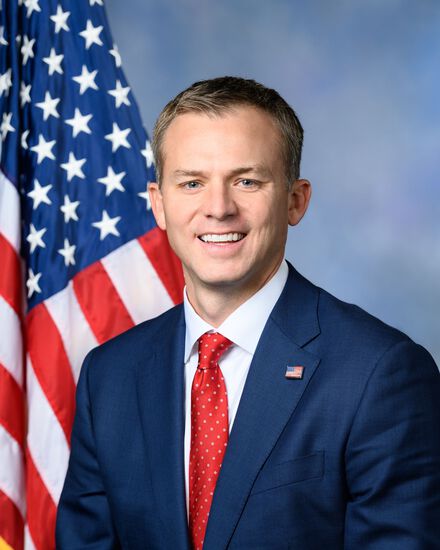
Photo of Blake D. Moore
R United States House · District 1 · Utah On the 2026 ballot

Rep. Blake D. Moore

Compare
Total votes
2,818
all sessions
Attendance
99%
30 missed
Higher than 90% of chamber peers
With party
93%
of cast votes
Near the chamber average
Bipartisan score
4%
crosses aisle rarely
Near the chamber average
Sponsored
722
bills & resolutions
Near the chamber average
Committees
5
assignments
722 bills and resolutions

Sponsored bills

Total
722
Primary
95
Co-sponsor
627
This page
722
matching current filters
Co-sponsor HR 5438
In committee · Iowa House · Co-sponsor
Incentivize Savings Act

Maddy summaryThis bill modifies federal budget rules for unspent agency funds. It requires federal agencies to allocate 49% of unused funds to the next fiscal year, 49% toward paying the national debt, and 2% for retention bonuses (capped at 10% of an employee's base pay). Agencies must also limit future budget requests to the previous year's amount adjusted for inflation. The bill directly affects all executive branch agencies (excluding the Red Cross), altering how they manage leftover budget authority. It does not create new savings programs for individuals but changes government fiscal management procedures.

In committee Feb 4, 2026 1 co-sponsor
Co-sponsor HR 3699
In committee · Iowa House · Co-sponsor
Energy Choice Act

Maddy summaryThis bill prevents state or local governments from banning or restricting energy connections (like installation, modification, or access) based on the type or source of energy, such as electricity, natural gas, or renewable fuels. It directly affects consumers choosing energy providers and energy companies seeking to offer services. The key provision prohibits local laws, regulations, or policies that limit energy services sold in interstate commerce, covering all energy types listed in the bill’s definitions. It does not create new programs but limits regulatory authority at the state or local level. The law aims to ensure open access to diverse energy sources without source-based restrictions.

In committee Feb 4, 2026 1 co-sponsor
Primary HR 7295
In committee · Iowa House · Lead sponsor
Comprehensive Congressional Budget Act of 2026

Maddy summaryThe Comprehensive Congressional Budget Act of 2026 would reform how Congress manages the federal budget by requiring a single annual budget act that includes all federal spending and revenue. The bill establishes a new timeline with key deadlines: the President must submit a budget in February, committees must submit detailed spending and revenue proposals by April 15, and the House must approve the annual budget act by June 10. It would require all committees to submit line-item spending and revenue proposals for inclusion in the annual budget, rather than focusing only on annual appropriations bills. The bill aims to address current fragmentation in the budget process, where only about 26% of federal spending is covered by annual appropriations bills, by creating a more comprehensive and coordinated approach to federal budgeting.

In committee Jan 30, 2026 0 co-sponsors
Co-sponsor HR 7253
In committee · Iowa House · Co-sponsor
Ticket to Work Advertisement Act

Maddy summaryThis bill requires the Social Security Administration to regularly inform disabled beneficiaries about the Ticket to Work program. Specifically, the Commissioner must send program information to each disabled beneficiary within one year of the law's enactment, and then every six months thereafter. The program helps disabled individuals access employment services while retaining benefits. This change directly affects Social Security disability beneficiaries by mandating ongoing outreach about work support options, without altering the program's existing rules or benefits.

In committee Jan 27, 2026 1 co-sponsor
Co-sponsor HR 6945
Passed · Iowa House · Co-sponsor
Supporting Pregnant and Parenting Women and Families Act

Maddy summaryHR 6945 clarifies that states may use federal grants under Section 403 of the Social Security Act to support pregnancy centers meeting specific criteria. These centers must promote protecting both mother and unborn child life while providing services like counseling, pregnancy testing, and material support (e.g., diapers, baby clothes). The bill explicitly prohibits interpreting existing law as barring such funding for eligible centers. It does not create new funding but defines which pregnancy resource organizations qualify for existing grants.

Passed Jan 26, 2026 1 co-sponsor
Primary HR 7226
In committee · Iowa House · Lead sponsor
Leveraging Artificial Intelligence to Streamline the Code of Federal Regulations Act of 2026

Maddy summaryThis bill requires the federal government to use AI systems to annually identify redundant or outdated regulations in the Code of Federal Regulations. Specifically, the Office of Management and Budget (with National Institute of Standards and Technology guidance) must deploy AI meeting strict standards to flag duplicative or obsolete rules, then refer these to the responsible agency for review within 30 days. Agencies must then either rescind redundant rules or amend/update outdated ones within 30 days, bypassing standard regulatory procedures. The bill directly affects all federal agencies that create or maintain regulations, aiming to streamline the regulatory code through AI-assisted review.

In committee Jan 22, 2026 0 co-sponsors
Primary HR 7040
In committee · Iowa House · Lead sponsor
SAFE KIDS Act

Maddy summaryThe SAFE KIDS Act would void surrogacy contracts between U.S. surrogates and foreign nationals from designated "foreign entities of concern" (nations listed under 10 U.S.C. §4872(f)(2)), except for married couples where at least one prospective parent is a U.S. citizen or lawful permanent resident. It prohibits surrogacy brokers from facilitating such contracts, imposing fines or up to one year in prison for knowingly arranging these agreements. If a contract is voided, custody decisions for the child would be determined by state courts based solely on the child’s best interests, disregarding the invalid agreement. The bill aims to address what Congress identifies as a national security threat involving exploitation of U.S. surrogacy laws and potential human trafficking.

In committee Jan 21, 2026 0 co-sponsors
Co-sponsor HR 7143
In committee · Iowa House · Co-sponsor
Roadside Pollinator Program Amendments Act

Maddy summaryThis bill amends a federal program to promote pollinator-friendly vegetation along roadsides and highway rights-of-way. It expands eligibility to include 501(c)(3) nonprofits managing such projects and requires consultation with the Fish and Wildlife Service before finalizing plans. The bill increases annual funding from $150,000 to $500,000 for program administration and raises the annual funding cap for projects from $2 million to $5 million (for fiscal years 2026-2031). These changes directly affect state transportation departments, federal land agencies, and qualifying nonprofit organizations managing roadside vegetation. The key policy shift is broadening partnership opportunities while increasing funding and clarifying consultation requirements.

In committee Jan 17, 2026 1 co-sponsor
Co-sponsor HR 7025
In committee · Iowa House · Co-sponsor
Evidence-Based Grantmaking Act

Maddy summaryHR 7025, the Evidence-Based Grantmaking Act, requires 15 federal agencies (including Education, Health and Human Services, and Housing and Urban Development) to use proven methods in awarding grants. It mandates that agencies clearly define grant goals in funding notices, prioritize applicants using evidence-based practices, and require grant recipients to implement such practices when delivering services. Agencies must also conduct regular evaluations of grant effectiveness, publicly share results, and use findings to improve future funding decisions. This law directly affects federal grant recipients and aims to ensure taxpayer funds achieve measurable outcomes through data-driven approaches.

In committee Jan 13, 2026 1 co-sponsor
Co-sponsor HR 4782
In committee · Iowa House · Co-sponsor
Local Farmers Feeding our Communities Act

Maddy summaryHR 4782, the Local Farmers Feeding our Communities Act, establishes a USDA program to connect local farmers with food distribution networks. It requires eligible entities (like state agriculture agencies) to use funds to purchase unprocessed or minimally processed local foods from covered producers - including at least 25% from small-size, mid-size, beginning, or veteran farmers - while providing technical assistance for food safety and supply chains. The bill allocates $200 million annually (2026-2030) from the Commodity Credit Corporation, mandating 10% for Tribal governments and 1% per state before distributing remaining funds. This directly supports regional food security by boosting economic opportunities for local farmers and improving access to fresh, nutritious food through established distribution channels.

In committee Jan 13, 2026 1 co-sponsor
Showing 81 to 90 of 722 bills
Previous 1 8 9 10 73 Next