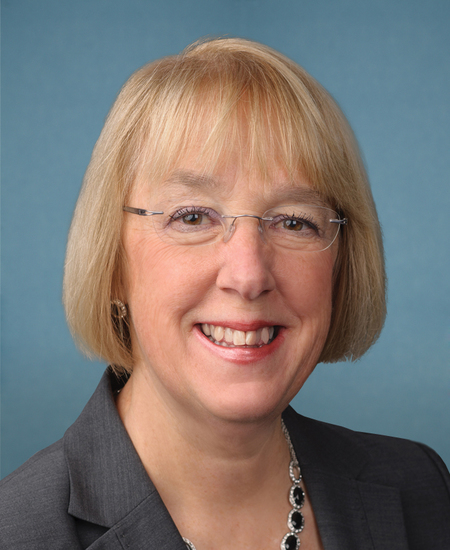
Photo of Patty Murray
D United States Senate · Washington

Sen. Patty Murray

Compare
Total votes
1,044
all sessions
Attendance
97%
34 missed
Lower than 95% of chamber peers
With party
99%
of cast votes
Higher than 80% of chamber peers
Bipartisan score
1%
crosses aisle rarely
Lower than 82% of chamber peers
Sponsored
1,131
bills & resolutions
Near the chamber average
Committees
18
assignments
1,131 bills and resolutions

Sponsored bills

Total
1,131
Primary
149
Co-sponsor
982
This page
1,131
matching current filters
Co-sponsor S 2553
In committee · Indiana Senate · Co-sponsor
Judiciary Accountability Act of 2021

Judiciary Accountability Act of 2021 This bill applies certain civil rights and employee protection laws to judicial branch employees. Specifically, the bill applies to judicial branch employees laws that prohibit discrimination based on race, color, religion, sex (including sexual orientation or gender identity), national origin, age, or disability. Further, the bill prohibits retaliation against whistleblowers within the judicial branch. Additionally, the bill establishes (1) the Commission on Judicial Integrity to oversee a program to prevent workplace misconduct; (2) the Office of Judicial Integrity to oversee confidential reporting systems regarding workplace misconduct, training programs on workplace behavior and bystander intervention, and other reporting initiatives regarding employee metrics and demographics; (3) the Special Counsel for Equal Employment Opportunity to investigate alleged workplace misconduct and complaints; and (4) the Office of Employee Advocacy to provide legal assistance, representation, and consultation to judicial employees. Finally, the bill establishes workplace discrimination, harassment, and retaliation as judicial misconduct.

In committee Jul 29, 2021 1 co-sponsor
Co-sponsor S 2569
In committee · Indiana Senate · Co-sponsor
Domestic Workers Bill of Rights Act

Domestic Workers Bill of Rights Act This bill provides rights and protections for domestic workers (e.g., housekeepers, nannies, caretakers, personal assistants, and chauffeurs), including pay and leave rights, and health and safety protections. Specifically, the bill repeals the exemption of domestic live-in employees from certain minimum wage and maximum hour requirements. Employers must provide written notice of termination and provide at least 30 days of lodging and two weeks of severance pay to terminated live-in employees. Live-in employees also must be provided with reasonable access to telephone and internet service during their employment. The bill requires employers to provide domestic workers with a written agreement covering wages, sick leave, benefits, and other matters. Further, domestic workers may request and be granted changes to work schedules due to personal events. The bill also provides domestic workers with certain privacy rights, extends to domestic workers protections against discrimination in employment, and increases the federal medical assistance percentage (FMAP) for certain Medicaid-funded medical services provided by domestic workers. The Department of Labor must (1) award grants for a domestic worker national hotline for reporting emergencies, training on hazards facing domestic workers, and workforce investment activities for domestic workers; and (2) establish a Domestic Worker Wage and Standards Board to investigate standards in the domestic workers industry. Labor must publish online a document that describes the rights and protections for domestic workers under this bill.


In committee Jul 29, 2021 1 co-sponsor
Co-sponsor S 1435
In committee · Indiana Senate · Co-sponsor
Affordable Prescriptions for Patients Act of 2021

Affordable Prescriptions for Patients Act of 2021 This bill prohibits product hopping by drug manufacturers, authorizes the Federal Trade Commission to enforce this prohibition, and imposes limits on patent litigation involving biological products. Generally, product-hopping describes a situation where, when the patents on a reference drug (or biological product) expire, the manufacturer switches to a follow-on product that is covered by a later-expiring patent. Under this bill, a follow-on product is a modified version of the reference drug that shares an indication (what the drug is used for) with the reference drug. The bill presumes product hopping has occurred when a reference drug manufacturer, after receiving notice that the Food and Drug Administration (FDA) has received an application to market a competing generic (or biosimilar) version, takes certain actions such as withdrawing the reference drug from the market and selling a follow-on product. A drug manufacturer may rebut these presumptions by demonstrating that its conduct was not intended to limit competition. The bill also limits in certain instances the number of patents that a reference biological product manufacturer can assert in a patent infringement lawsuit against a company seeking to sell a biosimilar version. Specifically, if the biosimilar manufacturer completes certain actions as part of an abbreviated pathway to get FDA market approval, the bill limits, subject to exceptions and waivers, the number of certain types of patents that the reference product manufacturer may assert, such as patents filed more than four years after the reference product received market approval.

In committee Jul 29, 2021 1 co-sponsor
Co-sponsor S 2172
In committee · Indiana Senate · Co-sponsor
Building Solutions for Veterans Experiencing Homelessness Act of 2021

Building Solutions for Veterans Experiencing Homelessness Act of 2021 This bill addresses various Department of Veterans Affairs (VA) grants, programs, and assistance related to services for homeless veterans. The bill removes certain funding limitations on grants that assist eligible entities in establishing or modifying programs to furnish outreach, rehabilitative services, vocational counseling and training, and transitional housing assistance to homeless veterans. Under the bill, grant recipients must not be subject to certain property disposition requirements. The bill increases the maximum rate of per diem payments provided to grant recipients furnishing services to homeless veterans. Under the Supportive Services for Veterans Families program, not less than 2% of the amounts available in any fiscal year may be available to provide technical assistance to entities providing supportive services to very low-income veteran families occupying permanent housing. Among other requirements, the VA must provide training and technical assistance to grant recipients regarding the planning, development, and provision of services for which the grant is made; establish and carry out a program to provide services to assist veterans with navigating housing and health care resources; and implement three pilot programs to provide improved public transportation, nursing staff, and substance use disorder and alcohol use disorder treatment services to certain veterans. The bill (1) extends through FY2025 the authority for appropriations for homeless veterans reintegration programs, and (2) increases the amount authorized to be appropriated annually for such programs from $50 million to $75 million.

In committee Jul 28, 2021 1 co-sponsor
Primary S 1965
In committee · Indiana Senate · Lead sponsor
Planning for Aging Veterans Act of 2021

Planning for Aging Veterans Act of 2021 This bill addresses the long-term care of veterans, including by implementing policies for the administration of state homes. First, the bill requires the Department of Veterans Affairs (VA) to develop a strategy for the long-term care of veterans. The VA must develop a standardized process for entering into sharing agreements between state homes and VA medical centers. A state home is a home established by a state for veterans who are disabled by age, disease, or otherwise and incapable of earning a living because of such disability. The term also includes a home that furnishes nursing home care for veterans. Under the bill, the VA must ensure that veterans who are catastrophically disabled are not required to pay a co-payment for medication received at a state home. Generally, veterans are catastrophically disabled if they have a permanent severely disabling injury, disorder, or disease that compromises the ability to carry out the activities of daily living. The VA must monitor any contractor it uses to conduct inspections of state homes, including by reviewing inspections, reporting deficiencies, and publishing inspection results on a public VA website. The VA must implement a two-year pilot program to provide geriatric psychiatry assistance to eligible veterans at state homes. Finally, the VA must work with public housing authorities and local organizations to assist aging homeless veterans in accessing existing housing and supportive services, even if a veteran is not eligible for such services from the VA.

In committee Jul 28, 2021 0 co-sponsors
Co-sponsor S 1220
In committee · Indiana Senate · Co-sponsor
United States Cadet Nurse Corps Service Recognition Act of 2021

United States Cadet Nurse Corps Service Recognition Act of 2021 This bill recognizes service as a member of the U.S. Cadet Nurse Corps between July 1, 1943, and December 31, 1948, as active duty service. The active duty designation entitles qualifying individuals to certain benefits afforded to veterans, such as burial benefits (not including interment at Arlington National Cemetery) and honorary veteran status. Under the bill, the Department of Defense (DOD) must issue individuals who served in the corps during the specified period a discharge from their service under honorable conditions if such a discharge is warranted based on the duration and nature of the service. Such individuals are not entitled to Department of Veterans Affairs benefits aside from those related to burials and memorials. The bill also authorizes DOD to produce a service medal or other commendation, memorial plaque, or grave marker to honor the individuals.

In committee Jul 28, 2021 1 co-sponsor
Co-sponsor S 2455
In committee · Indiana Senate · Co-sponsor
Tax-Free Pell Grant Act

Tax-Free Pell Grant Act This bill excludes from gross income, for income tax purposes, any amount received as a federal Pell Grant. It also expands the definition of qualified tuition and related expenses under the American Opportunity and Lifetime Learning tax credit to include computer or peripheral equipment (up to a maximum of $1,000), child and dependent care expenses, and course materials.

In committee Jul 22, 2021 1 co-sponsor
Co-sponsor S 2452
In committee · Indiana Senate · Co-sponsor
Encouraging Americans to Save Act

Encouraging Americans to Save Act This bill sets forth provisions to provide matching payments for retirement savings and Individual Retirement Account (IRA) contributions for individuals who have attained the age of 18 years, excluding taxpayer dependents. Specifically, it allows an enhanced 50% tax credit, up to $2,000, for deductible retirement savings contributions and for IRA contributions. The bill also directs the Internal Revenue Service (IRS) to establish the R-Bond Program as a permanent program for the establishment and maintenance of individual retirement plans and directs the IRS to educate taxpayers on the benefits of the savings programs provided by this bill.

In committee Jul 22, 2021 1 co-sponsor
Co-sponsor S 2434
In committee · Indiana Senate · Co-sponsor
Local Journalism Sustainability Act

Local Journalism Sustainability Act This bill allows individual taxpayers a tax credit up to $250 in any taxable year for subscriptions to one or more local newspapers for the taxpayer's personal use. It also allows a local news journalist employer a payroll credit for wages paid to local news journalists. The bill allows certain small businesses a tax credit for amounts paid for advertising in a local newspaper or through a broadcast of a radio or television station serving a local community.

In committee Jul 22, 2021 1 co-sponsor
Showing 931 to 940 of 1,131 bills
Previous 1 … 93 94 95 … 114 Next