

This bill releases certain reversionary interest in land to Tennessee. Upon the transfer of ownership of the approximately 0.90-acre parcel of land identified as the Webb property to Tennessee for inclusion in the Chickasaw State Forest and the transfer of the approximately 0.62-acre parcel of land identified as state forest land to Tennessee or a non-state entity, the Department of Agriculture (USDA) shall release to Tennessee the reversionary interest of the United States in the state forest land that requires the land to be used for public purposes. After such actions, USDA shall offer to sell to Tennessee the undivided mineral interests of the United States in the state forest land.
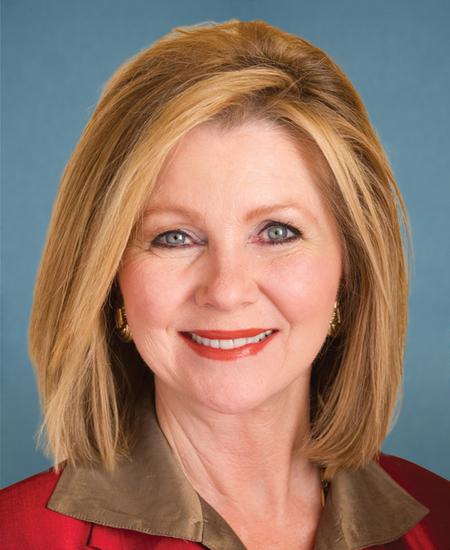
Sen. Marsha Blackburn
Sponsored bills
Affordable Housing Credit Improvement Act of 2021 This bill revises provisions of the low-income housing tax credit and renames it as the affordable housing credit . The bill increases the per capita dollar amount of the credit and its minimum ceiling amount beginning in 2021 and extends the inflation adjustment for such amounts. The bill modifies tenant income eligibility requirements and the average income formula for determining such income. It also revises rules for student occupancy of rental units and tenant voucher payments, and prohibits any refusal to rent to victims of domestic abuse. The bill further modifies the credit to increase state allocations of the credit; repeal the qualified census tract population cap; prohibit local approval and contribution requirements; increase the credit for certain projects designated to serve extremely low-income households; increase the credit for certain bond-financed projects designated by state agencies; eliminate the basis reduction for properties that receive certain energy-related tax benefits; and increase the population cap for difficult development areas (i.e., areas with high construction, land, and utility costs relative to area median gross income). The bill also includes Indian and rural areas as difficult development areas and modifies other requirements relating to casualty losses, acquisition credits, and foreclosures.
Supporting Accurate Views of Emergency Services Act of 2021 or the 911 SAVES Act This bill requires the Office of Management and Budget, by 30 days after the bill's enactment, to categorize public safety telecommunicators as a protective service occupation under the Standard Occupational Classification System.
Air Traffic Control Safe Operation and Readiness Act This bill revises the hiring process for air traffic control specialists. Specifically, the bill requires the Federal Aviation Administration (FAA) to consider for the interview stage of the hiring process candidates who score at or above the passing score on the Air Traffic Skills Assessment (AT-SA) and meet minimum qualifications established by the FAA, and revise the AT-SA to ensure that all questions are supported by a peer reviewed job analysis and that it does not incorporate any biographical questionnaire or other questions of a biographical nature.
Preserving Innovation for the Next Generation Act or the PING Act This bill expresses the sense of the Senate that the current restrictions prohibiting the Centers for Medicare & Medicaid Services from negotiating the prices or establishing a formulary for drugs under the Medicare prescription drug benefit should not be repealed. The bill also prohibits the Center for Medicare and Medicaid Innovation from testing any model that would repeal or require a waiver of such restrictions.
Competition in Professional Baseball Act This bill removes the limited exemption from the antitrust laws for professional baseball clubs. For purposes of this bill, the term antitrust laws means laws to protect against unlawful restraints and monopolies (Clayton Act) and to protect against unfair methods of competition (Federal Trade Commission Act).
Comprehensive Care for Alzheimer's Act This bill allows the Center for Medicare and Medicaid Innovation (CMMI) to test a Dementia Care Management Model that provides comprehensive care to Medicare beneficiaries with Alzheimer's disease or a related dementia. Under the model, participating health care providers receive payment under Medicare for comprehensive care management services that are provided to individuals with diagnosed dementia, excluding Medicare Advantage enrollees, hospice care recipients, and nursing home residents. Required services include medication management, care coordination, and health, financial, and environmental monitoring, as well as trainings and other support services for unpaid caregivers. Providers must furnish services through interdisciplinary teams and must ensure access to a team member or primary care provider 24-7. The CMMI must set payments and determine quality measures for the model in accordance with specified requirements. The bill also allows the CMMI to design a similar model under Medicaid.
This resolution honors the memory of U.S. Capitol Police Officer William Francis "Billy" Evans for the selfless acts of heroism he displayed on April 2, 2021.
Military Spouse Licensing Relief Act of 2021 This bill provides for the portability of professional licenses of service members and their spouses who are relocated, because of military orders, outside of the jurisdiction that issued the license. Specifically, a professional license in good standing of a service member or spouse shall be considered valid at a similar scope of practice and in the discipline applied for in the new jurisdiction for the duration of such military orders. To establish and maintain eligibility, a service member or spouse must (1) provide a copy of the military orders to the licensing authority in the new jurisdiction; (2) remain in good standing with the licensing authority that issued the license; and (3) submit to the authority of the licensing authority in the new jurisdiction for the purposes of standards of practice, discipline, and fulfillment of any continuing education requirements. The bill also provides that if a service member or spouse is licensed to operate in multiple jurisdictions through an interstate licensure compact, the service member or spouse is subject to the requirements of the compact or the applicable provisions of the state law rather than the provisions of this bill.
Access to Assistive Technology and Devices for Americans Study Act or the Triple A Study Act This bill directs the Government Accountability Office (GAO) to study issues related to health insurance and other coverage for assistive technologies, such as prosthetic devices and custom orthoses, for those who experience amputations or live with a limb difference. In conducting this study, the GAO must include comparisons of claims and other data from Medicare, the Department of Veterans Affairs, and commercial health insurers.