

This resolution expresses that the Senate has heard of the death of the Honorable Orrin G. Hatch, former U.S. Senator for the state of Utah. The resolution also expresses that the Senate honors the life and legacy of the late Senator Hatch for his unwavering dedication to Utah as a Senator and a public servant and accomplishments in legislating with principle and dedication for the good of the people of the United States. The resolution states when the Senate adjourns today, it stands adjourned as a further mark of respect to the memory of Senator Hatch.
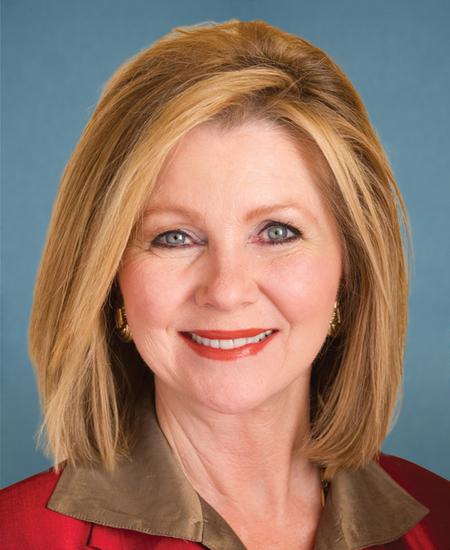
Sen. Marsha Blackburn
Sponsored bills
Ukraine Democracy Defense Lend-Lease Act of 2022 This bill temporarily waives certain requirements related to the President's authority to lend or lease defense articles if the defense articles are intended for Ukraine's government or the governments of other Eastern European countries affected by Russia's invasion of Ukraine. For FY2022 and FY2023, an agreement to lend or lease defense articles under this bill shall not be subject to certain requirements and provisions that typically apply to such lend-lease agreements, including a requirement that generally prohibits a loan or lease period from exceeding five years. The President must establish expedited procedures to ensure the timely delivery of defense articles loaned or leased to Ukraine under this bill.
This joint resolution nullifies a Department of Health and Human Services rule published on November 30, 2021, concerning vaccine and mask requirements to mitigate the spread of COVID-19 in Head Start programs. These programs provide comprehensive early education and development services to low-income children.
Preventing PLA Acquisition of United States Technology Act of 2022 This bill prohibits U.S. companies and universities that receive federal assistance and federal agencies from engaging in certain research or technical exchanges with Chinese entities. Specifically, this prohibition applies to research or exchanges involving (1) certain Chinese entities, including universities that receive funding from China's military and Chinese state-owned enterprises; and (2) certain technologies identified by the Chinese Communist Party as priorities for its strategy to mobilize non-military resources and expertise for military application.
Ukraine Invasion War Crimes Deterrence and Accountability Act This bill requires the President to report to Congress on atrocities committed during Russia's invasion of Ukraine since February 24, 2022. Specifically, the report must describe in detail (1) U.S. government efforts to collect, analyze, and preserve evidence related to war crimes and other atrocities committed during the invasion; (2) media, public diplomacy, and information operations to make the Russian people, including their military and political leaders, aware of efforts to identify and prosecute those responsible for such atrocities; and (3) the process for a domestic, foreign, or international court or tribunal to obtain information from the U.S. government related to such atrocities.
This bill prohibits the use of federal funds to establish or support the activities of a Disinformation Governance Board at the Department of Homeland Security.
Maddy summaryThis resolution (SRES 603) recognizes April 2022 as National Sexual Assault Awareness and Prevention Month. It expresses the Senate's support for efforts to educate the public about sexual violence, improve treatment for survivors, and prosecute perpetrators. The resolution acknowledges the work of organizations like RAINN and the Department of Defense's Safe Helpline, but does not create new laws or funding. As a symbolic gesture, it has no direct policy impact on affected individuals or services.
Chronic Wasting Disease Research and Management Act of 2022 This bill directs the Department of Agriculture (USDA) to address chronic wasting disease afflicting deer, elk, and moose populations. Specifically, the bill directs USDA to establish a program to research and manage the disease. Under the program, USDA must offer to enter into agreements with state or tribal wildlife agencies and departments of agriculture, institutions of higher education, and research centers to support research on the transmission of, resistance to, and diagnosis of the disease. In addition, USDA must offer to enter into agreements with such agencies and departments to support state and tribal efforts to develop and implement management strategies that address the disease. USDA must also develop and maintain materials to inform the public on chronic wasting disease and techniques to help prevent the spread of the disease. In addition, USDA must solicit public feedback on potential updates and improvements to standards of the chronic wasting disease herd certification program.
Spectrum Innovation Act of 2021 This bill specifies a process for auctioning a portion of the electromagnetic spectrum between 3100 megahertz (MHz) and 3540 MHz for nonfederal use, shared federal and nonfederal use, or a combination of those uses. Most wireless technologies (e.g., mobile communication) rely on the electromagnetic spectrum to transmit signals. Specifically, the Office of Management and Budget must transfer funding from the Spectrum Reallocation Fund to federal entities for planning related to the reallocation. The National Telecommunications and Information Administration (NTIA) and the Executive Office of the President must oversee the planning. Informed by the planning, the Department of Commerce must identify at least 200 MHz of spectrum for reallocation. In identifying the spectrum, Commerce must consult with the Department of Defense, the Office of National Science and Technology Policy, and the Federal Communications Commission (FCC). The FCC must (1) adopt rules authorizing the use of the identified spectrum in consultation with the NTIA, and (2) auction licenses for the identified spectrum within seven years of the bill's enactment. Additionally, the President must modify or withdraw (subject to certain limits) current federal assignments of the identified spectrum to increase nonfederal use. The FCC must allow for opportunistic uses (i.e., allow devices to opportunistically identify and transmit on unused spectrum without infringing on the rights of the spectrum license holder) of a withdrawn or modified assignment. An allowed opportunistic use must cease after the auction if the use is inconsistent with the rights of the licensee that obtains its license through the auction.
This joint resolution nullifies the rule issued by the Department of Health and Human Services on October 7, 2021, that reverts requirements for federally funded providers of family planning services to those in effect before May 3, 2019, and makes other changes to family planning programs. Specific changes in the rule include (1) removing restrictions on pregnancy options counseling and referrals for abortion services, (2) eliminating requirements for physical and financial separation between abortion-related activities and specified family planning activities, and (3) providing a particular focus on health equity.