

Transnational Repression Accountability and Prevention Act of 2021 or the TRAP Act of 2021 This bill establishes requirements related to U.S. cooperation with International Criminal Police Organization (INTERPOL) communications. No U.S. agency or department may arrest an individual based solely on an INTERPOL notice without (1) prior verification of the individual's eligibility for extradition, (2) a valid request for arrest from the requesting country, and (3) an arrest warrant. A U.S. agency or department may not use an INTERPOL communication from an INTERPOL member country as the sole basis for certain actions, such as detaining an individual or denying an individual a visa, without independent credible evidence supporting the communication. The bill requires reports on countries that abuse INTERPOL communications for political motives and other unlawful purposes.
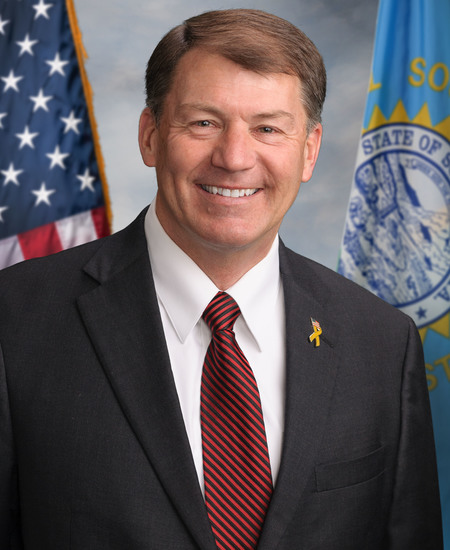
Sen. Mike Rounds
Sponsored bills
Lifesaving Gear for Police Act This bill invalidates any regulation, rule, guidance, recommendation, or policy issued on or after May 15, 2015, that limits the sale or donation of excess federal property to state and local law enforcement agencies unless it is enacted by Congress. Additionally, it prohibits the use of federal funds to implement such regulation, rule, guidance, recommendation, or policy. Property that was recalled or seized on or after May 15, 2015, must be returned, replaced, or reissued to the state or local law enforcement agency.
Thin Blue Line Act This bill expands the list of statutory aggravating factors in death penalty determinations to also include killing or targeting a law enforcement officer, firefighter, or other first responder.
Get Americans Back To Work Act This bill makes an individual ineligible for federal pandemic unemployment compensation (FPUC) after June 30, 2021. It also reduces the amount of FPUC to $150.00 for weeks of unemployment ending after May 31, 2021, and ending on or before June 30, 2021. Under current law, an individual is eligible for FPUC for weeks of employment ending on or before September 6, 2021 in the amount of $300.
Jobs and Childcare for Military Families Act of 2021 This bill allows an employer a work opportunity tax credit for hiring an individual who is certified by a designated local agency as being, as of the hiring date, the spouse or domestic partner of a member of the Armed Forces, and requires the creation of programs for uniformed services families to pay for childcare on a pretax basis. Specifically, an employer may receive a tax credit equal to 40% of a new employee's first-year wages if the employer hires a service member's spouse or domestic partner (as recognized under state law or by the Armed Forces). Currently, a similar tax credit exists for employers who hire certain disadvantaged individuals, including disadvantaged veterans. The bill requires the Department of Defense, the Department of Homeland Security (with respect to the Coast Guard), the Department of Commerce (with respect to officers of the National Oceanic and Atmospheric Administration), and the Department of Health and Human Services (with respect to the Public Health Service) to implement flexible spending arrangements that permit members of the uniformed services to use basic pay and compensation to pay for childcare services for their dependent children on a pretax basis.
This resolution condemns all manifestations of expressions of racism and anti-Asian and Pacific Islander or ethnic intolerance and calls for specified actions by the Senate Judiciary Committee, the Department of Justice (DOJ), and federal law enforcement. The resolution (1) calls on the Senate Judiciary Committee to consider holding a hearing related to the surge in violence against Asian Americans and Pacific Islanders, and (2) applauds DOJ's commitment to conducting a 30-day review of violence against Asian Americans and Pacific Islanders. The resolution calls on federal law enforcement officials, working with state and local officials, to expeditiously and vigorously investigate all reports of hate crimes against Asian Americans and Pacific Islanders in the United States, work to improve the reporting of such hate crimes, and hold the perpetrators of those crimes accountable and bring the perpetrators to justice.
Administrative Pay-As-You-Go Act of 2021 This bill provides statutory authority for the Office of Management and Budget (OMB) requirement that federal agencies must submit at least one proposal for reducing direct spending before taking a discretionary administrative action that increases direct spending. Further, an agency must submit to the OMB its legal basis for concluding that a proposed administrative action is nondiscretionary and, therefore, not subject to this requirement.
Creating Opportunities Now for Necessary and Effective Care Technologies (CONNECT) for Health Act of 2021 or the CONNECT for Health Act of 2021 This bill expands coverage of telehealth services under Medicare. Among other provisions, the bill allows the Centers for Medicare & Medicaid Services (CMS) to waive certain restrictions, such as restrictions on the types of technology that may be used; permanently removes geographic restrictions on originating sites (i.e., the location of the beneficiary) and allows the home of the beneficiary to serve as the originating site for all services; permanently allows federally qualified health centers and rural health clinics to serve as the distant site (i.e., the location of the health care practitioner); and allows the CMS to generally waive coverage restrictions during any public health emergency. Additionally, the CMS must report on the effects of expanded telehealth services during the COVID-19 public health emergency, including with respect to the utilization, quality, and outcomes of services. The Center for Medicare and Medicaid Innovation may also test alternative payment models relating to expanded telehealth services.
USTR Inspector General Act of 2021 This bill requires the President to appoint an Inspector General of the Office of the U.S. Trade Representative (USTR). Among other responsibilities, the Inspector General shall (1) conduct and supervise audits and investigations relating to the programs and operations of the USTR, (2) recommend policies for preventing and detecting fraud and abuse in those programs, and (3) provide a means for keeping the USTR and Congress informed about problems and deficiencies in those programs and operations.
This bill requires the Department of Veterans Affairs (VA) to submit a plan for obligating and expending covered funds, which are funds made available to the VA for response to the COVID-19 (i.e., coronavirus disease 2019) pandemic. The bill requires the VA to submit biweekly reports regarding obligations, expenditures, and planned uses of the funds until seven days after the VA has expended all covered funds. The Inspector General of the VA must submit reports examining the obligations and expenditures made using covered funds during the specified reporting period. Finally, the Government Accountability Office must submit an interim report and final report containing a review of obligations and expenditures made using covered funds.