

Foreign and Domestic Emoluments Enforcement Ac t This bill establishes statutory prohibitions, investigatory mechanisms, and enforcement provisions regarding the receipt from a foreign or domestic government of profits, gains, advantages, or payments (i.e., emoluments) by U.S. officeholders. Specifically, the bill prohibits any U.S. officeholder from accepting, directly or indirectly, emoluments from a foreign government without consent of Congress. The prohibition is enforceable through a civil action filed by the House of Representatives or Senate. Additionally, the bill prohibits the President from accepting emoluments from a domestic government other than compensation for his or her services as President. Both foreign and domestic emolument prohibitions are enforceable through administrative fines and civil actions by the Office of Government Ethics. The Office of Special Counsel must investigate violations of the bill.
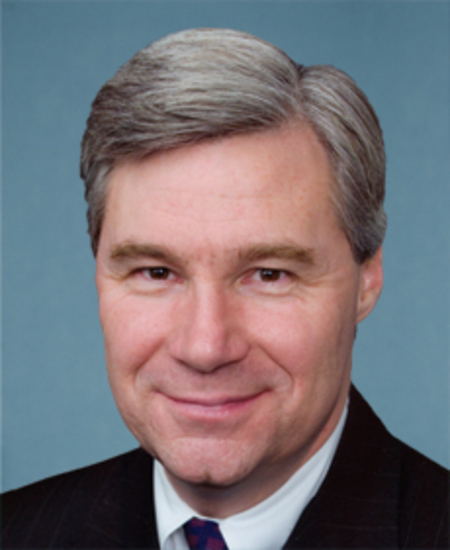
Sen. Sheldon Whitehouse
Sponsored bills
This resolution (1) expresses support for the designation of the week of November 1-November 5, 2021, as National Family Service Learning Week, (2) recognizes the importance of family service learning in cultivating civic engagement and community investment, and (3) encourages the public to support family service learning and community development programs. Family service learning is a multigenerational problem-solving approach that utilizes active participation to meet community needs and develop the skillsets of children and families.
John R. Lewis Voting Rights Advancement Act of 2021 This bill establishes new criteria for determining which states and political subdivisions must obtain preclearance before changes to voting practices may take effect. Preclearance is the process of receiving preapproval from the Department of Justice (DOJ) or the U.S. District Court for the District of Columbia before making legal changes that would affect voting rights. The bill also includes provisions related to federally protected activities at polling places and voting access on tribal lands. A state and all of its political subdivisions shall be subject to preclearance of voting practice changes for a 10-year period if 15 or more voting rights violations occurred in the state during the previous 25 years; or 10 or more violations occurred during the previous 25 years, at least 1 of which was committed by the state itself. A political subdivision as a separate unit shall also be subject to preclearance for a 10-year period if three or more voting rights violations occurred there during the previous 25 years. States and political subdivisions that meet certain thresholds regarding minority groups must preclear covered practices before implementation, such as changes to methods of election and redistricting. Further, states and political subdivisions must notify the public of changes to voting practices. Next, the bill authorizes DOJ to require states or political subdivisions to provide certain documents or answers to questions for enforcing voting rights. The bill also outlines factors courts must consider when hearing challenges to voting practices, such as the history of official voting discrimination in the state or political subdivision. In addition, the bill (1) includes certain protections for election workers, polling places, and election infrastructure; and (2) expands voting access on tribal lands.
Foreign Extortion Prevention Act This bill establishes a federal criminal offense involving bribery by foreign officials. Specifically, the bill makes it a crime for foreign officials to demand or accept anything of value personally or for another person or a nongovernmental entity to influence the performance of an official act or otherwise confer an improper advantage. The bill explicitly grants extraterritorial jurisdiction over the offense. A violation is subject to criminal penalties—a fine, a prison term of up to 15 years, or both. Finally, the bill establishes a Victims of Kleptocracy Fund in the Treasury and directs fines and penalties for violations to be deposited into the fund for anti-corruption initiatives.
Fair Day in Court for Kids Act of 2021 This bill provides legal protections for a noncitizen (i.e., an individual referred to as an alien in federal law) who is detained or subject to immigration-related proceedings. The Department of Justice (DOJ), or the Department of Health and Human Services (HHS) in a case involving an unaccompanied child, may appoint or provide counsel at the government's expense to noncitizens in removal proceedings and related appeals. An unaccompanied child must be represented by counsel paid for and appointed by the government at every stage of such proceedings unless the child has obtained counsel at their own expense. If HHS fails to provide counsel to an unaccompanied child, the deadline for filing a motion to reopen a proceeding shall not apply, and the filing of such a motion shall stay the child's removal from the United States. The Department of Homeland Security (DHS) must provide a complete copy of a noncitizen's immigration file to the noncitizen (or the noncitizen's counsel) within seven days of a notice to appear for an immigration proceeding, and failure to provide the file shall result in a delay in the proceeding. DHS must provide access to counsel for all detained noncitizens. The bill authorizes HHS to enter into contacts or award grants for providing immigration-related legal services to children. The Office of Refugee Resettlement must develop model guidelines for representing noncitizen children in immigration proceedings.
Ending Passenger Rail Forced Arbitration Act This bill prohibits all pre-dispute arbitration agreements and pre-dispute joint-action waivers with respect to consumer and civil rights disputes between Amtrak and its customers.
Cancer Drug Parity Act of 20 21 This bill requires group health plans that cover anticancer medications administered by a health care provider to provide no less favorable cost sharing for patient-administered anticancer medications. This requirement applies to medications that are (1) approved by the Food and Drug Administration; (2) medically necessary for the cancer treatment; and (3) clinically appropriate in terms of type, frequency, extent site, and duration. To comply with this requirement, plans may not, with respect to anticancer medications (1) change or replace benefits to increase out-of-pocket costs, (2) reclassify benefits to increase costs, or (3) apply more restrictive limitations to orally administered medications than to intravenously administered or injected medications.
Social Security 2100: A Sacred Trust This bill makes changes to Social Security benefits, taxes, and other aspects of the program, including by raising the primary insurance amount, increasing the maximum taxable earnings that are subject to Social Security payroll taxes, and requiring Social Security account statements to be mailed unless the individual recipient opts for electronic delivery.
Promoting Reentry through Education in Prisons Act of 2021 or the PREP Act This bill establishes, within the Bureau of Prisons, an Office of Prison Education. The office must provide educational services to incarcerated individuals in federal prisons and correctional institutions.
Protecting Americans from Dangerous Algorithms Act This bill limits a social media company's immunity from liability if it promotes certain content on its platform. Specifically, the bill removes this immunity from a social media company with more than 10 million monthly users if it utilizes an algorithm, model, or other computational process to amplify or recommend content to a user that is directly relevant to a claim involving (1) interference with civil rights, (2) neglect to prevent interference with civil rights, or (3) acts of international terrorism.