

Maddy summaryThe FAIR Labels Act of 2024 requires that imitation meat and poultry products - those marketed as meat or poultry but containing no actual meat or poultry - display the word "imitation" or a clear statement that they are derived from non-meat sources, along with a disclaimer that they do not contain meat or poultry, all prominently on the label. It also mandates that cell-cultured meat and poultry products (grown from animal cells outside a live animal) be labeled with "cell-cultured" or "lab-grown" in a visible manner. These labeling rules apply to all such products sold in interstate commerce with no exceptions, directly affecting food manufacturers and retailers. The bill aims to clarify product origins for consumers while aligning with existing federal meat and poultry inspection laws.
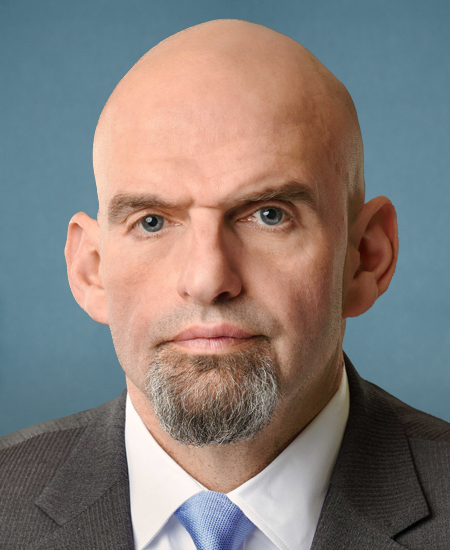
Sen. John Fetterman
Sponsored bills
Maddy summaryS 3688, the FAIR Act, sets pay adjustments for federal employees in 2025. It increases base pay by 4% for most federal workers covered under statutory pay systems and prevailing rate employees (those paid according to local market rates). Additionally, it raises locality pay adjustments by 3.4% for 2025. The bill directly affects all federal employees whose pay is determined under these specific pay systems. These changes are mandated by statute and apply to calendar year 2025.
Maddy summaryThis resolution (SRES 534) designates January as "Muslim-American Heritage Month" to officially recognize and celebrate the contributions of Muslim Americans to U.S. society. It directly affects Muslim Americans by formally acknowledging their cultural, historical, and economic impacts, including their roles in fields like architecture, business, military service, and the arts. The resolution supports the designation, honors Muslim Americans' integral role in the nation's economy and identity, and urges public observance through ceremonies and activities. As a non-binding Senate resolution, it does not create new laws but serves as a symbolic gesture of recognition.
Maddy summarySRES 533 is a Senate resolution expressing support for designating January 21-27, 2024, as "National Board Certified Teachers Week." It recognizes National Board Certified Teachers (NBCTs) for their role in improving student achievement, particularly in high-needs schools, and highlights that 44% of NBCTs serve in Title I schools. The resolution encourages schools, districts, and states to promote NBCT growth and provide incentives for certification, without creating new legal requirements or altering funding. As a symbolic gesture, it does not directly affect policy or individuals but aims to honor educators' contributions.
Maddy summaryThis bill updates the Agricultural Foreign Investment Disclosure Act (AFIDA) to strengthen reporting requirements for foreign ownership of U.S. agricultural land. It requires foreign individuals or entities holding at least 1% interest (directly or through multiple ownership layers) to report holdings, and directs the Farm Production and Conservation Business Center (FPAC-BC) to validate data and ensure compliance. The bill also mandates coordination with the Committee on Foreign Investment in the U.S. (CFIUS), updates the Farm Service Agency handbook using GAO recommendations, and analyzes streamlining electronic reporting. These changes aim to improve transparency and national security oversight of foreign agricultural land investments.
Maddy summaryThis bill increases the Child and Dependent Care Tax Credit for eligible taxpayers. It raises the maximum credit rate from 35% to 50% (with income phaseouts), doubles the annual dollar limits from $3,000/$6,000 to $8,000/$16,000 for one/two or more dependents, and makes the credit refundable for qualifying taxpayers. The credit becomes refundable, meaning families can receive payments even if they owe no income tax. The bill also includes automatic annual inflation adjustments starting in 2025 to maintain the credit's value. It directly benefits working families with childcare costs, particularly those earning between $125,000 and $400,000 in adjusted gross income.
Maddy summaryThis bill reauthorizes and improves the HOME Investment Partnerships Program, which provides federal funds to states and localities to develop affordable housing. It increases annual funding from $5 billion in 2024 to $6.08 billion in 2028 (with annual inflation adjustments), raises administration resource limits from 10% to 15% of funds, and establishes a new home loan guarantee program with up to $2 billion in initial funding. The bill modifies eligibility rules for affordable housing, eliminates a commitment deadline, reforms homeownership resale restrictions, and adds protections for tenants in small-scale housing projects. These changes directly affect states and localities administering the program, community housing development organizations, and low-income households living in affordable housing.
Maddy summarySRES 523 is a Senate resolution honoring the late Senator Herb Kohl of Wisconsin. The resolution expresses the Senate's sorrow at his death, directs the Secretary of the Senate to communicate it to the House of Representatives and send a copy to his family, and instructs the Senate to adjourn as a mark of respect. This procedural resolution does not create new laws or affect policy, but formally commemorates Kohl's service and legacy. It was introduced by a bipartisan group of Senators and passed unanimously on January 11, 2024.
Maddy summaryThis bill amends federal law to ensure military offenses under the Uniform Code of Military Justice (UCMJ) are treated equally with civilian offenses in child exploitation cases. It updates references throughout Title 18 to replace outdated phrasing (like "section 920 of title 10") with "the Uniform Code of Military Justice" in key provisions. The changes directly affect military personnel facing federal prosecution for child exploitation, ensuring their cases align with civilian legal standards. The bill makes no new penalties but clarifies that UCMJ offenses are considered equivalent to state offenses under federal sentencing guidelines.
Maddy summaryS 3627, the Distribution Transformer Efficiency and Supply Chain Reliability Act of 2024, prevents federal rules from requiring distribution transformers to meet efficiency levels stricter than "trial standard level 2" for liquid-immersed and dry-type transformers. It directly affects manufacturers of these transformers by limiting future efficiency standards. The key provision delays any finalized rule for "trial standard level 1 or 2" efficiency from taking effect for 10 years after finalization. This bill aims to provide stability for the supply chain by slowing the implementation of stricter efficiency requirements.