

Right to IVF Act This bill provides a statutory right to access fertility treatments (e.g., in vitro fertilization). Specifically, under the bill, individuals have the right to access fertility treatments and to make decisions about the use of their reproductive genetic material (e.g., embryos) without limitation or interference. Health care providers and insurers have the right to provide and cover these services, respectively. Manufacturers of applicable drugs or devices also have the right to provide these drugs or devices. The bill supersedes state laws that limit or otherwise interfere with the provision of fertility treatments as set out under this bill, including laws that require medically unnecessary procedures or services in conjunction with fertility treatments or that restrict the ability of individuals to receive fertility treatments based on marital status or sex (including sexual orientation or gender identity). The bill does not affect state health and safety regulations for medical facilities or health care providers that are in accordance with widely accepted and evidence-based medical standards and for which the purpose cannot be achieved in another, nonrestrictive manner. The Department of Justice may bring civil actions against states, individuals, or entities that implement or enforce limitations or requirements that violate this bill. Individuals and health care providers may also bring civil actions. In addition, the bill provides for coverage of fertility treatments under Medicare and Medicaid and for members of the uniformed services and veterans. It also requires private insurers that cover obstetrical services to also cover fertility treatments.
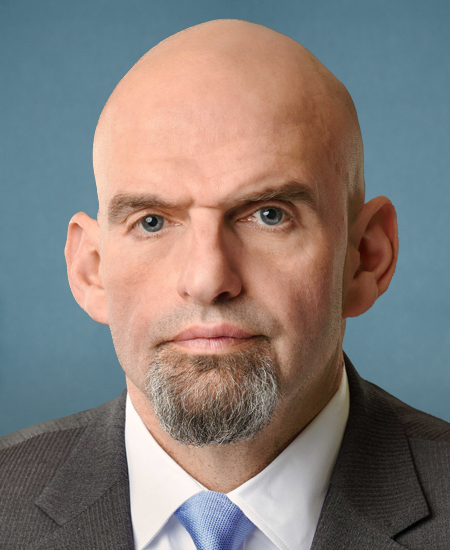
Sen. John Fetterman
Sponsored bills
Maddy summaryThis bill directs the National Park Service to conduct a feasibility study for designating Washington’s Trail - 1753 as a National Historic Trail. The study will examine a 500-mile route from Williamsburg, Virginia, to Waterford, Pennsylvania, following George Washington’s 1753 diplomatic journey. It focuses on the route’s historical significance and practicality for official designation under the National Trails System Act. The bill itself only authorizes the study - not the trail’s creation - and affects no specific communities or entities beyond the study’s scope.
Maddy summaryThis bill would expand eligibility for the Supplemental Nutrition Assistance Program (SNAP) to include college students who meet specific criteria, such as participating in work-study programs or meeting financial requirements. It creates a demonstration program to test new ways for students to use SNAP benefits on campus, including purchasing prepared foods from campus dining facilities without needing to buy a meal plan. The bill requires federal agencies to share data to identify students who might qualify for nutrition assistance and mandates institutions of higher education to provide information about available benefits. It also authorizes $1 billion in grants over seven years to support campus-based programs addressing food insecurity, housing instability, and other basic needs for students. The bill would directly affect millions of college students, particularly those from low-income backgrounds, by making it easier to access food assistance while attending college.
Maddy summaryThe Protecting American Agriculture from Foreign Adversaries Act of 2024 requires the Secretary of Agriculture to join the Committee on Foreign Investment in the United States (CFIUS) when reviewing transactions involving U.S. agricultural land, biotechnology, or agricultural industry sectors (including transportation, storage, and processing) with foreign entities from China, North Korea, Russia, or Iran. It mandates that the Secretary of Agriculture notify CFIUS about transactions where a foreign person from one of these "covered countries" is acquiring agricultural land, and CFIUS must then determine whether to initiate a review. This applies only to transactions already reportable under the 1978 Agricultural Foreign Investment Disclosure Act and expires for any covered country once it is removed from the official list of foreign adversaries. The law directly affects foreign investors from specified countries seeking to purchase U.S. agricultural assets and the federal review process for such transactions.
Maddy summarySRES 800 is a symbolic Senate resolution introduced on August 1, 2024, by a bipartisan group of senators. It condemns the July 13, 2024, attempted assassination of Donald J. Trump at a Butler, Pennsylvania, rally and honors three individuals affected: Corey D. Comperatore (who died shielding his family), David Dutch (critically injured), and James Copenhaver (critically injured). The resolution calls for national unity and civility following the violent incident. As a non-binding resolution, it does not create new laws or policies but expresses the Senate's stance on the event.
Maddy summary# Summary of Proposed Employment Rights and Anti-Discrimination Legislation This comprehensive bill proposes significant reforms to address workplace discrimination and harassment, with several key provisions: ## Key Provisions 1. **Expanded Protections**: - Extends protections to independent contractors, interns, volunteers, and trainees (Section 301) - Explicitly prohibits discrimination based on sex, sexual orientation, gender identity, and other protected characteristics 2. **Nondisclosure and Nondisparagement Agreements**: - Prohibits employers from requiring nondisclosure or nondisparagement clauses that cover harassment or discrimination claims (Section 302) - Establishes specific requirements for valid settlement agreements (21-day consideration period, written advice to consult attorney, 7-day revocation period) - Requires enforcement against employers who attempt to enforce prohibited clauses 3. **Arbitration Restrictions**: - Bans mandatory pre-dispute arbitration agreements for work disputes (Section 303) - Requires specific disclosures and waiting periods for post-dispute agreements - Allows civil actions for violations with attorney's fees 4. **Federal Contractor Requirements**: - Requires federal contractors to disclose labor and civil rights violations (Section 304) - Mandates periodic updates on compliance status - Establishes Labor Compliance Advisors within executive agencies 5. **Grant Programs**: - Creates national grants for preventing and addressing discrimination (Section 411-413) - Establishes legal assistance grants for low-income workers (Section 421-423) - Funds state advocacy systems to protect workers' rights (Section 431-436) ## Significance This legislation would substantially increase protections for workers by: - Making it easier to report harassment and discrimination - Preventing employers from silencing victims through restrictive agreements - Creating stronger enforcement mechanisms - Expanding access to legal assistance for vulnerable workers - Holding federal contractors accountable for labor violations The bill represents a major shift in workplace rights law, with implications for nearly all employers in the United States and significant changes to how discrimination claims are handled through legal processes.
Maddy summaryThe Moving Transit Forward Act of 2024 creates a new federal grant program to fund public transportation improvements in urban areas. It provides 80% federal funding for eligible costs, including operating expenses to increase service quality/frequency (e.g., more buses), security enhancements (like hiring personnel), and safety projects identified by transit agencies. Urbanized areas (cities over 50,000 people) receive apportioned funds based on their past operating expenses relative to all urban areas. Recipients must certify they will maintain or increase non-federal spending on these specific areas and cannot use funds to transition fixed-route service to third-party on-demand providers. This directly affects city transit agencies seeking to improve service access, safety, and security in their systems.
Maddy summaryThis Senate resolution (SRES 782) designates August 4-10, 2024, as "National Farmers Market Week" to symbolically recognize the role of farmers markets. It directly affects farmers markets across the U.S., which support local economies, connect urban and rural communities, and provide access to fresh food - particularly for low-income populations using nutrition benefits. The resolution highlights their economic impact ($1.7 billion in 2020), growth (8,771 markets in 2019), and contribution to sustainable farming and community health, without creating new laws or funding.
Maddy summaryThis resolution recognizes the progress made by the Americans with Disabilities Act of 1990 in advancing independent living and economic self-sufficiency for people with disabilities, while highlighting persistent challenges like high poverty rates, employment barriers, and inaccessible services. It calls on multiple federal agencies - including the Department of Labor, Health and Human Services, and the Federal Communications Commission - to take specific actions, such as developing employment policies, improving accessibility in communications, and expanding home- and community-based services. The resolution urges bipartisan efforts to dismantle systemic barriers and strengthen opportunities for people with disabilities to fully participate in work and community life. As a non-binding resolution, it does not create new laws but serves as a formal statement of congressional intent and a framework for future policy action.
Maddy summaryThe Section 508 Refresh Act of 2024 updates federal accessibility requirements for information and communications technology (ICT), replacing outdated terminology throughout the law. It requires federal agencies to routinely involve people with disabilities in developing, testing, and remedying ICT, establishes a uniform complaint process for accessibility violations, and mandates pre-acquisition testing for compliance. The bill imposes mandatory civil penalties of at least 3% of a contract's value for noncompliant vendors and requires agencies to appoint accessibility compliance officers who must annually certify compliance on agency websites. It also creates a "Good Samaritan" bonus program for vendors who identify missing accessibility requirements before contracts are finalized. The act aims to strengthen enforcement of accessibility standards across all federal ICT, making government services more accessible to people with disabilities.