

Maddy summaryThe Public Service Freedom to Negotiate Act of 2025 establishes federal minimum standards for collective bargaining rights for public employees and supervisory employees. The Federal Labor Relations Authority will determine if states' laws "substantially provide" these rights, and if not, the federal standards will apply to affected workers. The bill guarantees rights like forming labor organizations, negotiating wages and working conditions, and resolving disputes through mediation or arbitration, while prohibiting strikes that would disrupt emergency services. Existing collective bargaining agreements and units are protected from the bill's implementation.
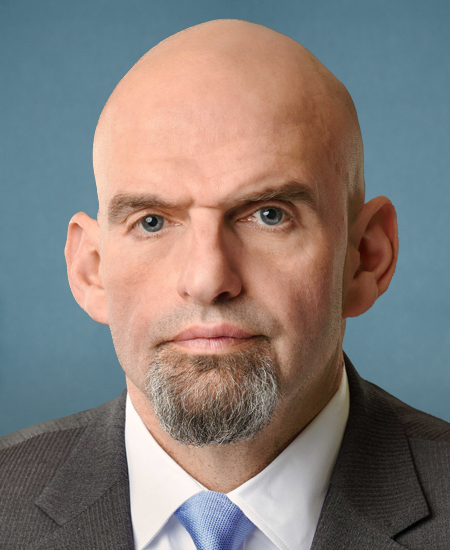
Sen. John Fetterman
Sponsored bills
Maddy summaryThis resolution (SRES 159) is a ceremonial Senate measure honoring the late Senator John Bennett Johnston, Jr. (1932-2024), who represented Louisiana in the U.S. Senate from 1972 to 1997. It commemorates his career, including his work on energy policy, flood control, and Louisiana conservation efforts, and requests the Senate adjourn in his memory while sending condolences to his family. As a non-binding resolution, it has no policy impact or direct effect on any individuals or laws.
Maddy summaryS 1310, the No Tax Breaks for Union Busting (NTBUB) Act, denies tax deductions for employer spending aimed at influencing workers' decisions about union organizing or collective bargaining. It amends the tax code to block deductions for expenses like anti-union consultant fees, captive audience meetings, and other tactics that interfere with labor rights under the National Labor Relations Act. Employers must report such spending on tax returns with specific details, including dates, amounts, and whether activities relate to unfair labor practice charges. This directly affects businesses that engage in anti-union organizing tactics, removing a tax incentive for these activities while preserving deductions for standard union negotiations.
Maddy summaryThe IDEA Full Funding Act (S 1277) mandates specific annual funding levels for the Individuals with Disabilities Education Act (IDEA) starting in fiscal year 2026. It sets fixed dollar amounts or percentage-based funding (ranging from 11.6% to 40% of a calculated base) for states providing special education services to children with disabilities aged 3-21. Funding becomes available on July 1 each year and remains accessible through September 30 of the following year, with amounts increasing annually through 2035. This directly affects all states receiving IDEA grants by guaranteeing minimum federal funding tied to the number of eligible students and national per-pupil spending averages.
Maddy summaryThis bill would allow workers to deduct union dues directly from their taxable income (an "above-the-line" deduction) and restore deductions for other work-related expenses like uniforms or tools that were disallowed after 2017. It affects employees who pay union dues or incur job-specific costs, particularly those in unionized workplaces or professions requiring specialized equipment. The key mechanism creates a new deduction for union dues under existing tax code sections and revives the ability to itemize other work expenses, excluding them from the 2% floor on miscellaneous deductions. These changes would apply to tax returns filed for years beginning after December 31, 2024.
Maddy summaryThe BOP SCAN Mail Act requires the Bureau of Prisons to implement digital mail scanning at all federal correctional facilities to detect and prevent synthetic drugs like fentanyl from entering prisons through inmate mail. Within 180 days of enactment, the BOP Director must evaluate scanning technology and submit a strategy to Congress for achieving 100% mail scanning, including providing inmates digital mail copies within 24 hours and physical copies within 30 days if no drugs are detected. The strategy must cover equipment, training, a 2025-2027 budget, and annual progress reports on drug detection and program efficiency. This directly affects 122 federal prisons, their 38,000 employees, and over 150,000 inmates by addressing a 600% rise in drug-related overdoses linked to mail-sent contraband.
Defending Education Transparency and Ending Rogue Regimes Engaging in Nefarious Transactions Act or the DETERRENT Act This bill expands oversight and disclosure requirements related to foreign sources and institutions of higher education (IHEs). Specifically, the bill requires an IHE to annually disclose to the Department of Education (ED) any year in which the IHE receives a gift from a foreign country of concern (e.g., China or Russia) or foreign entity of concern of any dollar amount; receives a gift or contract from a foreign source (other than a foreign country of concern or foreign entity of concern) that is valued at $50,000 or more, considered alone or in combination with all other gifts or contracts within a calendar year (current disclosure threshold is $250,000 or more), or which has an undetermined monetary value; enters into a contract with a foreign country of concern or foreign entity of concern after receiving a waiver for such contract; or is substantially controlled by a foreign source. Additionally, the bill prohibits IHEs from entering into contracts with a foreign country of concern or with a foreign entity of concern without obtaining a waiver, and requires certain IHEs to disclose gifts or contracts between covered individuals (e.g., researchers) and foreign sources. The bill requires ED to investigate possible violations of this bill and outlines the various penalties for each violation. Penalties may include losing eligibility for federal student financial aid.
Maddy summaryThe Fair Day in Court for Kids Act of 2025 requires the government to provide free legal counsel at no cost to unaccompanied children in immigration court proceedings, starting as soon as possible after a notice to appear is issued. It mandates that children receive their complete immigration file within 7 days and have at least 10 days to review it before court proceedings continue, unless they waive this time. The bill also requires annual reports to Congress on the number of children represented, their nationalities and ages, and the effectiveness of legal representation programs.
Maddy summaryThis bill requires the Department of Housing and Urban Development (HUD) to develop guidelines for states and local governments to reform zoning laws that limit housing supply. The guidelines would recommend specific changes like eliminating parking minimums, allowing more housing types (such as duplexes and accessory units), and streamlining approval processes for new projects. It directly affects state and local governments, housing developers, and communities facing housing shortages - addressing a 3.85 million home shortfall cited in the bill. HUD must report to Congress on which states and localities adopt these reforms and their impact on building permits.
Maddy summaryThe Rural Housing Service Reform Act of 2025 establishes a permanent housing preservation and revitalization program to maintain affordable multifamily housing projects financed under sections 514, 515, and 516 of the Housing Act of 1949, authorizing $200 million annually for fiscal years 2026-2030 to support loan restructuring, rental assistance renewal, and technical assistance for owners. The bill creates a $50 million annual set-aside for Native community development financial institutions to increase homeownership opportunities for Indian Tribes, Alaska Native communities, and Native Hawaiian communities. Additionally, it modifies Section 504 loans to reserve 60% for very low-income applicants and increases the loan cap from $7,500 to $15,000, while adjusting rural housing voucher processes to allow more frequent recalculation based on changing household circumstances.