

Maddy summaryThe Ending the Carried Interest Loophole Act changes how the IRS treats partnership interests given to employees for their work, specifically targeting financial managers and investment professionals. Under the new rules, these individuals must pay ordinary income tax on the value of their partnership shares at the time they receive them, rather than waiting until they sell the shares to pay lower capital gains taxes. The law also establishes a 10-year window during which any future profits earned from these shares are taxed as ordinary income instead of capital gains. Additionally, the bill repeals an existing tax provision that previously allowed certain carried interest payments to be classified as capital gains.
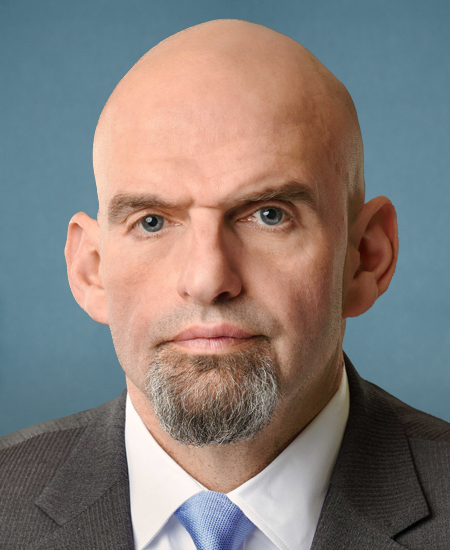
Sen. John Fetterman
Sponsored bills
Maddy summaryThe Stop CHEATERS Act directs the Internal Revenue Service to increase its enforcement efforts against high-income individuals and large corporations while also expanding taxpayer support services. To achieve this, the bill appropriates billions of dollars over several years to fund IRS investigations, hire additional staff, purchase vehicles, and modernize outdated technology systems. Additionally, the legislation requires the IRS Commissioner to submit regular reports to Congress detailing plans to shift auditing resources toward wealthy taxpayers and analyzing collection gaps across different income levels.
Maddy summaryThis bill, titled the "Keep Public Funds in Public Schools Act," repeals two sections of the Internal Revenue Code. It eliminates Section 25F, which provides a tax credit for contributions made to scholarship granting organizations. Additionally, the bill repeals Section 139K, which allows certain educational assistance to be excluded from an individual's gross income. These changes primarily affect taxpayers who currently claim these credits or exclusions, and organizations involved in scholarship grants or providing educational assistance. The amendments generally take effect for taxable years ending after December 31, 2026.
Maddy summaryThe Combating Illicit Xylazine Act places xylazine - a veterinary sedative increasingly found in illicit drug mixtures - into Schedule III of the Controlled Substances Act, subjecting it to federal regulation as a controlled substance. It specifically allows veterinary use without requiring registration of the ultimate user (e.g., pet owners or veterinarians) if xylazine is dispensed by a registered veterinarian or pharmacy with a vet prescription and used for animals owned by the user, under their care, or in authorized animal programs. The bill provides a one-year delay for labeling and packaging requirements and a 60-day delay for registration and recordkeeping for veterinary use to ease implementation. Additionally, it adds xylazine to the Arcos tracking system for controlled substances and mandates two congressional reports on illicit use prevalence within 18 months and 4 years of enactment.
Great Lakes Restoration Initiative Act of 2025 or the GLRI Act of 2025 This bill reauthorizes through FY2031 the Great Lakes Restoration Initiative, which carries out programs and projects to protect and restore the Great Lakes.
Maddy summaryThis bill, the Retirement Annuity Supplement Clarity Act, clarifies how federal retirement annuity supplements are divided in court orders, such as divorce decrees. For future court orders, these supplements will be included in the division of an annuity unless the order specifically states otherwise. The bill also provides a one-time payment to certain federal retirees whose annuity supplements were retroactively divided by the Office of Personnel Management between 2016 and the bill's enactment, despite their court orders being silent or excluding the supplement. Additionally, any related overpayments made to annuitants or former spouses before the bill's enactment are waived.
Maddy summaryThe Senior Hunger Prevention Act of 2026 aims to improve food access for older adults, adults with disabilities, and kinship families by expanding and streamlining several federal nutrition programs. The bill extends SNAP certification periods, creates a standard medical expense deduction, and establishes simplified application processes for eligible seniors and individuals with disabilities. It also funds a new program to reimburse retail food stores for delivering groceries to these vulnerable populations and provides grants for outreach and application assistance. Additionally, the Act expands eligibility and increases funding for the Commodity Supplemental Food Program and the Seniors Farmers' Market Nutrition Program, including grants for market modernization and infrastructure development to support local food access.
Maddy summaryThe National Quantum Initiative Reauthorization Act of 2026 reauthorizes and expands federal efforts to advance quantum information science, engineering, and technology through 2034. The bill establishes new workforce development programs, including quantum education initiatives, traineeships, and a Quantum Reskilling, Education, and Workforce Coordination Hub to address talent needs. It creates an International Quantum Cooperation Strategy to foster partnerships with allies and addresses quantum supply chain vulnerabilities through mapping and planning efforts. The act includes specific funding allocations for quantum research centers, testbeds, and post-quantum cryptography development, with annual evaluations required to assess program effectiveness. The legislation directly affects federal agencies, research institutions, and the quantum industry by providing structured funding and coordination for quantum technology advancement.
Maddy summaryS 1885, the Stop the Scroll Act, requires major social media platforms and anonymous content-sharing apps (defined as "covered platforms") to display clear mental health warning labels each time a U.S. user accesses the service. The labels must warn users about potential mental health risks linked to social media use and provide access to resources like the 988 Suicide Lifeline. Platforms must display the label prominently upon entry, redisplay it hourly after user acknowledgment, and cannot hide it in terms of service or allow disabling. This law directly affects all covered platform providers operating in the U.S., mandating specific disclosure practices to inform users about health risks before engagement.
Holocaust Expropriated Art Recovery Act of 2025 This act permanently extends and expands judicial authority under the Holocaust Expropriated Art Recovery Act of 2016. The law allows and establishes procedures for civil claims and causes of action to recover artwork and other property lost between 1933 and 1945 because of Nazi persecution. Among the changes, the act removes the deadline for filing civil claims or causes of action. Currently, the filing deadline is December 31, 2026. (Claims must still be filed within six years of the claimant's discovery of the property in question.) The act permits courts to exercise jurisdiction over civil claims or causes of action against a foreign state without regard to the nationality or citizenship of the alleged victim. The art or property at issue must still have a connection to the foreign state's commercial activities in the United States. Additionally, the act authorizes nationwide service of process, which allows courts to exercise personal jurisdiction over defendants in any judicial district where they may be found, reside, have an agent, or transact business. Finally, the act limits the defenses that may be asserted against civil claims or causes of action, including by prohibiting defenses based on the passage of time, including equitable defenses such as laches (i.e., unreasonable delays); and discretionary bases for dismissal that are unrelated to the merits of the claim, including international comity (i.e., deference to the laws of other countries). These changes apply to pending and future civil claims or causes of action.