

Maddy summaryThis bill directs the Government Accountability Office (GAO) to conduct a comprehensive study on liquid cooling technologies for data centers, specifically to assess their potential for improving energy efficiency as AI workloads grow. The study will evaluate technical aspects like single-phase vs. 2-phase cooling systems, coolant options, heat-reuse opportunities, and safety considerations, while comparing costs and benefits to traditional air cooling. Federal agencies, including the Department of Energy, will use the findings to inform future decisions about cooling infrastructure for government data centers and AI systems. The bill does not mandate new policies or funding but requires a detailed report within 90 days of enactment to guide future adoption.
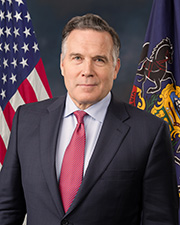
Sen. David McCormick
Sponsored bills
Maddy summaryThis bill requires federal agencies to submit proposed regulations affecting power generation for review by the Federal Energy Regulatory Commission (FERC) before finalizing them. It directly affects agencies like the Environmental Protection Agency (EPA) and Department of Energy (DOE) when they develop rules related to power plants or grid operations. The key mechanism mandates that if FERC’s Electric Reliability Organization (ERO) identifies a risk of insufficient power supply, the Commission must notify relevant agencies and require them to submit their regulations for review. FERC can then comment on reliability impacts and recommend modifications to avoid disruptions, with agencies needing to address these comments before finalizing rules.
Maddy summaryThe Combating Illicit Xylazine Act places xylazine - a veterinary sedative increasingly found in illicit drug mixtures - into Schedule III of the Controlled Substances Act, subjecting it to federal regulation as a controlled substance. It specifically allows veterinary use without requiring registration of the ultimate user (e.g., pet owners or veterinarians) if xylazine is dispensed by a registered veterinarian or pharmacy with a vet prescription and used for animals owned by the user, under their care, or in authorized animal programs. The bill provides a one-year delay for labeling and packaging requirements and a 60-day delay for registration and recordkeeping for veterinary use to ease implementation. Additionally, it adds xylazine to the Arcos tracking system for controlled substances and mandates two congressional reports on illicit use prevalence within 18 months and 4 years of enactment.
Maddy summaryThis bill directs the Federal Energy Regulatory Commission (FERC) to create new rules improving how new "dispatchable power" projects (like natural gas plants or battery storage that can be turned on when needed) connect to the grid. Transmission providers (utilities, grid operators) must propose prioritizing these projects in the interconnection queue to boost grid reliability and resilience, demonstrating how this improves service and allowing public input before submitting proposals. FERC must complete this rulemaking within 180 days of the bill's enactment, with regular updates every five years. The bill directly affects transmission providers and developers of new power projects by changing interconnection procedures to speed up reliable grid upgrades.
Maddy summaryThe Nuclear Energy Innovation and Deployment Act of 2026 aims to accelerate the development and deployment of advanced nuclear technologies in the United States. It expands the Department of Energy's (DOE) authority to regulate certain nuclear facilities and activities, including commercial ones on federal land or for federal purposes, and requires the Nuclear Regulatory Commission to revise related regulations. The bill establishes a "Nuclear Energy Launch Pad" program where private companies can test and demonstrate advanced nuclear reactors and fuel cycle technologies in designated federal zones, providing streamlined pathways to commercial licensing. Additionally, it allows Federal power marketing administrations to purchase, transmit, and market electricity from nuclear facilities. Finally, it creates a new program to repurpose surplus plutonium for use as fuel in advanced reactors, terminating the previous "dilute and dispose" program. These changes primarily affect the Department of Energy, private nuclear technology developers, federal power marketing agencies, and the Nuclear Regulatory Commission.
Maddy summaryThe National Quantum Initiative Reauthorization Act of 2026 reauthorizes and expands federal efforts to advance quantum information science, engineering, and technology through 2034. The bill establishes new workforce development programs, including quantum education initiatives, traineeships, and a Quantum Reskilling, Education, and Workforce Coordination Hub to address talent needs. It creates an International Quantum Cooperation Strategy to foster partnerships with allies and addresses quantum supply chain vulnerabilities through mapping and planning efforts. The act includes specific funding allocations for quantum research centers, testbeds, and post-quantum cryptography development, with annual evaluations required to assess program effectiveness. The legislation directly affects federal agencies, research institutions, and the quantum industry by providing structured funding and coordination for quantum technology advancement.
Holocaust Expropriated Art Recovery Act of 2025 This act permanently extends and expands judicial authority under the Holocaust Expropriated Art Recovery Act of 2016. The law allows and establishes procedures for civil claims and causes of action to recover artwork and other property lost between 1933 and 1945 because of Nazi persecution. Among the changes, the act removes the deadline for filing civil claims or causes of action. Currently, the filing deadline is December 31, 2026. (Claims must still be filed within six years of the claimant's discovery of the property in question.) The act permits courts to exercise jurisdiction over civil claims or causes of action against a foreign state without regard to the nationality or citizenship of the alleged victim. The art or property at issue must still have a connection to the foreign state's commercial activities in the United States. Additionally, the act authorizes nationwide service of process, which allows courts to exercise personal jurisdiction over defendants in any judicial district where they may be found, reside, have an agent, or transact business. Finally, the act limits the defenses that may be asserted against civil claims or causes of action, including by prohibiting defenses based on the passage of time, including equitable defenses such as laches (i.e., unreasonable delays); and discretionary bases for dismissal that are unrelated to the merits of the claim, including international comity (i.e., deference to the laws of other countries). These changes apply to pending and future civil claims or causes of action.
Maddy summaryThe Ensuring Better Interest Treatment and Deductibility Act modifies how businesses calculate interest expense limits for tax purposes. It removes a specific exception related to adjusted taxable income calculations that was added in previous legislation. This change applies to tax years starting after December 31, 2025, affecting businesses that deduct interest expenses on their federal income tax returns. The bill aims to alter the rules governing Section 163(j) of the Internal Revenue Code without changing the overall cap on deductible interest.
Maddy summaryThis bill, the Safer Roads for Those Who Serve Act of 2026, aims to improve safety for highway workers such as construction crews, utility personnel, and emergency responders by updating federal regulations and funding programs. It requires the Federal Highway Administration to better track and separate crash data for highway workers from other road users, and mandates that states with rising injury or fatality rates include specific strategies in their safety plans. The legislation also directs the National Highway Traffic Safety Administration to update public awareness materials and run public service announcements about Move Over laws, covering various types of workers and vehicles. Additionally, the bill requires that federal transportation grant applications include plans for protecting highway workers during and after construction, and authorizes funding for research and outreach to enhance roadside worker safety.
Maddy summaryThe ACE Nuclear Energy Act of 2026 makes two changes to the Export-Import Bank of the United States. First, it allows the bank to exclude certain financing for civil nuclear facilities, materials, or technology from its default rate calculations, which could affect how the bank assesses its lending performance. Second, it gives the bank's Board of Directors authority to compensate up to 100 employees without being limited by standard federal pay rules. These provisions directly impact the Export-Import Bank's operations and its ability to support nuclear energy export transactions.