

Maternal Care Access and Reducing Emergencies Act or the Maternal CARE Act This bill requires the Department of Health and Human Services (HHS) to award grants to health-professional training programs for training that addresses implicit bias (e.g., racial bias) in the practice of obstetrics and gynecology. HHS must also award grants to up to 10 states for pregnancy medical-home programs that reduce adverse maternal-health outcomes and racial disparities. Among other requirements, such programs must prioritize the care of uninsured individuals or Medicaid enrollees. The National Academy of Medicine must make recommendations for incorporating bias recognition in clinical-skills tests at medical schools.
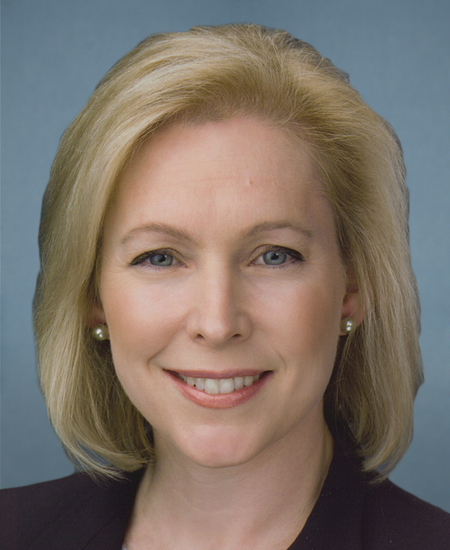
Sen. Kirsten E. Gillibrand
Sponsored bills
This bill excludes from gross income, for income tax purposes, a taxpayer subsidy provided by a state or local government to a resident for the purchase or installation of any wastewater management measure intended solely for the taxpayer's principal residence.
Hate Crimes Commission Act of 2021 This bill establishes the United States Commission on Hate Crimes. The commission must investigate and report on whether hate crimes have increased; factors that contributed to an increase in hate crimes, if one is determined to exist; policies or actions by law enforcement agencies to reduce the commission of hate crimes; the impact of underreporting on hate crimes statistics and prevention; and successful community bias prevention responses.
Civilian Climate Corps for Jobs and Justice Act This bill establishes a Civilian Climate Corps Program and generally revises benefits provided to national service program participants. The bill establishes a Civilian Climate Corps to operate (1) a national climate service program; and (2) a national climate service grant program to help communities respond to climate change and transition to a clean economy, including through reducing carbon emissions. The bill also provides for allowances for participants in certain national service programs, including the Volunteers in Service to America (VISTA) program and the National Civilian Community Corps. The bill expands the exclusion from gross income, for income tax purposes, to exclude amounts received as educational awards or benefits and income attributable to discharges of student loan debt under the National and Community Service Act of 1990.
Access to Contraception for Servicemembers and Dependents Act of 2021 This bill addresses Department of Defense (DOD) contraceptive care and family planning services. Specifically, the bill prohibits cost-sharing requirements with respect to TRICARE beneficiaries for specified prescription contraceptives. Additionally, the bill prohibits cost-sharing requirements for TRICARE Select and TRICARE Prime beneficiaries in relation to any in-network method of contraception or contraceptive care (including with respect to insertion, removal, and follow-up), any sterilization procedure, or any related patient education or counseling service. The bill requires DOD to provide information on all methods of emergency contraception and care to sexual assault survivors at its medical treatment facilities. Upon request by a sexual assault survivor, DOD must provide such emergency contraception or a prescription for emergency contraception. Finally, DOD must establish a uniform standard curriculum for education programs on family planning for all members of the Armed Forces. Such education programs must be provided to service members during their first year of service and at other appropriate times, as determined by each military department.
Big Cat Public Safety Act This bill revises requirements governing the trade of big cats (i.e., species of lion, tiger, leopard, cheetah, jaguar, or cougar or any hybrid of such species). Specifically, it revises restrictions on the possession and exhibition of big cats, including to restrict direct contact between the public and big cats.
Health, Opportunity, and Personal Empowerment Act of 2021 or the HOPE Act of 2021 This bill establishes two Health, Opportunity, and Personal Empowerment (HOPE) pilot projects to improve economic security for individuals who meet income or other requirements. The Department of Health and Human Services (HHS), the Department of Agriculture, and the Department of Housing and Urban Development must collaborate on the projects. The first project provides awards to certain government entities to assist eligible individuals in establishing HOPE accounts through banks, credit unions, or governmental agencies. HOPE accounts must (1) provide access to specified financial services and information on public benefits, health insurance, and other topics; and (2) facilitate activities such as applying for government benefits and filing taxes. HHS must hold a competition to award contracts to private businesses and nonprofits to develop technology applications and other tools for HOPE accounts. The second pilot project provides grants that allow government and nonprofit organizations to enter voluntary agreements with eligible individuals to carry out long-term plans related to improving economic security and upward mobility.
Master Sergeant Roddie Edmonds Congressional Gold Medal Act This bill provides for the posthumous award of a Congressional Gold Medal to Roddie Edmonds in recognition of his achievements and heroic actions during World War II.
United States-Israel Cybersecurity Cooperation Enhancement Act of 2021 This bill requires the Department of Homeland Security to establish a grant program that contributes to the homeland security capabilities of both the United States and Israel by supporting cybersecurity research and development as well as the demonstration and commercialization of cybersecurity technology. Grant applicants must address a requirement in the area of cybersecurity research or cybersecurity technology and be comprised of a joint venture between a U.S. entity and an Israeli entity (or the governments of each country).
Summer Meals Act of 2021 This bill revises provisions related to the Summer Food Service Program (SFSP) of the Department of Agriculture (USDA), which provides meals to children and teens in low-income areas during the summer months when school is not in session. The bill redefines areas in which poor economic conditions exist , where the SFSP may operate, as areas in which at least 40% (currently, 50%) of the children have been determined to be eligible for free or reduced price school meals under the school lunch and breakfast programs. The bill reimburses service institutions (other than school food authorities) for up to one meal and one snack per child each day during after-school hours, weekends, and school holidays during the regular school calendar. Currently, such institutions are reimbursed for meals and snacks served to children over the summer months or to children who are on vacation under a continuous school calendar. USDA must award competitive grants to service institutions to increase participation in the summer food service program for children who lack the ability to access a congregate feeding site through (1) innovative approaches to limited transportation, (2) mobile meal trucks, and (3) any other method or approach that does not require children to access a congregate feeding site. Service institutions that are participating in the summer food service program for children may serve up to three meals, or two meals and one snack, during each day of operation. Currently, this option is reserved for camps and service institutions that serve meals primarily to migrant children.