

Human-Services Emergency Logistic Program Act of 2021 or the HELP Act of 2021 This bill requires the Department of Health and Human Services (HHS) to allot funding to states, tribal nations, and territories to improve the 2-1-1 and 9-8-8 telecommunication systems. The 2-1-1 system provides callers with information and referrals with respect to health and human services and other provider agencies, and the 9-8-8 system provides callers with mental health or suicide crisis support and resources through the National Suicide Prevention Lifeline. The funds must be used solely for making the call systems available to all individuals in the service area, enhancing community information and referrals with respect to human services, or both. As a condition of this funding, recipients must appoint a lead entity to manage activities to improve the call systems. Recipients must also establish a Human Services State Oversight Council to provide the lead entity with guidance and oversight related to the call systems. In addition, HHS must establish a Human Services National Board, comprised of federal and non-federal representatives, to manage the allocation of funds and evaluate the call systems.
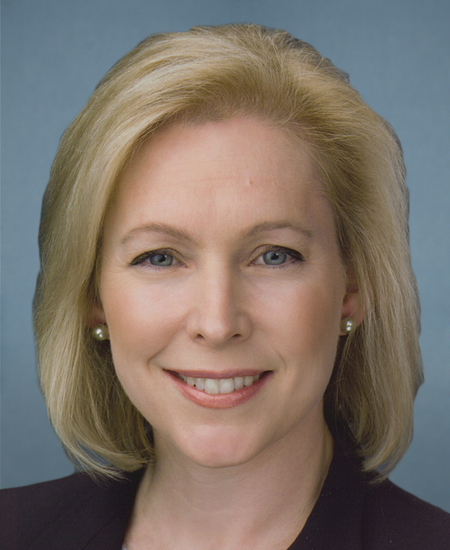
Sen. Kirsten E. Gillibrand
Sponsored bills
Military Child Care Expansion Act of 2021 This bill modifies and implements policies to update child care facilities and administration at the Department of Defense (DOD). Specifically, the bill removes certain requirements for members of the Armed Forces to receive funding for an in-home child care provider under the DOD pilot program that provides financial assistance to such members who pay for in-home child care. The bill also allows DOD to expand the pilot program to additional locations (currently it is authorized for five). DOD must establish a three-year pilot program to expand access to child care for members of the Armed Forces by entering into agreements with public or private child care facilities or development centers. Under the bill, DOD must determine the (1) root causes contributing to poor or failing facility conditions at its child development centers, and (2) total cost to improve the conditions of such centers. The Government Accountability Office must review the determinations and make recommendations on how to improve DOD child development center conditions. Lastly, DOD must utilize its existing authority to carry out minor military construction projects to construct child development centers.
Promoting Energy Alternatives is Key to Emission Reductions Act of 2021 or the PEAKER Act of 2021 This bill addresses the emissions from peaker plants and provides financial incentives for renewable energy to reduce the need for peaker plants. Peaker plants are defined as fossil fuel-fired power plants or units of power plants that are run primarily to meet peak electricity demand. In other words, peaker plants are run where there is above average energy demand, such as during extremely hot or cold weather. The bill establishes an additional investment tax credit for renewable energy generation and battery storage to replace the need for peaker plants in disadvantaged communities. In addition, the Department of Energy (DOE) must establish a grant program to provide up to $1 billion annually through FY2032 to eligible entities for clean energy projects. Specifically, grants must be awarded to assist eligible entities in carrying out (1) projects associated with the construction, installation, or acquisition of qualifying renewable energy facilities and qualifying energy storage facilities; or (2) community energy proposals or community energy studies to reduce or replace the need for peaker plants. Entities that are eligible to receive grants include state or local governments, nonprofit organizations, community-owned energy generation facilities or energy storage facilities located in disadvantaged communities, community-based energy cooperatives, or certain partnerships. DOE must also assess and report on the location of each peaker plant, the quantity and type of pollution each plant is producing, and related data as specified by the bill.
Untraceable Firearms Act of 2021 This bill establishes a federal statutory framework to regulate the manufacture, sale, offer to sell, transfer, purchase, and receipt of ghost guns (i.e., guns without serial numbers). Additionally, the bill revises the federal statutory framework regulating the manufacture, possession, sale, import, shipment, delivery, receipt, and transfer of undetectable firearms. Among the revisions, the bill defines undetectable firearm as a firearm without a major component wholly made of detectable material.
Servicemember Parental Leave Equity Act This bill modifies Department of Defense parental leave provisions for members of the Armed Forces. Specifically, the bill increases parental leave for primary caregivers to 18 weeks (currently 12) following the birth of a child and to 12 weeks (currently 6) following the adoption of a child. The bill increases parental leave for a secondary caregiver from 21 days to 12 weeks in connection with the birth or adoption of a child. Primary or secondary caregivers of a long-term foster child are authorized to take up to 12 weeks of leave in connection with such placement. Parental leave for a primary or secondary caregiver for a birth, adoption, or foster child placement may be taken in more than one increment. For primary caregivers, the leave must be utilized within one year of the event. The bill authorizes up to 12 weeks of leave to certain service members who would have been secondary caregivers but for a miscarriage, stillbirth, or infant death. The following activities required of an active-duty member within a 12-month postpartum period must have the approval of a health care provider and be at the election of the member or in the interest of national security: (1) an order of temporary duty overnight travel or to participate in physically demanding field training exercises, (2) meeting of body composition standards, or (3) passing a physical fitness test. The bill also reduces the service commitment required for participation in the Career Intermission Program.
Foreign Service Families Act of 2021 This bill increases access to career and educational opportunities for eligible family members of foreign service employees. Specifically, the Department of State must use additional hiring preferences and apply appropriate hiring standards to eligible family members seeking employment in certain civil service positions overseas. Additionally, the State Department may take other steps to improve job portability and otherwise support employment of eligible family members who work in the federal civil service or private sector jobs. The State Department must also report on the implementation of the Foreign Service Family Reserve Corps, a program that expedites hiring and onboarding processes for family members who are eligible for appointment to positions overseas. Furthermore, each federal agency must include in its telework policy the circumstances under which an employee may temporarily work from an approved location overseas. The bill also makes foreign service employees (or their spouses and dependent children) who are domiciled or assigned to a duty station in a given state eligible for in-state tuition at public institutions of higher education in that state. Such individuals retain their eligibility for in-state tuition provided they maintain continuous enrollment even if their domicile or duty station changes. Additionally, the bill entitles members of the Foreign Service who are posted abroad to terminate residential and motor vehicle leases and telephone service contracts without being subject to early termination fees.
Andrew Kearse Accountability for Denial of Medical Care Act of 2021 This bill establishes a new federal criminal offense for failing to obtain medical attention for an individual in federal custody who displays medical distress. Specifically, the bill requires federal law enforcement officers and the Bureau of Prisons' personnel to provide or obtain immediate medical attention for an individual in federal custody who displays medical distress. It criminalizes the negligent failure to obtain or provide such medical attention that results in unnecessary pain, injury, or death. A violator is subject to criminal penalties—a fine, a prison term of up to one year, or both.
Safe Interactions Act of 2021 This bill requires the Department of Health and Human Services to award grants to nonprofit disability organizations to develop training programs for law enforcement officers who may encounter individuals with disabilities.
Jobs and Childcare for Military Families Act of 2021 This bill allows an employer a work opportunity tax credit for hiring an individual who is certified by a designated local agency as being, as of the hiring date, the spouse or domestic partner of a member of the Armed Forces, and requires the creation of programs for uniformed services families to pay for childcare on a pretax basis. Specifically, an employer may receive a tax credit equal to 40% of a new employee's first-year wages if the employer hires a service member's spouse or domestic partner (as recognized under state law or by the Armed Forces). Currently, a similar tax credit exists for employers who hire certain disadvantaged individuals, including disadvantaged veterans. The bill requires the Department of Defense, the Department of Homeland Security (with respect to the Coast Guard), the Department of Commerce (with respect to officers of the National Oceanic and Atmospheric Administration), and the Department of Health and Human Services (with respect to the Public Health Service) to implement flexible spending arrangements that permit members of the uniformed services to use basic pay and compensation to pay for childcare services for their dependent children on a pretax basis.
Universal School Meals Program Act of 2021 This bill revises requirements under the food and nutrition programs of the Department of Agriculture, such as the school lunch and breakfast programs. For example, the bill permanently provides free meals to all school children regardless of income. The bill increases the reimbursement rate for school food authorities participating in the food and nutrition programs. The bill also prohibits school food authorities from (1) physically segregating or otherwise discriminating against any child participating in the free breakfast program, or (2) overtly identifying a child participating in the program with a special token or announcement. Additionally, the bill expands the summer food service program by making all children eligible for participation in the program. Further, the bill revises eligibility determinations for measuring poverty to include runaway or homeless youth, foster children, migratory children, and children participating in specified programs (e.g., Head Start).