

Environmental Justice Act of 2021 This bill requires agencies to address and mitigate the disproportionate impact of environmental and human health hazards on communities of color, indigenous communities, and low-income communities resulting from agencies' programs and policies. The bill also requires agencies to address cumulative impacts of pollution in permitting decisions and expands the types of legal actions available to individuals regarding charges of federal discriminatory practices. Specifically, the bill provides statutory authority for a variety of existing programs, executive orders, federal guidance, and committees concerning environmental justice, including Executive Order 12898; a guidance issued in 1997 by the Council on Environmental Quality titled Environmental Justice Guidance Under the National Environmental Policy Act ; a guidance issued in 2016 by the Environmental Protection Agency titled EPA Policy on Consultation and Coordination with Indian Tribes: Guidance for Discussing Tribal Treaty Rights ; the National Environmental Justice Advisory Council; the Environmental Justice Small Grants Program; and the Environmental Justice Collaborative Problem-Solving Cooperative Agreement Program. In addition, the bill requires agencies renewing or issuing specified permits under the Clean Water Act or the Clean Air Act to consider the cumulative impacts of pollution. The bill also allows individuals to bring actions under the Civil Rights Act against entities that receive federal assistance and engage in discriminatory practices that have a disparate impact. Currently, individuals must request that federal agencies bring such actions on their behalf.
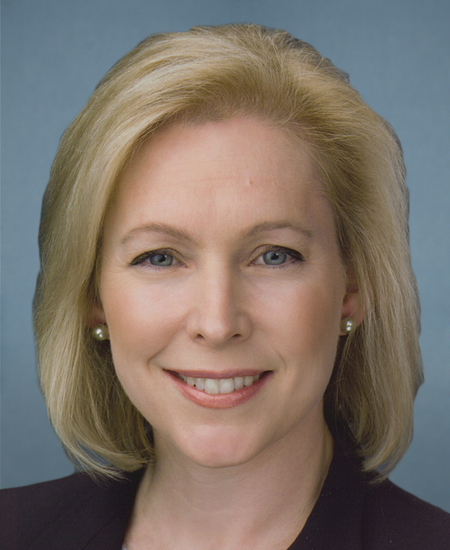
Sen. Kirsten E. Gillibrand
Sponsored bills
State Public Option Act This bill allows residents who are not already eligible for Medicaid and not concurrently enrolled in other health insurance coverage to buy into a state Medicaid plan beginning January 1, 2022, at the option of the state. State Medicaid programs may set premiums and cost-sharing requirements for such coverage in accordance with specified limitations. The bill also (1) provides the enhanced Federal Medical Assistance Percentage (i.e., federal matching rate) to every state that expands Medicaid coverage for individuals who are newly eligible under the Patient Protection and Affordable Care Act, regardless of when such expansion takes place; and (2) requires state Medicaid programs to cover comprehensive reproductive health care services, including abortion services.
This joint resolution repeals specified authorizations for the use of military force against Iraq.
This concurrent resolution recognizes the disparity in wages paid to Black women and its impact on women, families, and the nation, and reaffirms Congress' support for ensuring equal pay and closing the gender wage gap.
Directed Energy Threat Emergency Response Act This bill requires actions to address anomalous health incidents. The President must designate an appropriate senior official as the Anomalous Health Incidents Interagency Coordinator. The interagency coordinator must (1) coordinate the U.S. government's response to anomalous health incidents, (2) ensure that affected personnel and dependents get access to care, and (3) ensure adequate training and education for relevant U.S. government personnel. The bill also requires certain agencies, including the Department of Defense and the Office of the Director of National Intelligence, to designate an appropriate senior official to serve as the Anomalous Health Incident Agency Coordination Lead. These officials must (1) work with the interagency coordinator to achieve objectives related to anomalous health incidents, and (2) jointly provide quarterly briefings to Congress on its activities. Such agencies must also develop updated workplace guidance to address anomalous health incidents, including processes to self-report suspected exposure to a possible anomalous health incident.
This resolution expresses the condolences of the Senate regarding the death of the Honorable Carl Levin, former Senator for Michigan.
This bill extends through October 18, 2021, the order issued by the Centers for Disease Control and Prevention (CDC) titled Temporary Halt in Residential Evictions To Prevent the Further Spread of COVID-19 and published on September 4, 2020. The bill also permits the CDC to further extend the order as it determines necessary.
This resolution expresses the condolences of the Senate regarding the death of the Honorable Mike Enzi, former Senator for Wyoming.
Domestic Workers Bill of Rights Act This bill provides rights and protections for domestic workers (e.g., housekeepers, nannies, caretakers, personal assistants, and chauffeurs), including pay and leave rights, and health and safety protections. Specifically, the bill repeals the exemption of domestic live-in employees from certain minimum wage and maximum hour requirements. Employers must provide written notice of termination and provide at least 30 days of lodging and two weeks of severance pay to terminated live-in employees. Live-in employees also must be provided with reasonable access to telephone and internet service during their employment. The bill requires employers to provide domestic workers with a written agreement covering wages, sick leave, benefits, and other matters. Further, domestic workers may request and be granted changes to work schedules due to personal events. The bill also provides domestic workers with certain privacy rights, extends to domestic workers protections against discrimination in employment, and increases the federal medical assistance percentage (FMAP) for certain Medicaid-funded medical services provided by domestic workers. The Department of Labor must (1) award grants for a domestic worker national hotline for reporting emergencies, training on hazards facing domestic workers, and workforce investment activities for domestic workers; and (2) establish a Domestic Worker Wage and Standards Board to investigate standards in the domestic workers industry. Labor must publish online a document that describes the rights and protections for domestic workers under this bill.
Supreme Court Ethics Act This bill establishes a new statutory requirement for the Judicial Conference of the United States to issue a judicial code of conduct for judges and justices of U.S. courts, including Justices of the Supreme Court. Currently, the Judicial Conference issues a code of conduct for judges of U.S. courts (but not for Justices of the Supreme Court).